
- 1. SECTOR NAME
- 2. SECTOR VISION STATEMENT
- 3. CURRENT CHALLENGES AND NEEDS
- 4. PROPOSED FUNCTIONS OF THE GARDEN AND GREEN COMMUNITY PLAZA
- 5. KEY STAKEHOLDERS AND PARTNERSHIPS
- 6. EXPECTED IMPACT
- 7. MONITORING AND KEY PERFORMANCE INDICATORS (KPIs)
- 8. SUSTAINABILITY AND RESILIENCE
- 9. CONNECTION WITH OTHER HELICES
- 10. ONE KEY MESSAGE
- 11. VISUAL OR SYMBOLIC ELEMENT
 Doc Summary

Community Gardening Political Vision – Growing Together for a Sustainable Future
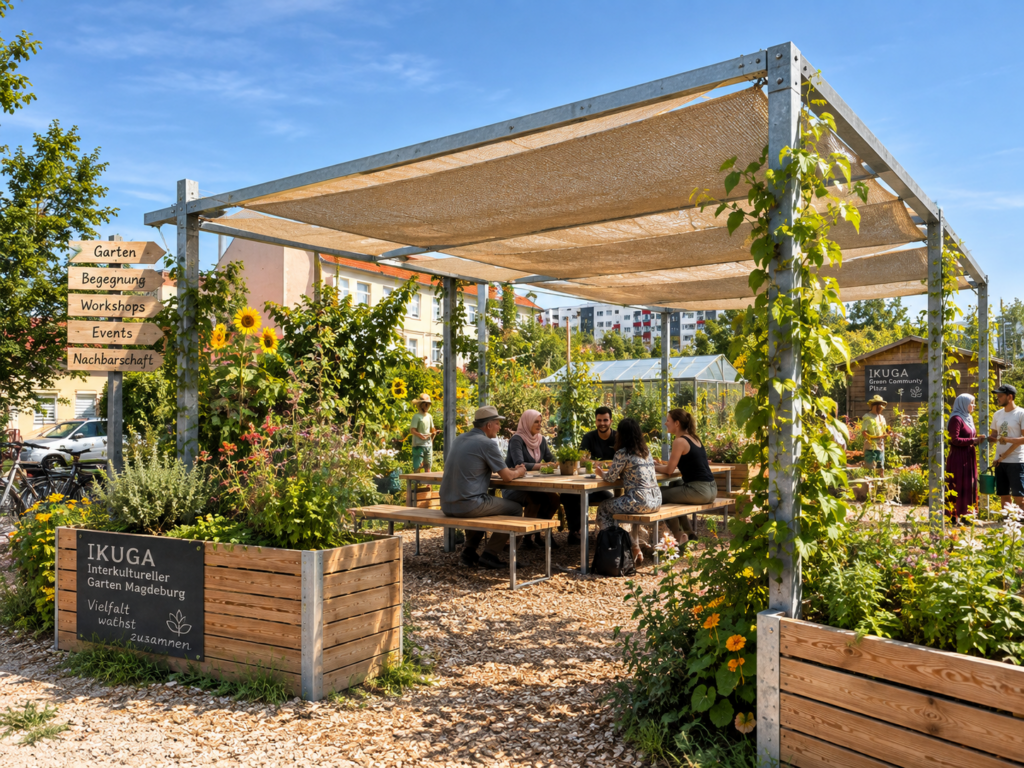
Vision for Participatory Neighbourhood Governance and Community Stewardship (created with support of ChatGPT)
IKUGA – Interkultureller Garten Magdeburg
1. SECTOR NAME #
Politics / Governance: civic participation, shared decision-making and multi-level public cooperation subsystem.
In the Quintuple Helix adaptation used in the BeCom learning material, the political sector is understood as the governance dimension of a community project: how people participate in decisions, how responsibilities are organised, how community initiatives interact with public institutions, and how local experience can inform wider urban policy. This interpretation connects closely with the New European Bauhaus approach, which emphasises participatory processes, multi-level engagement and transdisciplinary collaboration.
2. SECTOR VISION STATEMENT #
IKUGA: Growing Together for a Sustainable Future – A Neighbourhood Governance Hub Rooted in Participation
The political vision for IKUGA is to strengthen the intercultural garden as a trusted local interface between residents, gardeners, civil-society organisations and public institutions. The aim is not to turn the garden into a political organisation, but to make everyday participation visible, understandable and practicable: people can discuss local needs, jointly decide on garden matters, work with municipal actors on neighbourhood issues and contribute their experience to sustainable urban development.
The vision rests on three complementary governance streams: democratic self-management within the garden community; an open neighbourhood dialogue function using the garden and its Green Community Plaza as an accessible meeting place; and structured cooperation with municipal, regional and educational partners. Together, these streams create a low-threshold civic infrastructure in which responsibilities remain clear, participation remains open, and local knowledge can be translated into practical proposals for the neighbourhood.
The political dimension therefore links IKUGA’s everyday practice with the NEB principles of participation, multi-level engagement and co-creation. It also supports the broader NEB objective of enabling sustainable and inclusive places through cooperation between communities, institutions and other stakeholders.
3. CURRENT CHALLENGES AND NEEDS #
Context of IKUGA
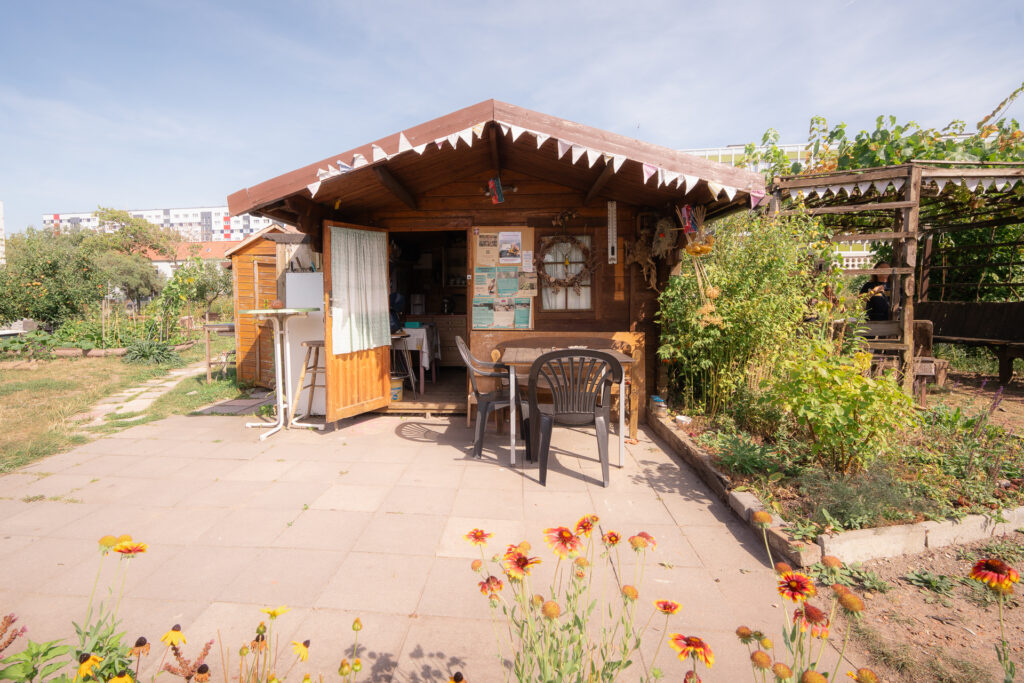
IKUGA is an intercultural community garden in Magdeburg’s Neue Neustadt. The official project website describes a 2,600 m² gardening oasis created on former fallow land, bringing together people from different countries and cultural backgrounds. The project developed from an idea in 2009, moved into practical gardening in 2012, built shared infrastructure such as a pergola, greenhouse and public benches from 2014, and has been administered by Interkultureller Garten Magdeburg e.V. since 2018. The association states that the garden has been in the gardeners’ self-management since then. The website also describes regular meetings in which decisions concerning the garden are made together.
Since May 2025, IKUGA has additionally expanded its education and neighbourhood work through a sustainability-education project supported by the State of Saxony-Anhalt and the City of Magdeburg. The current programme describes cooperation with local educational and cultural organisations and a goal of anchoring sustainability more strongly in the neighbourhood. These documented relationships provide an important starting point for the political/governance dimension.
Needs
- Need for stable participatory structures. Shared decision-making works best when meetings, responsibilities and ways of making decisions are understandable and predictable for both long-standing and new participants.
- Need for an accessible interface with public institutions. Community knowledge about the garden, public space, local environmental conditions and neighbourhood needs should have a clear channel into dialogue with municipal actors.
- Need for broad and inclusive participation. Different languages, ages, social backgrounds and levels of civic experience can make participation uneven; low-threshold formats can help widen access.
- Need for transparency and accountability. Decisions, responsibilities, funding relationships and agreed follow-up actions should be documented in a simple form that community members can understand.
- Need for continuity beyond individual volunteers. The governance system should retain knowledge and working routines when coordinators or active members change.
- Need for constructive conflict management. An open garden must be able to address practical problems such as vandalism, waste, competing uses or maintenance questions through dialogue and clearly defined responsibilities.
Challenges
- Volunteer capacity is limited. A self-managed association can create strong ownership, but administrative dialogue and participation processes also require time for preparation, documentation and follow-up.
- Participation can become uneven. People who are new to Germany, new to the neighbourhood or less confident in German may need additional communication support to participate on equal terms.
- Community and administration operate with different timelines and procedures. Public authorities may have formal responsibilities, legal requirements and funding cycles that do not match the pace of volunteer-led initiatives.
- The open character of the garden must coexist with safety, maintenance, environmental and legal requirements. Governance therefore needs both flexibility and clear rules.
- There is a risk of participation fatigue. Too many formal meetings can reduce engagement; the challenge is to create a small number of meaningful formats linked to real decisions and visible outcomes.
- Long-term cooperation can be fragile when it depends on individual contacts. Institutional memory and documented agreements are therefore important for resilience.
4. PROPOSED FUNCTIONS OF THE GARDEN AND GREEN COMMUNITY PLAZA #
From the political perspective, IKUGA can operate as a small-scale civic interface: a self-managed community space that connects everyday gardening with neighbourhood dialogue, collaborative problem-solving and structured cooperation with public institutions. The planned Green Community Plaza, with seating, shade and information elements, can provide a visible and accessible setting for these activities.
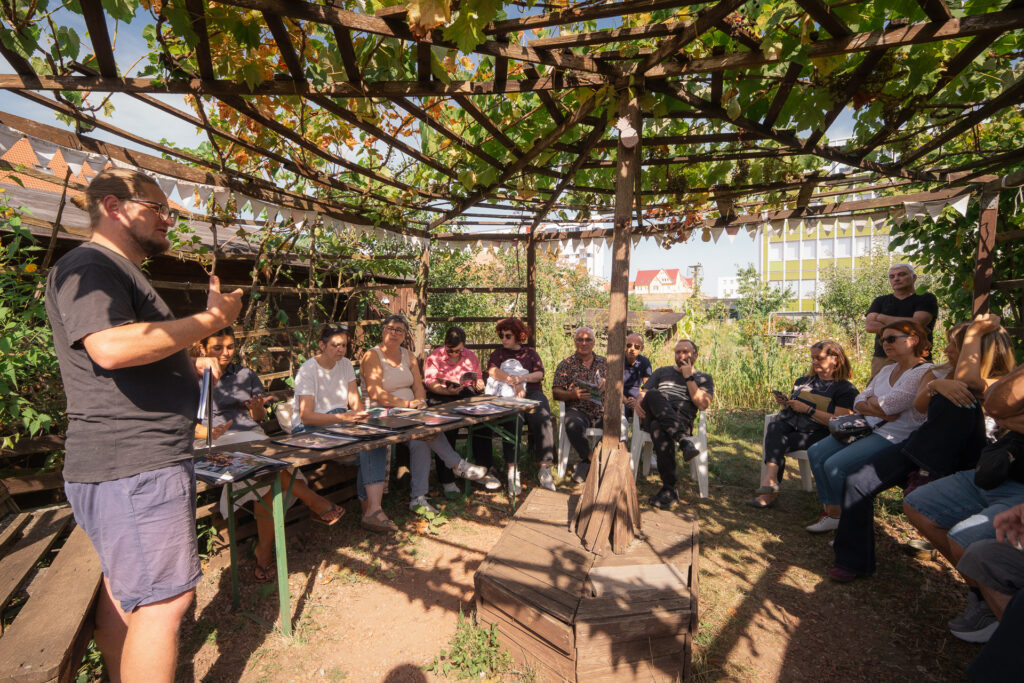
A. Shared Decision-Making and Garden Self-Management
Main activities and services
- Regular garden assemblies in which matters affecting the shared space are discussed and decided collectively.
- A simple annual governance calendar identifying key decisions, maintenance periods, funding tasks, public events and partnership meetings.
- Clear division of roles for facilitation, minutes, communication, finances and liaison with external partners, with responsibilities that can rotate over time.
- Short decision records so that absent members and new participants can understand what was agreed and what remains open.
Good-practice principle
Keep participation close to real decisions. The aim is not more bureaucracy, but a visible link between discussion, decision, responsibility and action.
Target groups: Garden members, new participants, neighbourhood residents and volunteers who wish to take part in organising the shared space.
Frequency of use: Regular monthly or seasonal meetings, supplemented by short ad-hoc meetings when a concrete decision is needed.
B. Neighbourhood Civic Dialogue and Issue Forum
Main activities and services
- An open “Garden & Neighbourhood Forum” using the garden or Green Community Plaza for low-threshold discussion of local issues such as public-space use, waste, biodiversity, maintenance and neighbourhood activities.
- Problem-solving sessions that bring residents and relevant public or civil-society actors together around a clearly defined issue rather than around abstract debate.
- Short multilingual summaries, visible noticeboard information and clear follow-up actions so that participation is understandable beyond those who attend a meeting.
- A mechanism for collecting questions, suggestions and concerns from residents and routing them to the appropriate community or institutional contact.
Expected civic value
The forum makes the garden a practical place for neighbour-to-neighbour exchange and for contact between community actors and institutions, while keeping the focus on concrete local matters.
Target groups: Residents, migrant and intercultural organisations, families, youth, local initiatives, nearby institutions and interested public-service representatives.
Frequency of use: Monthly or quarterly, with additional issue-focused sessions when required.
C. Institutional Cooperation and Local Policy Learning
Main activities and services
- Regular site visits and working meetings with the City of Magdeburg and other relevant public actors to discuss practical questions arising from the garden and neighbourhood.
- Jointly developed small pilot proposals related to community gardening, neighbourhood participation, sustainability education, climate-conscious open spaces or intercultural engagement.
- Simple documentation of what worked, what did not, and what could be adapted elsewhere, creating an evidence base for future cooperation or funding applications.
- Use the garden as a learning environment for professionals and decision-makers who want to understand community-led practice at neighbourhood scale.
Governance principle
Treat public institutions as cooperation partners with their own responsibilities, not as remote funders only. The goal is clearer communication, realistic expectations and practical co-creation.
Target groups: City of Magdeburg departments, relevant local and regional authorities, educational institutions, civil-society organisations and other partners working on neighbourhood development.
Frequency of use: At least two structured institutional dialogues per year, plus project-based meetings as needed.
D. Participation, Transparency and Communication Infrastructure
Across the three main governance functions, IKUGA can also establish a light participation infrastructure: a public information board at the garden, a simple online page for decisions and upcoming meetings, multilingual invitations where useful, and a clearly identified contact route for cooperation with the association. These tools should remain proportionate to the capacity of a volunteer-led organisation and should support, not replace, face-to-face participation.
Core functions
- Make current decision topics, meeting dates and agreed actions visible.
- Maintain a small archive of key decisions, contacts and cooperation agreements.
- Provide accessible entry points for people who are not yet active members of the garden.
- Support continuity when coordinators or volunteers change.
5. KEY STAKEHOLDERS AND PARTNERSHIPS #
The governance model depends on a small but coordinated ecosystem of community, institutional and educational actors rather than a single decision-maker. The stakeholder roles below distinguish between relationships documented on the IKUGA website and proposed governance functions for the future vision.
Target Group | Type | Needs & Interests | Project Focus |
|---|---|---|---|
Gardeners & IKUGA members | Local | Clear rules, fair participation, manageable responsibilities | Shared decisions, rotating roles, transparent follow-up |
Neighbourhood residents | Local | Accessible information, voice in local issues, reliable contacts | Neighbourhood forum, feedback channels, public information |
Intercultural & migrant organisations | Local/Regional | Inclusive access, representation, opportunities for cooperation | Outreach, co-hosted events, multilingual participation |
City of Magdeburg | Local | Constructive cooperation, clear responsibilities, neighbourhood-level knowledge | Institutional dialogue, permits and coordination, urban-policy learning |
State of Saxony-Anhalt | Regional | Sustainable development, education and civic engagement outcomes | Programme support, funding dialogue, transferability |
KanTe e.V. / founding network | Local | Continuity of the original cultural and community mission | Institutional memory and network support |
Schools, youth and cultural partners | Local | Practical learning, participation and neighbourhood connection | Projects, workshops, youth participation, joint activities |
Moritzhof and other local institutions | Local/Regional | Accessible cultural and sustainability cooperation | Joint formats, communication and neighbourhood networking |
Local initiatives and civil society | Local/Regional | Shared solutions for public space and sustainability | Issue-based collaboration and civic action |
Universities / research partners | Regional | Applied learning and community-based research | Documentation, evaluation, pilot studies |
Media and local communication channels | Regional | Relevant local stories and transparent information | Public communication about participation and project results |
Documented institutional and civil-society links
The current IKUGA website documents support from the State of Saxony-Anhalt and the City of Magdeburg for sustainability education and describes cooperation with the Hort Abenteuerwelt, Gemeinschaftsschule Thomas Müntzer, Kinder- und Jugendhaus “Knast” and Moritzhof. The project history also records the earlier support of KanTe e.V. and the establishment of the self-administering Interkultureller Garten Magdeburg e.V. in 2018. These relationships can form the practical basis for a stronger governance network, but any new formal roles or agreements would need to be agreed with the respective partners.
6. EXPECTED IMPACT #
Short-term impact (1–2 years)
The first phase should make existing self-management more visible and easier to understand. IKUGA establishes a simple governance calendar, documents key decisions, holds regular neighbourhood dialogue sessions and creates a clear contact route for cooperation with public institutions. At least a small number of structured exchanges with municipal actors are held around concrete local issues. The intention is to improve coordination without creating a heavy administrative burden.
Medium-term impact (3–5 years)
The garden develops a stable rhythm of community assemblies, neighbourhood forums and institutional working meetings. Cooperation with local education, culture and sustainability actors becomes more systematic. Issues that affect the shared space can be routed to the responsible actor more clearly, and small joint pilot actions can be tested and documented. The governance model becomes less dependent on individual contacts and more resilient through shared knowledge and repeatable routines.
Long-term impact (5–10 years)
Over a longer horizon, IKUGA can function as an established neighbourhood civic interface where community members, local initiatives and public institutions meet around practical questions of sustainable and inclusive urban development. The garden can provide a documented example of how self-managed community spaces contribute to participatory governance, place-based learning and stronger local networks. Elements of the model could be shared with other community gardens and neighbourhood initiatives through the BeCom network.

7. MONITORING AND KEY PERFORMANCE INDICATORS (KPIs) #
The political dimension should be monitored with a small number of practical indicators that can be collected without turning participation into administrative work. The targets below are proposed planning targets for the vision, not reported current performance figures.
Governance Dimension | KPI | Short-term Target (1–2 yrs) | Long-term Target (5–10 yrs) | Measurement Method |
|---|---|---|---|---|
Participation | Open garden assemblies held | At least 6 per year | Stable annual cycle with 8–12 meetings | Meeting calendar / minutes |
Participation | Unique participants involved in governance | Baseline established; 25+ participants reached | Growing and recurring participation across seasons | Attendance lists / simple sign-in |
Inclusion | Accessible participation formats | Multilingual invitation/support used where needed | Routine accessibility practice embedded in governance | Event records / participant feedback |
Decision-making | Key decisions documented with follow-up | At least 80% of major decisions recorded | Consistent decision log with responsibilities and status | Decision log / annual review |
Neighbourhood dialogue | Garden & Neighbourhood Forums held | At least 4 forums per year | Regular forum recognised as a local dialogue format | Event calendar / minutes |
Institutional cooperation | Structured meetings with municipal or public actors | At least 2 per year | Regular multi-level dialogue with agreed annual topics | Meeting records / partner confirmation |
Problem solving | Local issues with documented next steps | 10 issues tracked from discussion to follow-up | Increasing share resolved or formally handed to responsible actors | Issue register |
Shared responsibility | Volunteers taking governance roles | At least 4 people able to facilitate or document meetings | Distributed role pool maintained across seasons | Role rota / coordinator records |
Transparency | Public information on decisions and upcoming meetings | Simple noticeboard/online update maintained | Regular public information cycle linked to annual governance calendar | Website/noticeboard check |
Partnerships | Active cooperation relationships | 3–5 partners engaged in governance or civic activities | 10+ recurring cooperation relationships | Partner registry / agreements |
Policy learning | Joint proposals or pilot actions prepared | At least 1 documented pilot or proposal | Several documented examples transferable to other neighbourhoods | Project documentation |
Transferability | Other organisations adopting governance elements | Model documented as case study | At least 1–2 external adaptations | Feedback / project reports |
Reporting rhythm
- Quarterly or seasonal check-ins: review participation, upcoming decisions and open issues with minimal paperwork.
- Annual governance review: coordinators, members and key partners reflect on participation, cooperation and unresolved issues and agree priorities for the next year.
- Shared learning: selected results and case examples are documented for BeCom and partner networks without publishing personal data.
8. SUSTAINABILITY AND RESILIENCE #
IKUGA’s governance resilience depends on keeping participation simple, distributed and connected to real decisions. A small number of repeatable meeting formats is more sustainable for a volunteer-led organisation than a large committee structure. Clear roles for facilitation, documentation and external liaison can reduce the risk that the governance system depends on one person.
Resilience also comes from institutional memory. A short decision log, partner list, annual calendar and archive of key agreements can preserve knowledge when volunteers change. This creates continuity without turning the garden into a heavily managed organisation.
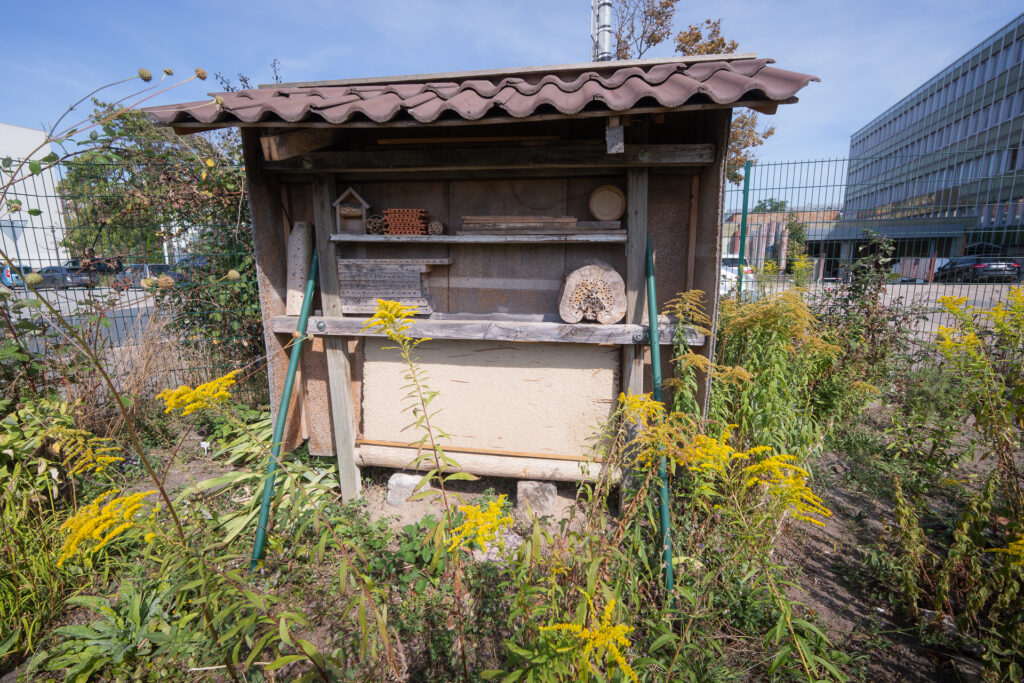
A second resilience factor is diversity of relationships. Cooperation with neighbourhood residents, educational and cultural partners, the City of Magdeburg, the State of Saxony-Anhalt and wider civil-society networks can provide different forms of support and expertise. The current sustainability-education funding relationship with the State and City demonstrates that public support can be connected with practical community activity; future arrangements should continue to be based on clear roles and agreed expectations.
Finally, resilience requires trust. Transparent communication, accessible participation and respectful conflict management can help ensure that public cooperation strengthens the self-organised character of IKUGA rather than replacing it.
9. CONNECTION WITH OTHER HELICES #
The political / governance vision is not a separate layer. It creates the conditions in which the other Quintuple Helix dimensions can work together and remain connected to the NEB working principles.
Politics / Governance ⇄ Society
Shared decision-making gives social inclusion a practical form. Participation becomes more than attending events: residents can help define priorities, take responsibility and see how their input affects the shared space.
Politics / Governance ⇄ Environment
Environmental measures often require coordination over land use, maintenance, water, waste, biodiversity and shared public space. Governance creates channels through which local ecological knowledge can inform practical cooperation with responsible institutions.
Politics / Governance ⇄ Education
Educational activities can build civic as well as environmental knowledge: participants learn how local decisions are made, who is responsible for what, how proposals can be developed, and how community evidence can contribute to neighbourhood learning.
Politics / Governance ⇄ Economy
A transparent governance structure can support sustainable partnerships with local businesses, funders and service providers by clarifying expectations, responsibilities and public-interest outcomes. Economic support can in turn strengthen the capacity needed for coordination and participation.
Politics / Governance ⇄ NEB Working Principles
The strongest connection is with the NEB way of working itself: participatory processes, multi-level engagement and a transdisciplinary approach. IKUGA can provide a neighbourhood-scale setting in which these principles become practical through shared decisions, cooperation with institutions and joint learning across community, education, culture and environmental practice.
10. ONE KEY MESSAGE #
“IKUGA turns everyday gardening into participatory neighbourhood governance – where residents, community organisations and public institutions can learn, decide and act together for an inclusive and sustainable urban environment.”
11. VISUAL OR SYMBOLIC ELEMENT #
Symbol
As a symbolic sketch, the garden can be shown at the centre of a simple governance wheel. Four elements surround the garden bed: a group of people (shared decision-making), a speech bubble (neighbourhood dialogue), a city or public-building icon (institutional cooperation), and a checklist or open notebook (transparency and continuity). Arrows connect these elements back to the garden, illustrating a continuous cycle of participation, decision, action, reflection and learning.
“Growing together for a sustainable future – deciding, caring and acting together.”
Source Basis
Project information was based primarily on the official IKUGA website and project pages, including the English project overview, the IkuGa project history, the sustainability-education programme and the current events information. The governance interpretation is aligned with the New European Bauhaus Compass, especially its working principles of participatory processes, multi-level engagement and transdisciplinary collaboration. The proposed targets and future functions in this document are planning elements developed for the BeCom political-sector vision and should not be read as current IKUGA performance data.
Key sources: https://ikuga.de/en | https://ikuga.de/de/projekt | https://ikuga.de/en/nachhaltigkeitsbildung | https://ikuga.de/de/events | https://new-european-bauhaus.europa.eu/system/files/2023-01/NEB_Compass_V_4.pdf
Disclaimer / Copyright Notice
Parts of this material were created and structured with the support of AI research tools. The content was created to support analysis, training and project reporting and was adapted and reviewed for the BeCom project purpose. Research was conducted using publicly available materials from the project website and European institutional sources.
All trademarks, organisation names and product names mentioned are acknowledged and remain the property of their respective owners. The linked learning materials remain subject to the terms and copyright notices of their respective publishers.
SBH Magdeburg, Germany | BeCom Project Team, September 2026