
- Vision for Băiuț Building Restoration and Community Use
- 2. SECTOR VISION STATEMENT
- 3. CURRENT CHALLENGES AND NEEDS
- 4. PROPOSED FUNCTIONS OF THE RESTORED BUILDING
- 5. KEY STAKEHOLDERS AND PARTNERSHIPS
- 6. EXPECTED IMPACT
- 7. SUSTAINABILITY AND RESILIENCE
- 8. CONNECTION WITH OTHER HELICES
- 9. ONE KEY MESSAGE
- 10. VISUAL OR SYMBOLIC ELEMENT
 Doc Summary

Vision for Băiuț Building Restoration and Community Use #
2. SECTOR VISION STATEMENT #
ANIMa–Building: Where Story, Identity and Imagination Shape a Regenerative Future
The media- and culture-based vision for ANIMa–Building is to transform a restored heritage building into a visible cultural lighthouse and narrative engine that shapes how Băiuț sees itself — and how it is seen by others.
ANIMa–Building becomes a space where cultural expression, public dialogue, and media storytelling converge to create shared meaning around heritage, ecology, and rural regeneration.
By integrating social capital (trust, participation, networks) and human capital (creativity, artistic skill, communication competence), ANIMA strengthens local identity while positioning Băiuț within regional, national, and European cultural conversations — including initiatives such as the New European Bauhaus.
Rather than being only an economic or educational hub, ANIMa–Building becomes a platform of imagination and public visibility, turning rural transformation into a cultural movement.
3. CURRENT CHALLENGES AND NEEDS #
Social and medial challenges in Băiuț: #
Needs
Need for a positive narrative.
- Post-mining rural areas often carry external labels of decline. Băiuț needs a new story — one that highlights creativity, ecological intelligence, craftsmanship, and innovation.
Need for cultural activation.
- Heritage buildings risk becoming static monuments unless activated by exhibitions, performances, storytelling, and artistic production.
Need for public visibility.
- Without strong media presence — digital platforms, documentation, storytelling — local transformation remains invisible beyond the village.
Need for intergenerational dialogue.
- Local memory, traditions, and identity must be translated into formats accessible to younger generations and international audiences.
Challenges
Low media capacity.
- Limited local expertise in communication, digital storytelling, branding, and cultural programming.
Fragmented public discourse.
- Declining trust in institutions and limited spaces for structured civic dialogue.
Outmigration of creatives.
- Young artists, designers, and communicators often leave rural areas due to lack of opportunities.
Cultural marginalization.
Rural culture is often perceived as peripheral rather than innovative or forward-looking.
How the building’s current state reflects these challenges: #
In its current underused and partially deteriorated state, ANIMa–Building reflects the broader challenges of limited cultural activation, weak media visibility, fragmented public dialogue, and the absence of a strong, forward-looking narrative for Băiuț — symbolising not only physical neglect but also the unrealised social and creative capital of the community.
Restored and reactivated, however, the building has the potential to become a vibrant cultural and media beacon that amplifies local voices, rebuilds shared identity, and positions Băiuț as an inspiring example of rural regeneration aligned with the values of the New European Bauhaus.
4. PROPOSED FUNCTIONS OF THE RESTORED BUILDING #
From the media and cultural perspective, ANIMA Building operates as a Cultural-Narrative Hub with three interconnected dimensions: #
Cultural Production and Artistic Programming #
Main activities and services
- Exhibitions on mining heritage, forest ecology, wooden architecture, and rural futures
- Artist residencies focused on landscape, memory, sustainability, and bioconstruction
- Community theatre, storytelling evenings, music performances
- Film screenings and documentary festivals related to environment and regeneration
- Craft demonstrations and contemporary reinterpretations of traditional skills
- ANIMa–Building acts as a stage and laboratory, where culture is not preserved passively but continuously reinterpreted.
Target groups
- Local residents (youth, elders, families)
- Regional artists and cultural practitioners
- Visiting creatives connected to educational and economic stream
- National and international cultural networks
- Frequency of use
- Monthly exhibitions or events
- Seasonal festivals
- Ongoing residency cycles
- Please ADD MORE!
Media, Communication and Public Storytelling #
Main activities and services
Digital storytelling lab documenting local regeneration processes
Podcast or video series on “Life After Mining”
Social media campaigns linking Băiuț to wider European conversations
Documentation of field schools, retreats, and eco-tours
Public communication training for local youth
- ANIMa–Building becomes a content generator, ensuring that transformation is visible and replicable.
Target groups
Diaspora networks
European partners
Journalists and researchers
Rural youth interested in digital media
Frequency of use
Continuous online presence
Quarterly thematic campaigns
Annual impact storytelling reports
C. Public Dialogue and Civic Culture #
Main activities and services
Town-hall discussions on forest management, heritage protection, rural futures
Intergenerational dialogue events (“memory meets future”)
Participatory design workshops aligned with sustainability principles
Public debates connected to regional and European initiatives
- ANIMa–Building functions as a safe civic space where different perspectives meet constructively.
- Please ADD MORE
Target Groups:
- Primary: School-age children, youth ages 16-30. Adults and seniors of Băiuț and nearby communities. (vocational training, digital skills), adults (exchange of experiences and skills, lifelong learning)
- Secondary: Municipalities, NGOs, ….
Frequency of Use:
- Daily: After-school / evening programs, co-working/study spaces, discussion events, ……
- Weekly: Evening workshops, weekend training sessions, topic based communities, …..
- Seasonal: Summer camps, Annual festivals, ……
5. KEY STAKEHOLDERS AND PARTNERSHIPS #
Cultural and Artistic Actors: #
Regional artists, musicians, writers
Cultural NGOs and arts councils
Romanian and European creative networks
- Please add which specific schools can help disseminate the vision
Media Partners:
Regional press and online platforms
Documentary filmmakers
Communication departments of universities
Educational Institutions
Schools contributing to youth storytelling projects
Universities integrating cultural documentation into curricula
Civil Society
e.g., Rogepa as regional NGO anchor
Local associations and informal cultural groups
Diaspora ambassadors promoting ANIMA abroad
- Please add more information
6. EXPECTED IMPACT #
Short-Term Impact (1-2 years): #
Immediate benefits after restoration:
Establishment of a visible cultural calendar
Launch of a digital storytelling platform
3–4 public debates annually
Youth involvement in media production
Improved perception of ANIMa–Building as a shared civic space
Local pride increases as residents see their stories professionally documented and publicly valued.
Long-Term Impact (5-10 years): #
Changes for the community:
Băiuț becomes known as a cultural regeneration village within Maramureș
Stable artist residency programme
Recognised contribution to European rural innovation debates
Strong digital archive documenting ecological and social transition
Emergence of local creative professionals (guides, designers, media creators)
- ANIMa–Building evolves into a regional narrative lighthouse.
- Please add more information
7. SUSTAINABILITY AND RESILIENCE #
Cultural sustainability at ANIMa Building rests on:
Continuous integration with economic and educational streams
Hybrid funding (ticketed events, cultural grants, partnerships)
Youth capacity building in communication and event management
Annual public evaluation of cultural relevance and inclusivity
By constantly producing and sharing stories of ecological protection, heritage restoration, and learning, ANIMa–Building reinforces the long-term legitimacy of its entire regeneration model.
- Please add other funding opportunities?
8. CONNECTION WITH OTHER HELICES #
Society → Environment #
Environmental stewardship becomes culturally meaningful through exhibitions, storytelling, and artistic interpretation of forests, mineral springs, and wooden architecture. Nature is not only protected — it is narrated and emotionally valued.
Society → Education #
Educational programs generate content, research, and creative output. Students document their fieldwork, exhibitions interpret research findings, and artistic practice becomes a learning method.
Society → Economy #
Cultural visibility strengthens tourism, retreat attractiveness, and brand identity. High-quality storytelling increases perceived value and international reach.
Society → Politics/Governance #
Transparent communication, public debates, and documented decision-making strengthen democratic trust. ANIMa–Building becomes a mediator between institutions and citizens.
Please add other connections.
9. ONE KEY MESSAGE #
ANIMa–Building transforms a restored heritage building into a cultural and narrative engine where creativity, dialogue, and media visibility turn rural regeneration into a shared public story — locally rooted and European in resonance. Let’s build together.
10. VISUAL OR SYMBOLIC ELEMENT #
Symbol: #
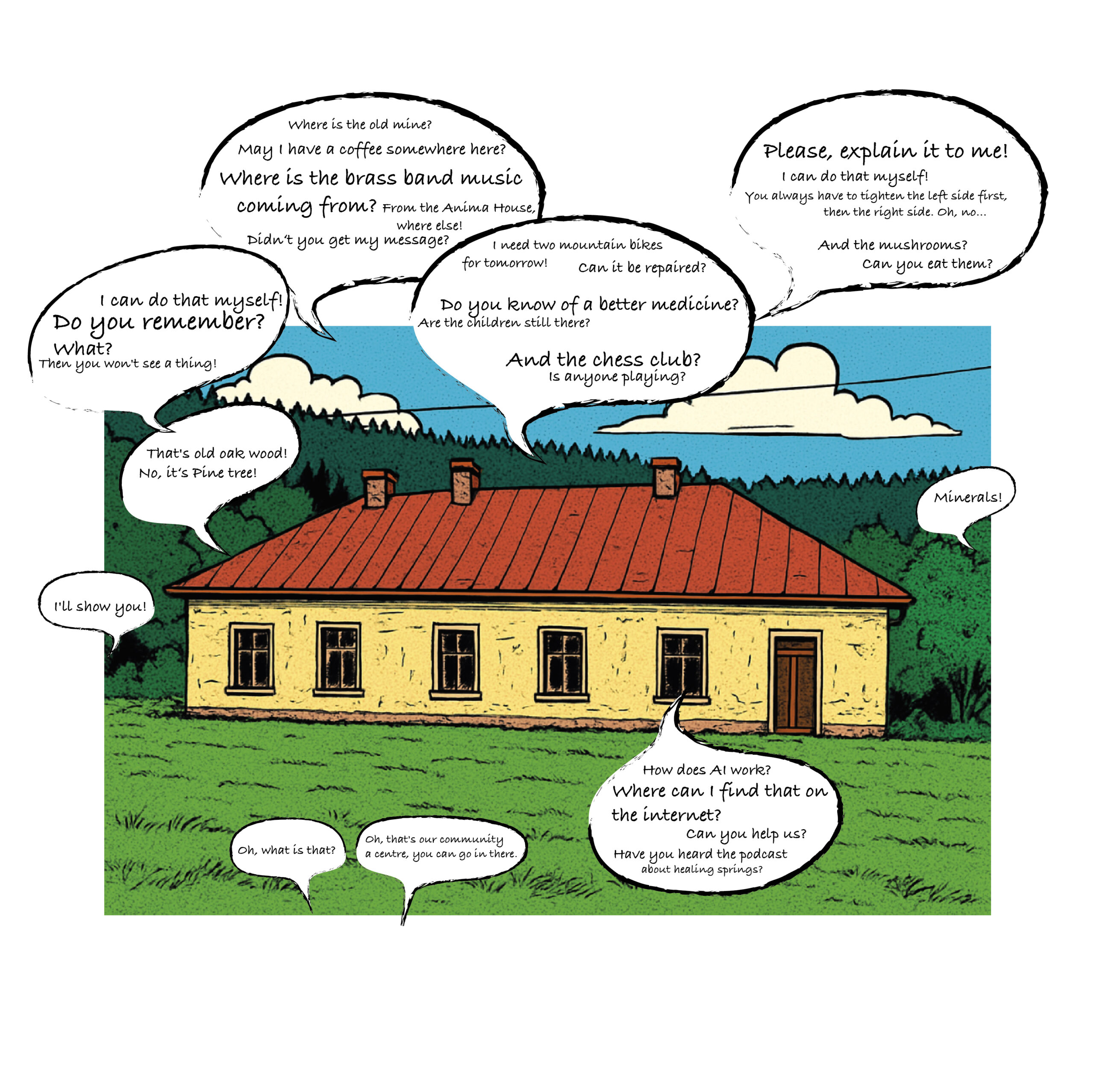
Generated with ChatGPT and Offline Tools