- Vision for Băiuț Building Restoration and Community Use
- 2. SECTOR VISION STATEMENT
- 3. CURRENT CHALLENGES AND NEEDS
- 4. PROPOSED FUNCTIONS OF THE RESTORED BUILDING
- 5. KEY STAKEHOLDERS AND PARTNERSHIPS
- 6. EXPECTED IMPACT
- 7. SUSTAINABILITY AND RESILIENCE
- 8. CONNECTION WITH OTHER HELICES
- 9. ONE KEY MESSAGE
- 10. VISUAL OR SYMBOLIC ELEMENT
 Doc Summary

Vision for Băiuț Building Restoration and Community Use #
2. SECTOR VISION STATEMENT #
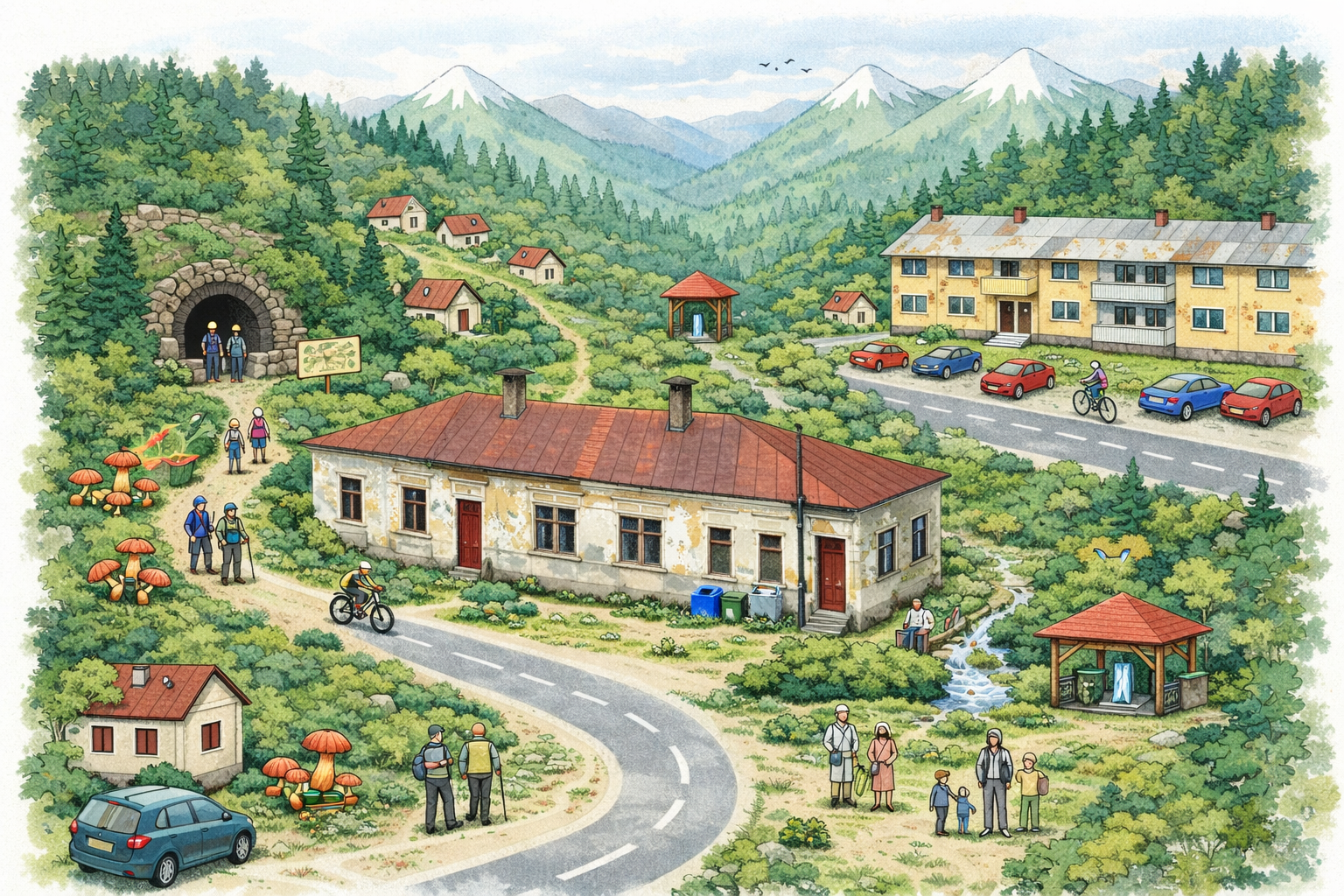
Our vision for the ANIMa building is that it becomes a reference point for reconnecting the community of Băiuț with its surrounding natural environment, positioning the restored building as a gateway to local landscapes, ecological knowledge, and sustainable resource management. Rooted in bioconstruction principles, the rehabilitation of the building itself will act as a tangible demonstration of how traditional materials and contemporary environmental practices can coexist.
ANIMa is imagined as a place where the natural elements of the territory are made visible, understood, and valued. Through interpretive resources, territorial mapping, and shared knowledge, the building will help residents and visitors discover local forests, landscapes, mushrooms, and other natural assets, strengthening collective awareness of the ecological richness of the area. This knowledge will be activated through seasonal activities and community-led initiatives, such as mushroom walks, forest interpretation days, and nature observation workshops, allowing environmental learning to be closely linked to lived experience.
The restored building will also function as a starting point for healthy and nature-based routes, encouraging outdoor activities and everyday contact with the landscape. These routes will be designed as inclusive and accessible experiences that connect ANIMa with key natural sites, reinforcing the role of the building as a connector between the built environment and the surrounding ecosystems while promoting well-being, slow mobility, and care for the territory.
Special emphasis will be placed on wood as a central material and cultural resource. By fostering collaboration with local craftsmen and traditional artisans, ANIMa will highlight the links between sustainable forest management, traditional woodworking practices, and contemporary uses of timber. Hands-on activities and demonstrations will explore the full cycle of wood, from responsible forest stewardship to construction and craft, reinforcing the value of local resources and skills.
Beyond the building itself, the vision includes the recovery and ecological enhancement of its immediate surroundings. Outdoor spaces will be restored as learning and gathering areas, supporting biodiversity and offering opportunities for environmental education, informal encounters, and community-led stewardship. Through partnerships with local schools, environmental organizations, and civic groups, ANIMa will promote long-term territorial care initiatives, positioning the building as a catalyst for collective responsibility towards the natural environment.
Ultimately, this vision benefits the entire community by transforming ANIMa into a shared space where nature, culture, and sustainability intersect. By restoring both the building and its landscape context, the project contributes to environmental regeneration, strengthens local identity, and reinforces residents’ sense of attachment, affection, and active engagement with their territory.
3. CURRENT CHALLENGES AND NEEDS #
- Băiuț is facing important environmental challenges linked to its mining past and to a gradual loss of connection between the community and the natural environment. Contaminated soils and degraded areas are still present in the region, affecting ecosystems and limiting the potential of the landscape. At the same time, many of the area’s natural values remain under-recognized and underused.
- The region has significant environmental assets, such as mature forests, diverse landscapes, medicinal waters, clean air, and rich biodiversity. However, these resources are not sufficiently valued or communicated, and there are few spaces where people can learn about them or engage with nature in an active way. This lack of awareness reduces opportunities for environmental education, local pride, and sustainable development.
- Another key challenge is the strong historical dependence on mining. As mining activity declines, there is a need to develop new economic models that are not extractive and that can create local opportunities. Responsible tourism and nature-based activities could play an important role, but they require shared spaces for coordination, learning, and experimentation.
- There is also a growing need to reconnect people with nature, especially younger generations. Without accessible places for environmental learning, outdoor activities, and intergenerational exchange, nature risks being perceived as distant or irrelevant to everyday life.
How the building’s current state reflects these challenges: #
The rehabilitation of the ANIMa building offers an opportunity to respond directly to these environmental needs. Through bioconstruction and energy-efficient renovation, the building can become a practical example of sustainable building practices in a post-mining context. As a community space, it can support environmental education, promote knowledge about local natural assets, and serve as a starting point for nature-based activities and responsible tourism initiatives. By reconnecting people with the landscape and offering a shared place for learning and collaboration, the restored building can help shift Băiuț towards a more regenerative relationship with its environment and a more resilient local future.
4. PROPOSED FUNCTIONS OF THE RESTORED BUILDING #
From the perspective of the natural environment sector, the restored ANIMa building is conceived as a multifunctional hub that connects people, nature, and sustainable local development. Its uses combine environmental education, nature-based activities, research, and innovation, responding to the needs of both the local community and visitors throughout the year.
Nature Routes and Outdoor Activities Hub #
One of the core functions of the building will be to act as a starting point for nature routes and outdoor activities. ANIMa will host services linked to the discovery of the surrounding landscapes, including bike, snowshoe, and walking pole rental, as well as information and coordination with local nature guides. These activities will encourage healthy lifestyles and regular contact with nature, while supporting local employment linked to responsible tourism. This function will mainly serve the local population, second-home residents, and nature tourists, with seasonal intensity during winter and summer, and increased activity in spring and autumn.
#
Actions: #
• Starting point for hiking, cycling, and snowshoe routes
• Bike, snowshoe, and walking pole rental
• Information point on local landscapes and natural routes
• Coordination with local nature guides
• Seasonal outdoor programs (winter and summer focus)
• Activities for local residents, second-home users, and nature tourists
Natural and Cultural Heritage Discovery #
Another key function of the building will be the discovery and interpretation of natural and cultural heritage. ANIMa will offer permanent and temporary exhibitions presenting local landscapes, species, forests, and traditional knowledge through maps, panels, stories, and interactive tools. Rotating exhibitions and thematic displays will allow the content to evolve over time and respond to seasonal and community interests. This space will be used daily by residents and visitors, while also hosting punctual and programmed activities such as talks, presentations, and academic encounters.
#
Actions: #
• Permanent exhibitions on landscapes, forests, and species
• Temporary and rotating thematic exhibitions
• Maps, panels, stories, and interactive interpretation tools
• Programs on traditional ecological knowledge
• Talks, presentations, and academic encounters
• Daily use with seasonal and programmed activities
Environmental Innovation and Traditional Knowledge #
The building will also function as a space for study, innovation, and knowledge exchange focused on the relationship between local crafts, traditional practices, and nature conservation. Special attention will be given to how local craftsmanship and forest-related traditions contribute to sustainable forest management and environmental care. Topics such as the use of wood, pellet-based heating systems as alternatives to coal, and new ecological energy solutions will be explored through workshops, demonstrations, and applied research.
Actions: #
• Workshops on local crafts and nature conservation
• Sustainable forest management practices
• Wood use and traditional craftsmanship demonstrations
• Training on pellet heating and alternative energy solutions
• Applied research and pilot environmental projects
Coworking, Research, and Collaboration Spaces #
To support these activities, ANIMa will include flexible multipurpose spaces and shared working areas. These will function as coworking and collaboration spaces for local businesses, new entrepreneurs, researchers, and students. Partnerships with universities in Cluj and Baia Mare will allow the building to host research projects, study visits, and innovation initiatives linked to environmental regeneration, post-mining landscapes, and rural sustainability.
Actions: #
• Shared workspaces for local businesses and entrepreneurs
• Coworking spaces for students and researchers
• Meetings and study spaces for environmental projects
• University partnerships (Cluj and Baia Mare)
• Research projects on post-mining landscapes and rural sustainability
Target Groups: #
- Primary: Local population of Băiuț (children, youth 16–30, adults, seniors), second-home residents, local craftsmen, forest workers, and nature guides.
- Secondary: Nature tourists, researchers and academics, local entrepreneurs, municipalities, NGOs, and universities.
Frequency of Use: #
- Daily: Information point for nature routes, exhibitions, citizen nature lab activities, coworking and study spaces, and informal community use.
- Weekly: Guided routes, workshops, citizen science sessions, training programs, academic talks, and community meetings.
- Seasonal: Summer and winter nature activities, camps, tourism programs, festivals, and research stays, with higher intensity during peak seasons.
5. KEY STAKEHOLDERS AND PARTNERSHIPS #
Local Residents and Community Members
• Residents of Băiuț as key knowledge holders of the territory, forests, landscapes, and traditions
• Elders and local practitioners contributing traditional ecological knowledge
• Families and youth participating in environmental education and nature-based activities
• Second-home residents supporting seasonal activities and local initiatives
Local Businesses, Craftsmen, and Artisans
• Local craftsmen working with wood and traditional materials
• Forest-related businesses promoting sustainable forest management
• Small enterprises linked to nature-based tourism and outdoor services
• Cooperatives and emerging green businesses using ANIMa as a workspace and meeting point
Nature Guides and Territorial Knowledge Holders
• Local guides specialized in hiking, cycling, and seasonal activities
• Mushroom experts and nature interpreters
• Local experts on medicinal waters, forests, and landscapes
• Contributors to guided routes, interpretation programs, and citizen science initiatives
Vocational Training Providers
• Construction and trades schools offering Green building and bioconstruction certifications
• Traditional crafts training programs linked to woodworking, carpentry, and forest-based skills
• Environmental training providers focused on ecological restoration and sustainable land management
Schools (Primary and Secondary)
• Local primary and secondary schools in Băiuț and nearby communities
• Schools using ANIMa for field trips, outdoor learning, and environmental workshops
• Educational partners helping disseminate environmental awareness and nature-based values
Universities and Research Institutions
• Partnership with Centrul Universitar Nord din Baia Mare for environmental studies, forestry, and territorial research
• Technical University of Cluj-Napoca for architecture, heritage conservation, and sustainable construction case studies
• Universities and research centers focusing on forestry, environmental sciences, rural development, and post-mining landscapes
• Student internships, thesis projects, and applied research hosted at ANIMa
NGOs and Civil Society Organizations
• Rogepa for youth engagement, leadership, and community development programs
• Heritage preservation associations working on cultural and landscape values
• Environmental NGOs focused on biodiversity, forest protection, and ecological education
• Associations promoting responsible tourism and community-based initiatives
Municipality of Băiuț
• Formal recognition of training and educational activities hosted in the ANIMa building
• Integration of ANIMa programs into local environmental and development strategies
• Support for partnerships with schools, NGOs, and regional institutions
• Facilitation of permits, public communication, and long-term governance
Supramunicipal and Governmental Institutions
• County-level authorities supporting environmental regeneration and tourism strategies
• Regional agencies responsible for forestry, environment, and rural development
• Public programs and funding bodies aligned with post-mining regeneration and green transition
6. EXPECTED IMPACT #
Short-Term Impact (1-2 years): #
In the first years after the restoration, the ANIMa building will generate immediate and visible benefits for both the local community and visitors. The rehabilitation of the building itself, based on bioconstruction and energy-efficient principles, will serve as a concrete example of sustainable renovation in a post-mining context. This will increase awareness of environmentally responsible building practices and demonstrate their feasibility at a local scale.
ANIMa will quickly become an active reference point for nature-based activities and environmental education. The opening of exhibitions, information services, and the starting point for nature routes will strengthen residents’ daily connection with the surrounding landscape. Local guides, craftsmen, and small businesses will benefit from new opportunities linked to outdoor activities, workshops, and responsible tourism services.
In the short term, the building will also support knowledge exchange and learning. Citizen science initiatives, school visits, and collaborations with universities will activate the space as a place for observation, research, and shared environmental learning. These activities will contribute to a renewed sense of pride in local natural assets and help rebuild trust in the value of the territory.
Indicators:
• Number of visitors to the ANIMa building per year
→ 1,200–1,800 visitors/year (Local residents, school groups, second-home residents, and first nature tourists)
• Number of nature-based activities organized per year
→ 40–60 activities/year (Guided routes, workshops, exhibitions, citizen science sessions, talks)
• Number of local actors actively involved
→ 20–30 local actors (Guides, craftsmen, teachers, NGOs, municipal staff, local experts)
• Number of school and university activities hosted
→ 15–25 activities/year (Field trips, workshops, research visits, student projects)
• Surface restored or activated with sustainable solutions
→ 100–300 m² of building + immediate outdoor areas (Renovated building, small outdoor learning and gathering spaces)
Long-Term Impact (5-10 years): #
Over the long term, the ANIMa project is expected to contribute to deeper and more sustainable changes in Băiuț’s relationship with its natural environment. The building will consolidate its role as a permanent hub for environmental education, innovation, and community-led stewardship, supporting a cultural shift away from extractive models toward regenerative and nature-based practices.
The continuous use of ANIMa as a space for training, research, and entrepreneurship will help diversify the local economy. New activities linked to sustainable forestry, responsible tourism, environmental services, and green innovation will create stable opportunities for employment and local development. This diversification will reduce dependency on mining-related narratives and strengthen economic resilience.
In the long term, the integration of environmental monitoring, education, and territorial care will support healthier ecosystems and improved landscape quality. Strong partnerships with schools, universities, NGOs, and public authorities will ensure continuity of knowledge transfer and long-term impact. As a result, ANIMa will contribute to stronger community attachment, intergenerational engagement, and a shared responsibility for the care and regeneration of Băiuț’s natural environment.
Indicators:
• Number of stable jobs or income-generating activities supported
→ 8–15 sustained jobs or regular income sources (Local guides, trainers, tourism services, green entrepreneurs)
• Number of long-term partnerships established
→ 10–15 formal partnerships (Universities, NGOs, public authorities, training providers)
• Area of land monitored or restored through programs
→ 50–120 hectares (Forests, water systems, post-mining or landscape areas involved in monitoring or stewardship)
• Annual number of participants in responsible tourism and learning activities
→ 2,500–4,000 participants/year (Visitors taking part in routes, workshops, exhibitions, educational programs)
• Adoption of alternative and low-impact practices
→ 25–40 local households or entities adopting alternatives (Pellet heating, sustainable wood use, participation in forest management or environmental programs)
7. SUSTAINABILITY AND RESILIENCE #
The vision for ANIMa contributes to the long-term sustainability of both the building and the community by combining diverse income sources, adaptable uses, and strong partnerships. This mixed model ensures that the building remains active, financially viable, and socially relevant over time, while continuing to respond to environmental challenges and changing local needs.
The maintenance of the building will be supported through a hybrid economic model. Income generated from the rental of equipment for nature routes, guided activities, and the rental of multipurpose spaces will contribute to covering operational and maintenance costs. At the same time, keeping exhibitions free of charge ensures accessibility for the local community and reinforces ANIMa’s role as a public and inclusive space. Additional revenue streams, such as a small tourist tax linked to guided activities or seasonal programs, will help reinvest tourism benefits directly into the care of the building and the surrounding environment.
Long-term sustainability will also be strengthened through stable collaboration with universities and governmental institutions. Research projects, academic fieldwork, and public programs will provide recurring funding and ensure continuous use of the building throughout the year. These partnerships allow ANIMa to adapt its activities to emerging themes, such as climate adaptation, post-mining regeneration, or sustainable forest management, ensuring its relevance over time.
From a resilience perspective, ANIMa is designed to respond to social, economic, and environmental changes. By supporting local guides, craftsmen, and green entrepreneurs, the project contributes to economic diversification and reduces dependence on a single sector. Seasonally adaptable activities, such as winter and summer nature routes, allow the building to remain active despite fluctuations in tourism or climate conditions.
Environmentally, the focus on bioconstruction, low-energy use, and sustainable forest-based practices reduces long-term operational costs and environmental impact. Socially, the combination of free access, community-led activities, and intergenerational learning strengthens local ownership and collective responsibility. Together, these elements position ANIMa as a resilient, adaptable, and sustainable asset for Băiuț and its natural environment in the long term.
8. CONNECTION WITH OTHER HELICES #
Natural environment – Education
The Natural Environment sector strengthens the educational dimension of ANIMa by transforming the surrounding landscape into a living classroom. Nature routes, citizen science activities, and heritage interpretation programs provide hands-on learning opportunities for schools, families, and universities. Environmental monitoring, traditional ecological knowledge, and bioconstruction practices connect formal education with experiential and place-based learning, reinforcing intergenerational knowledge transfer and lifelong learning.
Natural environment – Economy
Environmental activities are directly connected to local economic diversification. Nature-based tourism, guiding services, equipment rental, and green entrepreneurship programs generate income while promoting responsible use of natural resources. The valorization of forests, traditional crafts, and sustainable energy solutions creates new economic pathways that move beyond extractive models, strengthening long-term economic resilience.
Natural environment – Governance
The Natural Environment sector supports governance by providing concrete tools for territorial planning and environmental management. Data generated through citizen science and research partnerships can inform municipal and regional strategies related to forestry, tourism, and post-mining regeneration. Collaboration with local authorities ensures that environmental programs hosted at ANIMa are aligned with public policies and contribute to shared decision-making and long-term stewardship.
Natural environment – Society and Civil Community
By offering free access to exhibitions, inclusive outdoor activities, and community-led programs, the Natural Environment sector reinforces social cohesion and a shared sense of responsibility for the territory. Residents, second-home users, and visitors are actively involved in caring for landscapes and natural resources, strengthening community attachment, well-being, and intergenerational engagement.
9. ONE KEY MESSAGE #
ANIMa reimagines a former mining-era building as a living hub where nature, knowledge, and community meet to regenerate landscapes, create sustainable livelihoods, and strengthen long-term attachment to the territory of Băiuț.
10. VISUAL OR SYMBOLIC ELEMENT #
Symbol: #