
 Doc Summary

Vision for Can d’en Pont Building Restoration and Community Use

Sector Name #
Economic
Sector Vision Statement #
Can d’en Pont: A Circular Bioeconomy Hub for Sustainable Rural Regeneration
The economic vision for Can d’en Pont is to transform a former paper mill into a vibrant, self-sustaining economic engine that supports local prosperity without compromising the ecological balance, cultural identity, or social cohesion of the Vall de Carme.
Adopting a Circular Bioeconomy Hub model will allow Can d’en Pont to combine productive circular activity with practical learning, enterprise development, and community-facing functions in a single regenerative framework.
At its core, this model is based on pellet production using suitable locally and regionally available biomass streams, creating a stable year-round productive function for the building and a concrete form of local value creation for the valley.
Around this core activity, Can d’en Pont also supports training, demonstration, and complementary circular production practices, including paper-related experimentation and other renewable-material applications that broaden its educational, social, and heritage value.
This approach ensures greater economic resilience by generating year-round activity, diversifying local income sources, and reducing dependence on seasonal or purely visitor-based uses of the site.
At the same time, it creates new opportunities for employment, technical training, rural entrepreneurship, and local supply-chain development, helping Can d’en Pont become not only a restored heritage building, but a practical nucleus of a new regenerative economy in Vall de Carme.
Current Challenges and Needs #
Needs:
- Need for sustainable livelihoods. The Vall de Carme needs year-round economic opportunities that go beyond seasonal visitor flows or fragmented service activity, and that offer residents a realistic basis for living and working locally.
- Need for financial autonomy. Can d’en Pont requires a productive economic use capable of generating stable own revenues, so that the restored building is not dependent only on public budgets, isolated projects, or sporadic grant cycles for its long-term operation and upkeep.
- Need for local value creation. The valley needs an economic model that retains and upgrades local value by transforming nearby agricultural residues, woodland by-products, skills, and heritage assets into productive circular activities rather than letting those potentials remain unused or leave the territory in raw form.
- Need for youth-oriented opportunity structures. To attract and retain younger generations, the area needs forms of work that combine practical production, technical learning, entrepreneurship, and visible future prospects, rather than limiting the local economy to low-value seasonal or purely service-oriented roles.
- Need for stronger territorial identity in the economy. Can d’en Pont must help position the valley not only as a place of natural and historical interest, but as a place where regenerative production, local enterprise, and rural innovation can take root in a credible way.
Challenges:
- The transit trap. One of the clearest risks identified in the current material is that the building could become merely a stopover or attractive destination without meaningfully rebuilding the local economy or strengthening the social fabric of the valley.
- Demographic imbalance and loss of critical mass. If younger people continue to leave and local work remains too weak or too narrow, the valley risks losing the human base needed to sustain everyday economic and community life over the long term.
- Heritage versus transformation. The project must find a way to reactivate the former paper mill economically without reducing heritage to nostalgia, and without treating tradition as something frozen rather than something that can be translated into new circular forms of value creation.
- Skills and capacity gaps. A circular bioeconomy model requires technical, managerial, entrepreneurial, and logistical competences that cannot be assumed to exist automatically at the local level and will therefore need to be built through training, partnerships, and gradual experimentation.
- Physical and infrastructural constraints. Because the building is relatively isolated and closely tied to its river-and-road setting, its success depends on coordinated solutions for access, logistics, infrastructure, and public support, so that it does not remain economically and socially disconnected from the wider valley.
Proposed Functions of the Restored Building #
From the economic perspective, the success of Can d’en Pont depends on a coordinated ecosystem of biomass suppliers, technical and training partners, public institutions, and community actors rather than on a single operator or isolated project stream.
Because pellet production is the core economic activity of the hub, its partnerships must above all secure reliable resource flows, technical know-how, operational capacity, market access, and long-term governance support, while complementary educational and community functions strengthen the wider circular bioeconomy model around that core.
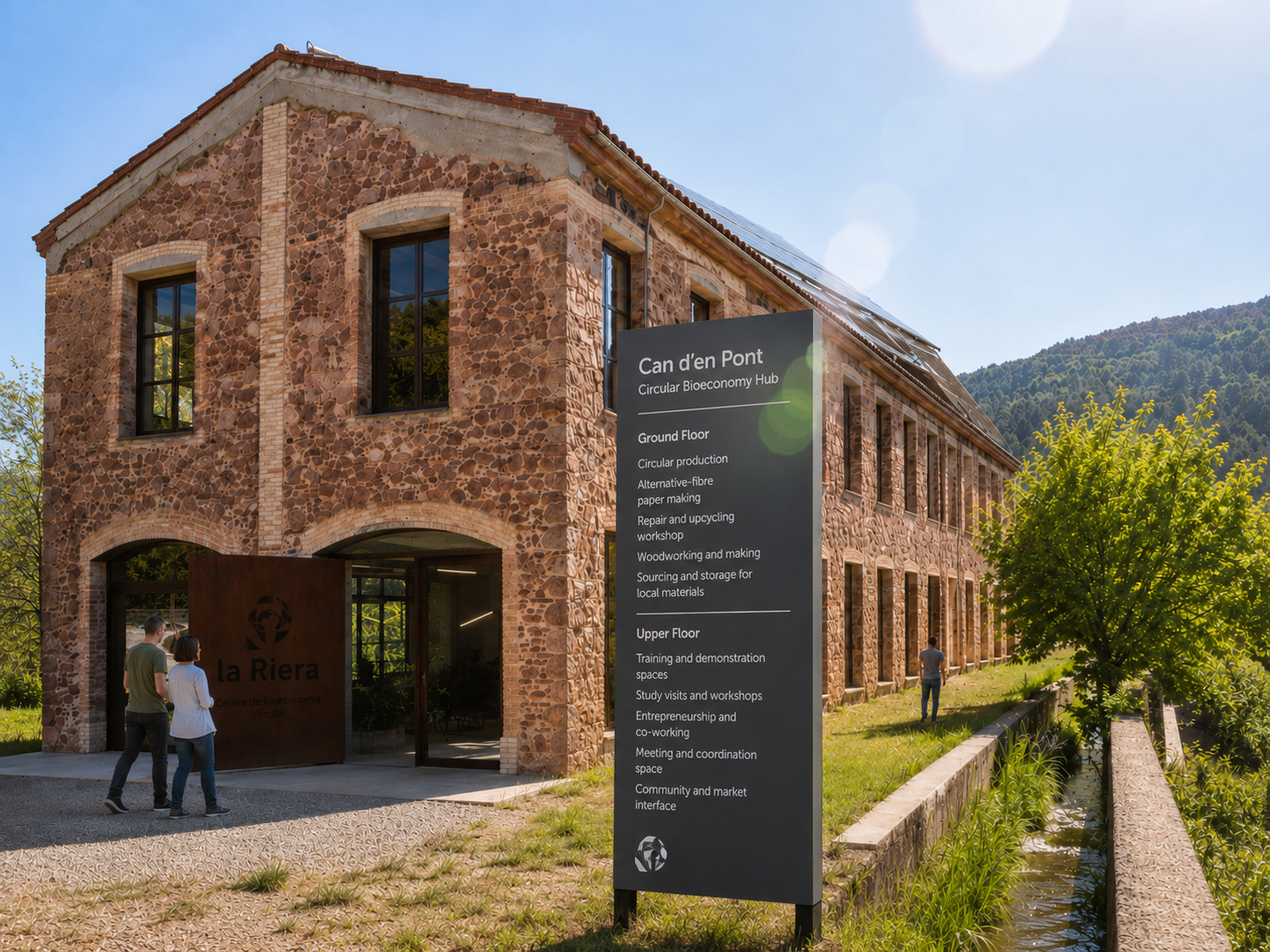
A. Core Economic Function — Circular Production and Local Value Creation
Main activities and services
- Pellet production as the primary economic activity of the hub, using suitable locally and regionally available biomass streams to create a clear year-round productive function for the building.
- Training and demonstration in pellet-production technology, including biomass preparation, drying, handling, storage, processing, and quality control, so that the site also functions as a practical learning environment.
- Complementary circular production activities, including alternative-fibre paper-making, repair, upcycling, woodworking, and other renewable-material applications that broaden the hub’s educational, social, and heritage value.
- Organization of sourcing, sorting, storage, preparation, and logistics needed to support pellet production and related circular manufacturing while strengthening local supply chains.
Target groups
- Local farmers, cooperatives, land-based actors, craftspeople, and suppliers who can contribute materials, knowledge, or services to the productive system.
- Small rural enterprises, artisans, and emerging circular businesses working with renewable materials, repair, fabrication, or place-based production.
- Public and development actors seeking a concrete model of regenerative rural enterprise rooted in local assets.
Frequency of use
- Year-round, with daily or regular use of the productive spaces and seasonal variation in sourcing cycles, workshop themes, and output rhythms.
B. Secondary Function — Learning, Transfer, and Demonstration
Main activities and services
- Hands-on training in paper-making, circular production methods, biomass and fibre handling, repair practices, material reuse, and practical rural entrepreneurship.
- Demonstration of visible material cycles in the building itself, including reused components, repair culture, renewable energy systems, and low-impact operational models.
- Study visits, workshops, and technical learning programmes that connect schools, universities, artisans, public actors, and adult learners to real circular activity.
- Intergenerational transfer programmes through which traditional local knowledge and younger innovative capacities are brought together in a practical setting.
Target groups
- Young people from the valley and nearby municipalities seeking practical skills and future-oriented work pathways.
- Schools, vocational programmes, universities, and adult learning actors interested in circular economy practice.
- Professionals, NGOs, and municipalities looking for demonstrable and transferable rural regeneration models.
Frequency of use
- Continuous through the year, through workshops, open days, formal training modules, and production-linked learning.
C. Tertiary Function — Community and Market Interface
Main activities and services
- A meeting and coordination space where local residents, entrepreneurs, and partners can connect productive activity with local needs, local identity, and wider market opportunities.
- Public-facing interpretation that explains how the building works as a circular economy hub and makes its productive systems socially visible and understandable.
- Showcases, fairs, and presentation moments for locally made products, circular techniques, and emerging enterprises linked to the hub.
- Selective visitor-facing functions that support visibility and regional attractiveness without allowing the site to become a purely touristic stopover.
Target groups
- Local community members, associations, and informal networks.
- Buyers, project partners, institutions, and mission-aligned visitors.
- Entrepreneurs and micro-enterprises interested in collaboration, incubation, or product testing.
Frequency of use
- Regular through the year, with intensified use during events, educational programmes, and market-facing activities.
D. Shared Economic Support Functions — Enterprise Development and Coordination
Across these functions, Can d’en Pont also acts as a support platform for enterprise development, incubation, and coordination.
This includes mentoring, partnership-building, supply-chain coordination, branding support, and project development that help local actors move from isolated activities toward a more connected and resilient circular economy ecosystem.
In this way, the building becomes not only a place where production happens, but also a place where a broader local economic system is actively organized and strengthened.
Key Stakeholders and Partnerships #
From the economic perspective, the success of Can d’en Pont depends on a coordinated ecosystem of producers, knowledge actors, public institutions, and community partners rather than on a single operator or isolated project stream.
Because the hub is meant to combine circular production, skills development, enterprise creation, and territorial regeneration, its partnerships must link local resource flows with technical knowledge, market access, and long-term governance support.
Local Producers and Supply-Chain Actors
- Farmers, agricultural cooperatives, and other land-based producers are essential partners because pellet production depends on a reliable supply of suitable biomass streams, including agricultural residues and other locally or regionally available organic raw materials.
- Woodland owners, forestry-related actors, transport providers, and local logistics partners are also important where biomass sourcing, drying, storage, and delivery become part of the core economic model of the hub.
- Existing partners already suggested in the Can d’en Pont material, such as agricultural cooperatives, remain highly relevant because they illustrate how underused local by-products can be redirected into new productive value chains.
- Artisans, repair practitioners, and small-scale makers still have a place in the ecosystem, but as complementary actors who broaden the circular profile of the hub around its main pellet-production function.
Educational and Research Institutions
- Universities and higher education partners are important for research, testing, process improvement, and the development of applied learning programmes linked to circular economy practice and heritage-based innovation.
- The existing Can d’en Pont material already points to relevant actors such as the University of Barcelona, especially its conservation-restoration field, which could help connect industrial heritage, material knowledge, and contemporary sustainable production methods.
- Vocational schools, technical institutes, and adult learning providers are equally important because the hub’s credibility depends on turning production into a real training environment rather than a symbolic showcase.
Cultural and Heritage Partners
- The Capellades Paper Mill Museum is a particularly strong strategic partner because it connects directly to the paper-making heritage of the building and can help frame Can d’en Pont within a wider regional narrative of industrial memory, craftsmanship, and contemporary reinterpretation.
- Arts and crafts institutions, including those already named in the supplied material such as Escola de la Llotja and the Artistes i Artesans del FAD network, can support product experimentation, material innovation, and the connection between productive activity and higher-value creative applications.
- These actors are especially relevant if Can d’en Pont aims not only to manufacture, but also to position its outputs within broader cultural, educational, and design-oriented circuits.
Public Authorities and Development Bodies
- The municipality and wider local public administration are indispensable because the building’s location, access conditions, and infrastructure needs require active coordination rather than passive ownership.
- County-level and regional development actors are also important in view of the valley’s broader strategic agenda around economy and business, housing and infrastructure, and natural resources and energy transition.
- Their role is not only to support permits and infrastructure, but also to help align Can d’en Pont with wider rural regeneration, reindustrialization, and territorial development priorities.
Community and Civil Society Actors
- Local associations, informal community networks, and intergenerational groups are necessary to ensure that the building does not become detached from local life or perceived as a project mainly for outsiders.
- The current Can d’en Pont vision repeatedly emphasizes the need for young people to see themselves in the project, so youth participation, mentoring structures, and community-level co-creation should be treated as part of the economic ecosystem, not as an optional social add-on.
- Civil society actors can also help translate productive functions into broader local legitimacy by connecting enterprise development with cultural continuity, belonging, and everyday use.
Market and Strategic Partners
- Buyers, circular economy networks, renewable-material actors, and mission-aligned enterprises are needed to ensure that local production is linked to real market pathways rather than remaining a purely experimental activity.
- Cooperative and business-development partners can help with branding, product positioning, distribution, and scale-appropriate commercialization, especially if Can d’en Pont combines functional products with higher-value crafted or educational outputs.
- In this sense, external partners should not displace the local economy, but extend its reach and increase the viability of locally rooted production models.
Expected Impact #
Short-term impact (1–2 years)
In the first years after Can d’en Pont becomes operational as a Circular Bioeconomy Hub, the most important impact will be the visible establishment of small-scale pellet production as the building’s economic core, giving the restored site a concrete year-round productive identity rather than leaving it at the level of symbolic regeneration or intermittent use.
Alongside the launch of this appropriately scaled production activity, the hub can also begin offering training and demonstration in pellet technology, biomass preparation, storage, and handling, while complementary activities such as paper-related experimentation, repair, and upcycling broaden the site’s educational and community value.
Within this initial phase, the hub can begin to generate the first local jobs and hybrid roles in coordination, material sourcing, workshop delivery, production support, maintenance, and community-facing operations.
At the same time, the first local supply relationships with farmers, cooperatives, artisans, and educational partners can be activated, making the building economically relevant not only in itself, but as a catalyst for a wider local network.
As in the already developed Can d’en Pont material, one of the earliest visible benefits should be that local people, artisans, and learners begin to see sustainability not as an abstract concept, but as something that produces work, skills, and practical opportunity.
A further short-term effect should be the strengthening of confidence in the site as a serious local project rather than a speculative or purely cultural intervention.
If the first productive functions, training activities, and partner collaborations are clearly structured, Can d’en Pont can begin covering a meaningful share of its basic operating costs while demonstrating that heritage reuse can support an active and credible economic model.
Long-term impact (5–10 years)
Over a longer horizon, Can d’en Pont can evolve into a recognized rural circular economy reference point within the Vall de Carme and the wider region, known not only for restoration quality but for its capacity to convert local resources, inherited knowledge, and underused infrastructure into a functioning regenerative economy.
By this stage, the building should no longer be seen as an isolated project, but as the nucleus of a broader ecosystem of suppliers, makers, educators, small enterprises, and civic actors connected through a shared circular development logic.
The long-term economic effect should be the emergence of a stronger local opportunity structure for younger generations.
Rather than leaving the valley as the only viable option, young people could increasingly find pathways into technical work, local enterprise, creative production, or hybrid careers that combine making, learning, and entrepreneurship.
This is closely aligned with the wider valley strategy described in the supplied material, which links revitalization to housing, job creation, and the attraction of people who will actually live and work in the area.
In the longer term, Can d’en Pont can also help establish a more durable symbiosis between the valley’s environmental assets and its economic future.
If local agricultural residues, reeds, craft traditions, and rural skills are integrated into viable productive circuits, the project can demonstrate that ecological responsibility and economic regeneration are not opposing goals, but mutually reinforcing ones.
As the model matures, its methods and results may also become transferable to other heritage or underused rural buildings, giving Can d’en Pont significance not only as a local success, but as a replicable example of circular rural regeneration.
Sustainability and Resilience #
The economic vision for Can d’en Pont is designed so that the building, the local economy, and the surrounding environment reinforce each other over the long term rather than produce a short cycle of enthusiasm followed by underuse or decline.
Its sustainability does not depend on a single event stream or a speculative visitor economy, but on an appropriately scaled productive core: small-scale pellet production supported by training, demonstration, and complementary circular activities that fit the building’s size, heritage character, and local resource base.
At the center of this resilience is the use of suitable locally and regionally available biomass streams that can be turned into practical value while strengthening local supply relationships and creating a concrete economic role for the site.
This makes the model more realistic than a large industrial proposition, while still giving Can d’en Pont a year-round productive function that is clearer and more durable than a purely symbolic or event-led reuse model. At the core of this resilience is the productive circular model itself.
By relying on agricultural residues, reeds, fibre-based materials, repair practices, and other locally rooted circular inputs, Can d’en Pont builds economic value from resources that are already present in or near the territory rather than depending primarily on imported demand or externally controlled supply chains.
This strengthens local autonomy while also making the building more legible as a real economic asset for the valley.
Economic sustainability is also inseparable from environmental sustainability in this model.
The current Can d’en Pont material already emphasizes reclaimed materials, renewable energy systems, rainwater harvesting, low-impact building techniques, visible repair culture, and the reuse of agricultural and river-based fibres, which means that the building itself functions as a practical demonstration of circularity rather than merely hosting circular rhetoric.
In this framework, environmental care is not an external moral add-on, but part of the economic logic: if local resources, water systems, material quality, and landscape integrity are degraded, the productive and educational credibility of the hub is weakened as well.
Resilience is also built through diversified but coherent functions.
The main economic engine remains productive circular activity, but that core is reinforced by training, demonstration, workshops, partnerships, and market-facing functions that create multiple forms of value around the same focus rather than scattering effort across unrelated uses.
This makes the model less vulnerable to seasonal fluctuations, single-market dependence, or the transit trap identified in the current material, where the site risks becoming visible without becoming structurally useful.
A further dimension of resilience lies in skills, knowledge transfer, and social continuity.
Because the project connects production with training and intergenerational exchange, it helps build a local base of people who can operate, adapt, and gradually improve the model over time rather than leaving knowledge concentrated in a single expert or project cycle.
This is particularly important in a valley where the lack of opportunities for younger people creates a real risk of depopulation and weakening local capacity.
Finally, long-term resilience requires governance and financial discipline.
If Can d’en Pont is to remain viable, part of the value generated through its productive and educational functions must be reinvested into maintenance, equipment renewal, capacity building, and gradual upgrading of the building and its systems.
Clear agreements between operators, public authorities, and partners will therefore be essential to ensure that economic gains are translated into lasting institutional stability rather than short-term project activity alone.
Connection with Other Helices #
The economic vision for Can d’en Pont only works if it is understood as part of a wider interdependent system.
Its purpose is not simply to create revenue, but to make economic activity the driver that helps connect circular production, learning, social anchoring, environmental stewardship, and public coordination in one coherent rural regeneration model.
Economy <=> Environment
The economic model depends directly on the responsible use of local and regional biomass streams and on the ecological systems from which those materials are derived.
In practical terms, small-scale pellet production only makes sense if agricultural residues, woodland by-products, and other suitable organic materials are sourced within ecological limits, handled efficiently, and integrated into circular rather than extractive processes.
By giving underused biomass streams a productive role while keeping the scale appropriate to the building and its setting, Can d’en Pont can create an incentive to manage local resources more intelligently and to connect environmental stewardship with concrete economic value..
Economy <=> Education
The economic core of Can d’en Pont is inseparable from learning and skills development.
Paper-making, repair, upcycling, woodworking, renewable-material experimentation, and circular production methods all function not only as economic activities, but also as teaching environments where schools, universities, vocational learners, artisans, and residents can engage with practical knowledge.
In this way, the building becomes a place where economic production generates educational value, and educational partnerships strengthen the quality, adaptability, and legitimacy of the economic model.
Economy <=> Society
Economically, Can d’en Pont is designed to generate benefits that spread beyond the building itself.
By creating jobs, supply-chain opportunities, workshop access, and visible reasons for younger people to remain in or return to the valley, the hub addresses the social risks of depopulation, weak local opportunity structures, and the feeling that rural places are only being prepared for outsiders or visitors.
Its community-facing functions are therefore not secondary in a symbolic sense, but socially necessary for ensuring that economic regeneration is experienced as shared local value rather than as a detached project.
Economy <=> Politics / Governance
The economic vision also depends on supportive and coordinated governance.
Because the building is physically isolated and connected to broader questions of access, infrastructure, housing, economic development, and energy transition, public authorities have a direct role in making the model workable rather than merely endorsing it rhetorically.
At the same time, a financially active and clearly focused Can d’en Pont strengthens the case for public investment and long-term policy support by showing that heritage assets can function as practical development infrastructure.
Economy <=> Natural Environment (feedback loop)
Finally, Can d’en Pont has the potential to become a local proof point that environmental responsibility can produce visible economic returns.
If the project can demonstrate that jobs, skills, enterprise development, and local value creation emerge from circular use of local materials rather than from depletion or speculative growth, it creates a persuasive feedback loop for wider rural policy and community thinking.
In that sense, the hub does not only depend on the other helices; it also feeds evidence back into them by showing how circularity can be translated into practical territorial resilience.
One Key Message #
Can d’en Pont transforms a former paper mill into a circular bioeconomy hub where small-scale pellet production, practical training, and complementary material uses create year-round local value, strengthen supply chains, and support rural resilience in the Vall de Carme.
Disclaimer / Copyright Notice for ALL #
© Parts of this material were created and structured with the support of Artificial Intelligence (LLM); other parts were searched and created using CoPilot. The content was created to support analysis and reporting and was adapted and reviewed by the project team. Research was conducted using Bing and/or Google searches.
All trademarks and product names mentioned are acknowledged and remain the property of their respective owners.