
- 1. SECTOR NAME
- 2. SECTOR VISION STATEMENT
- 3. CURRENT CHALLENGES AND NEEDS
- 4. PROPOSED FUNCTIONS OF THE GARDEN AND GREEN COMMUNITY PLAZA
- 5. KEY STAKEHOLDERS AND PARTNERSHIPS
- 6. EXPECTED IMPACT
- 7. MONITORING AND KEY PERFORMANCE INDICATORS (KPIs)
- 8. SUSTAINABILITY AND RESILIENCE
- 9. CONNECTION WITH OTHER HELICES
- 10. ONE KEY MESSAGE
- 11. VISUAL OR SYMBOLIC ELEMENT
 Doc Summary

IKUGA – ECONOMIC SECTOR VISION
Community Gardening Economic Vision – Growing Together for a Sustainable Future
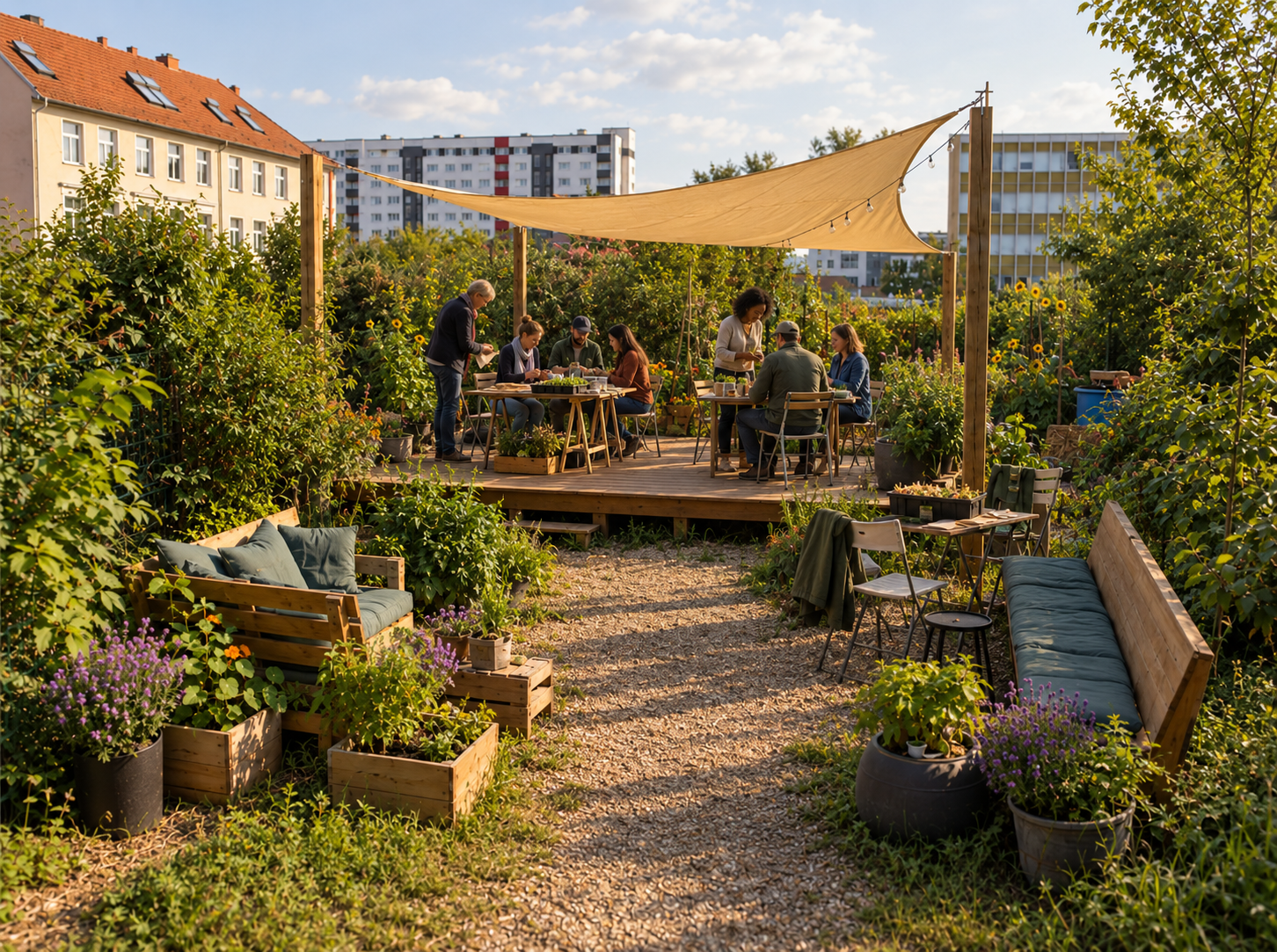 Vision for the Green Community Plaza and Community Use
IKUGA – Interkultureller Garten Magdeburg
1. SECTOR NAME #
Economy: Local value-creation, small-scale entrepreneurship and resource-efficiency subsystem.
This vision belongs to the economic helix: the modest but real flows of money, produce, skills and opportunity that a community garden can generate for its neighbourhood, without turning the garden itself into a commercial enterprise or compromising its social and ecological character.
2. SECTOR VISION STATEMENT #
IKUGA: Growing Together for a Sustainable Future – A Neighbourhood Micro-Economy Rooted in the Garden
The economic vision for IKUGA is to transform a volunteer-run, grant-dependent community garden into a small but resilient local economic hub – one that generates modest own income, builds entrepreneurial capacity in the neighbourhood, and reduces long-term dependency on sporadic public funding, all while keeping the garden’s social and ecological mission at its centre.
Rather than a single business model, IKUGA’s economic vision rests on three complementary, low-threshold income and value streams: a retail and local-food partnership with a supermarket chain such as REWE, entrepreneurship and income-generation workshops for neighbourhood residents, and rental of the garden’s Green Community Plaza and wooden deck for community and externally organised events aligned with sustainability and ESG themes.
Together, these three streams echo the “small-scale circular value” role already identified for the Economy helix in IKUGA’s wider Growing Together vision: local food, repair, reuse and resource efficiency turned into everyday, tangible economic benefit for residents. None of the three streams is designed to make IKUGA rich; together, they are designed to make it durable, self-reliant and useful to the people who live around it.
3. CURRENT CHALLENGES AND NEEDS #
Context of IKUGA
IKUGA, the intercultural garden of Magdeburg, is a place for tolerance and cooperation where people from many countries and cultures garden together. The idea was developed in 2009 by Caterina Mendel as a student research project and matured in 2010 into a concept supported by the cultural association KanTe e.V. Real garden work began in 2012; since 2014 the community has built a pergola, greenhouse and public benches, an association was formally established in 2018, and IKUGA marked its tenth anniversary in 2022. The association today counts roughly 25–30 active members.
Needs
- Need for financial autonomy. IKUGA currently depends heavily on municipal support and irregular grants; it needs stable, if modest, own revenue to cover recurring costs such as water, basic equipment, maintenance and coordinator honoraria.
- Need for sustainable local livelihoods. The neighbourhood needs realistic, low-barrier pathways to income and entrepreneurship, not only social and environmental benefits from the garden.
- Need for visible local value creation. The garden’s produce, knowledge and space have real economic value (food, skills, venue, image) that is currently underused as a source of income or community benefit.
- Need for reduced dependency on ad hoc funding. A diversified, partly self-generated income base would reduce IKUGA’s vulnerability to funding cycles and political change.
- Need for a low-threshold economic model. Any economic activity must remain accessible and non-commercial in spirit, so the garden does not lose the trust of the very community it depends on.
Challenges
- Low purchasing power in the neighbourhood. The socio-economic profile of the surrounding area limits how much residents can realistically pay for workshops, products or venue use, which caps the ambition of any revenue model.
- Limited entrepreneurial and administrative capacity. IKUGA is run largely by volunteers; few have the time, skills or mandate to manage supplier relationships, sponsorships or paid bookings on top of daily gardening work.
- Small physical scale and seasonal output. The garden’s productive area and harvest volumes are modest and seasonal, which constrains how much can realistically be sold, bought back or exchanged through a retail partnership.
- Participant rotation and fragile continuity. Turnover among volunteers and participants makes it hard to sustain economic initiatives (a workshop series, a rental calendar) that require continuity from one season to the next.
- Risk of commercial dilution. If economic activity is not carefully bounded, there is a risk that revenue-seeking behaviour could crowd out the inclusive, low-threshold character that makes IKUGA valuable to migrant groups, families and long-standing members alike.
4. PROPOSED FUNCTIONS OF THE GARDEN AND GREEN COMMUNITY PLAZA #
From the economic perspective, IKUGA operates as a three-stream micro-economy, anchored in the existing garden and its planned Green Community Plaza (wooden deck, sun sail, seating and lounge areas).
A. Retail and Local-Food Partnership (“REWE as partner”)
Main activities and services
- Buy-back of garden produce. A local supermarket partner purchases part of IKUGA’s harvest (vegetables, fruit, herbs, flowers), giving the garden’s productive beds a direct commercial outlet.
- Sponsored community workshops. The retail partner co-funds and helps publicise “how to grow” workshops on vegetables, fruit and flowers, aimed at neighbourhood residents rather than experts.
- Neighbourhood loyalty scheme. A loyalty shopping card for the surrounding neighbourhood links everyday shopping at the partner store to visible support for the garden, creating a recurring, low-effort funding mechanism.
Incentives for the retail partner
- Visibility and improved image in the immediate neighbourhood and in the wider region.
- A replicable model it can point to and potentially extend to other stores.
- A form of “authorship” or ownership over a recognisable local sustainability initiative.
- Increased footfall and turnover generated by visibility, positive perception and the loyalty card mechanism.
Cost of the partnership (what IKUGA needs the partner to cover)
- Fixed running costs: basic garden maintenance, water, gardening equipment.
- Fixed costs #2: honoraria for one to three garden coordinators, addressing the core capacity gap identified above.
Target groups: Neighbourhood households, families, and everyday shoppers who are also potential or existing garden participants.
Frequency of use: Seasonal for produce buy-back (aligned with harvest cycles); periodic (monthly/seasonal) for sponsored workshops; continuous/year-round for the loyalty card mechanism.
B. Entrepreneurship and Income-Generation Workshops
Main activities and services
- Practical workshops that increase the entrepreneurial potential and income-generation capacity of neighbourhood residents, going beyond gardening skills into small business and self-employment basics.
- Sessions delivered by educational institutions and by successful local businesses, giving participants exposure to real entrepreneurial experience rather than only theory.
- Funding secured from local, regional or federal employment and economic-development authorities, and/or EU funding instruments (e.g. adult-education and social-inclusion programmes), possibly complemented by corporate sponsorships.
Rationale and expected effect
In the short term, these workshops build individual skills and confidence; in the long term, they are intended to reduce local social and welfare expenditure by helping residents move toward self-employment or improved employability.
Cost structure
- Educators’ fees.
- Organiser’s fee for space rental and organisation, counted as direct income for IKUGA.
- Materials for participants.
- Promotion in the neighbourhood, including a dedicated website and social media presence and printed flyers distributed locally.
Target groups: Unemployed or underemployed neighbourhood residents, migrants seeking economic integration, young people exploring self-employment, and existing garden volunteers looking to formalise skills.
Frequency of use: Periodic workshop cycles (e.g. seasonal cohorts), scalable according to available sponsorship and demand.
C. Green Community Plaza – Event and Venue Rental
Main activities and services
- Rental of the Green Community Plaza’s wooden deck, sun sail and seating areas for community events and, more significantly, for broader external events on topics aligned with community/urban gardening and ESG themes.
- The physical infrastructure already envisioned for the plaza – flexible seating, planting containers, an information board, solar lighting and bicycle parking – makes the space usable for meetings, workshops, small festivals and cultural events well beyond IKUGA’s own programming.
- Possible formats include neighbourhood meetings, environmental and sustainability workshops, Erasmus+ activities, women’s breakfasts, seed exchanges, and small cultural or gardening-demonstration events.
Target groups: NGOs, schools, adult-education providers, sustainability-focused businesses and institutions, and neighbourhood associations seeking an affordable, characterful outdoor venue.
Frequency of use: Regular through the year, intensifying in spring and summer around the garden’s own programme of seed exchanges, harvest events and cultural evenings.
D. Shared Economic Support Functions
Across all three streams, IKUGA also functions as:
- A small-scale circular economy demonstrator, where local food, repair, reuse and resource-efficiency practices generate visible, if modest, economic value rather than remaining purely symbolic.
- A light incubation space for residents experimenting with small food, craft or service micro-enterprises linked to the garden’s produce, skills or space.
- A coordination point between local businesses, foundations and the garden, translating in-kind support (materials, sponsorship, practical expertise) into concrete economic activity.
These shared functions ensure that economic activity at IKUGA reinforces, rather than competes with, its educational and social roles.
5. KEY STAKEHOLDERS AND PARTNERSHIPS #
The economic model depends on a small but coordinated ecosystem of local actors rather than a single operator.
Target Group | Type | Needs & Interests | Project Focus |
Retail partner (e.g. REWE) | Local business | Visibility, image, replicability, increased turnover | Produce buy-back, sponsored workshops, loyalty card |
Neighbourhood residents & families | Local | Affordable goods, learning opportunities, income prospects | Workshops, loyalty scheme, produce access |
Unemployed / underemployed residents | Local | Entrepreneurial skills, income-generation pathways | Entrepreneurship workshops |
Educational institutions & successful local businesses | Local/Regional | Community engagement, applied teaching opportunities | Workshop delivery, mentoring |
Employment / economic development authorities & EU funders | Regional/EU | Reduced local welfare costs, demonstrable social return | Workshop sponsorship and co-financing |
Municipality | Local | Access, permits, small grants, urban strategy | Enabling framework for the plaza and events |
NGOs, schools and event organisers | Local/Regional | Affordable, characterful venue for related events | Green Community Plaza rentals |
IKUGA volunteers & coordinators | Local | Recognition, honoraria, manageable workload | Coordination of all three income streams |
KanTe e.V. | Local | Continuity of the founding cultural mission | Oversight and institutional anchoring |
Media partners
Regional press and local online platforms covering neighbourhood economic and sustainability initiatives.
Civil society & institutions
KanTe e.V. as founding association; the City of Magdeburg and district funding bodies; local associations and diaspora networks who can help promote workshops and events within their own communities.
6. EXPECTED IMPACT #
Short-term impact (1–2 years)
In the first phase, the priority is proving that each of the three income streams can work at a small, credible scale. A first retail partnership pilot is agreed with a local supermarket, covering at least basic fixed costs (water, equipment) and part of one coordinator’s honorarium. A first cohort of entrepreneurship workshops is delivered, funded through a combination of local employment-support budgets and modest corporate sponsorship, reaching an initial group of neighbourhood residents. The Green Community Plaza, once its shade, seating and lighting infrastructure is in place, hosts its first paid or in-kind-compensated external bookings alongside IKUGA’s own events. This mirrors the “welcome & shade” and “community lounge” phases already foreseen in IKUGA’s broader development roadmap for 2027–2028.
Medium-term impact (3–5 years)
As the plaza’s outdoor-learning and biodiversity features mature, workshop programming becomes more regular and diversified, and the retail partnership deepens into predictable seasonal buy-back and a functioning loyalty-card mechanism. New local partnerships and volunteer participation strengthen the coordination capacity that the model depends on.
Long-term impact (5–10 years)
Over a longer horizon, IKUGA’s three-stream micro-economy becomes an established feature of the neighbourhood, in line with the vision of IKUGA as a recognised European Green Learning Hub by around 2035. The retail partnership and loyalty scheme generate a steady, if modest, revenue base; a track record of successful entrepreneurship cohorts demonstrably reduces reliance on local welfare spending; and the Green Community Plaza is a sought-after, self-financing venue for sustainability-themed events across the wider region. The model, documented and shared through BeCom’s European networks, becomes transferable to other community gardens seeking similarly low-cost, low-risk paths to economic resilience.
7. MONITORING AND KEY PERFORMANCE INDICATORS (KPIs) #
Following the same monitoring logic already used across the wider IKUGA Growing Together vision and the BeCom toolkit’s KPI dashboard, the economic dimension is tracked through a small set of concrete, low-effort indicators – grouped by income stream – so that progress can be reviewed annually without creating heavy administrative burden for volunteers.
Income Stream / Dimension | KPI | Short-term Target (1–2 yrs) | Long-term Target (5–10 yrs) | Measurement Method |
|---|---|---|---|---|
Retail partnership | Revenue from produce buy-back (€/season) | Pilot agreement signed; first buy-back season completed | Stable seasonal contract covering ≥30% of basic operating costs | Partner sales/purchase records |
Retail partnership | Active loyalty-card holders in the neighbourhood | Initial uptake (approx. 50–100 cardholders) | Established scheme with recurring revenue share for IKUGA | Partner data, periodic reporting |
Coordination capacity | Number of coordinator honoraria funded | 1 partially funded coordinator role | 2–3 stable, funded coordinator roles | Financial records / budget review |
Entrepreneurship workshops | Workshops delivered and participants reached | First workshop cohort delivered (1–2 sessions) | Regular seasonal cohorts with cumulative participant tracking | Attendance lists, facilitator records |
Entrepreneurship workshops | Share of participants reporting new income-generating activity | Baseline established through initial follow-up | 20–30% of participants self-employed, employed or running a micro-activity | Follow-up surveys, interviews |
Venue rental | Paid or in-kind external bookings of the Green Community Plaza | First external bookings secured | Regular income stream; plaza booked on a recurring basis throughout the season | Booking calendar, income records |
Venue rental | Revenue generated from rentals (€/year) | Modest first-year income recorded | Meaningful contribution to annual operating budget | Income records, annual financial review |
Local economic ecosystem | Number of active local economic partners (retail, sponsors, businesses) | 2–3 partners active | 10+ established partners | Partner registry |
Local economic ecosystem | Volume/value of garden produce monetised or exchanged | Baseline harvest and sales tracking established | Increasing share of harvest monetised year over year | Harvest logs, sales records |
Financial resilience | Share of operating costs covered by own-generated revenue | Initial share covered (e.g. 10–15%) | Substantial self-sufficiency (e.g. 40–50% or more) | Annual financial review |
Transferability | Other gardens/organisations adopting elements of the model | Model documented as a case study | Model transferred to at least 1–2 other locations | Website analytics, partner feedback |
Reporting rhythm
- Annual review meeting: coordinators, retail partner and key stakeholders assess KPI progress against short- and long-term targets, following the same annual review logic used in IKUGA’s broader monitoring framework.
- Seasonal check-ins: lightweight tracking of harvest sales, workshop attendance and plaza bookings at the end of each season, feeding into the annual review rather than requiring separate reporting infrastructure.
- Shared indicators: results are documented and shared through BeCom’s European networks, consistent with the transferability principle already applied across the wider Growing Together vision.
8. SUSTAINABILITY AND RESILIENCE #
IKUGA’s economic resilience does not depend on any single income source, but on the interaction of three modest, complementary streams that can absorb each other’s fluctuations. If a given season’s harvest is weak, workshop and rental income can carry fixed costs; if sponsorship for workshops is temporarily reduced, retail-partnership income and loyalty-card revenue provide continuity.
This mirrors the modular implementation logic already built into IKUGA’s wider Growing Together vision: each physical and programmatic module (shade and comfort, welcome and identity, learning and participation) can be implemented and funded independently, so the garden’s economic activity can start small and expand only as resources and confidence allow.
Resilience is also built through diversified financing: small local and municipal grants, Erasmus+ cooperation funding, charitable foundations, corporate sponsorship (from the retail partner and others), and in-kind and volunteer contributions all feed the same modest economic base, reducing dependence on any one funder or programme cycle.
Finally, resilience depends on people. Training coordinators and facilitators, using honoraria funded through the retail partnership to stabilise at least a core team, and building intergenerational knowledge transfer between long-standing members and newer participants, ensures that the economic model does not collapse if one or two volunteers step back.
9. CONNECTION WITH OTHER HELICES #
The economic vision for IKUGA only works if income generation reinforces, rather than competes with, the garden’s education, social, environmental and governance dimensions.
Economy ⇄ Environment
Every economic stream depends on the garden’s ecological health: the retail partnership depends on produce quality and volume from well-tended, biodiverse beds; the plaza’s rental value depends on attractive native planting, shade and microclimate; and the “small-scale circular value” that anchors the whole model (local food, repair, reuse, resource efficiency) is itself an environmental practice turned into economic benefit.
Economy ⇄ Education
The entrepreneurship workshops and REWE-sponsored gardening sessions are educational products first and economic products second: they build practical skills in growing food, running a small activity, and engaging with a business partner, extending the outdoor-learning stations and citizen-science elements already present in the garden’s educational programme.
Economy ⇄ Society
Revenue from the retail partnership and plaza rentals is explicitly meant to help fund coordinator honoraria and community activity, spreading benefit across the volunteer base rather than concentrating it. The economic model also gives migrant groups, families and long-standing members a shared, visible reason for continued engagement, addressing the participant rotation and loss-of-ownership challenges already identified in IKUGA’s social vision.
Economy ⇄ Politics / Governance
A garden that can demonstrate a working local partnership, a track record of workshop delivery, and a functioning rental calendar is a far stronger candidate for municipal support, EU co-financing and employment-authority funding than one relying purely on appeals for help. In this way, economic activity strengthens IKUGA’s case for continued public backing, while supportive governance (permits, small grants, urban strategy alignment) in turn makes the economic model workable.
Economy ⇄ Natural Environment (feedback loop)
By showing, in concrete terms, how many workshop participants, coordinator jobs and partner relationships exist because the garden is biodiverse and well cared for, IKUGA becomes a persuasive local example that small-scale, nature-based economic activity is viable – evidence that can feed back into wider municipal and regional thinking on urban gardening and green neighbourhood economies.
10. ONE KEY MESSAGE #
“IKUGA turns a community garden into a small but resilient neighbourhood economy – where local produce, shared skills and a shaded plaza generate real income, real jobs, and real opportunity, growing together for a sustainable future.”
11. VISUAL OR SYMBOLIC ELEMENT #
Symbol
As a symbolic sketch, the productive garden bed can be drawn with small icons rising from it – a shopping basket (retail partnership), a handshake (entrepreneurship workshops) and a small tent or sun sail (event rental) – all connected by a single root system, representing three income streams growing from one shared garden.
 “Growing together for a sustainable future.”
Disclaimer / Copyright Notice #
Parts of this material were created and structured with the support of AI research tools. The content was created to support analysis, training and project reporting and was adapted and reviewed by the project team. Research was conducted using publicly available materials from international organisations, European institutions, educational projects and specialist gardening organisations.
All trademarks, organisation names and product names mentioned are acknowledged and remain the property of their respective owners. The linked learning materials remain subject to the terms and copyright notices of their respective publishers.
Glenfield, Serbia | BeCom Project Team, September 2026