
- 1. SECTOR NAME
- 2. SECTOR VISION STATEMENT
- 3. CURRENT CHALLENGES AND NEEDS
- 4. PROPOSED FUNCTIONS OF THE GARDEN AND GREEN COMMUNITY PLAZA
- Educational partners, community organisations, cultural actors and public institutions can contribute expertise, access, funding, spaces and networks that help the educational programme remain low-threshold and sustainable.
- 6. EXPECTED IMPACT
- 7. MONITORING AND KEY PERFORMANCE INDICATORS (KPIs)
- 8. SUSTAINABILITY AND RESILIENCE
- 9. CONNECTION WITH OTHER HELICES
- 10. ONE KEY MESSAGE
- 11. VISUAL OR SYMBOLIC ELEMENT
 Doc Summary

Community Gardening Educational Vision – Learning Together for a Sustainable Future
Vision for the Green Community Plaza as a Place of Learning, Exchange and Participation
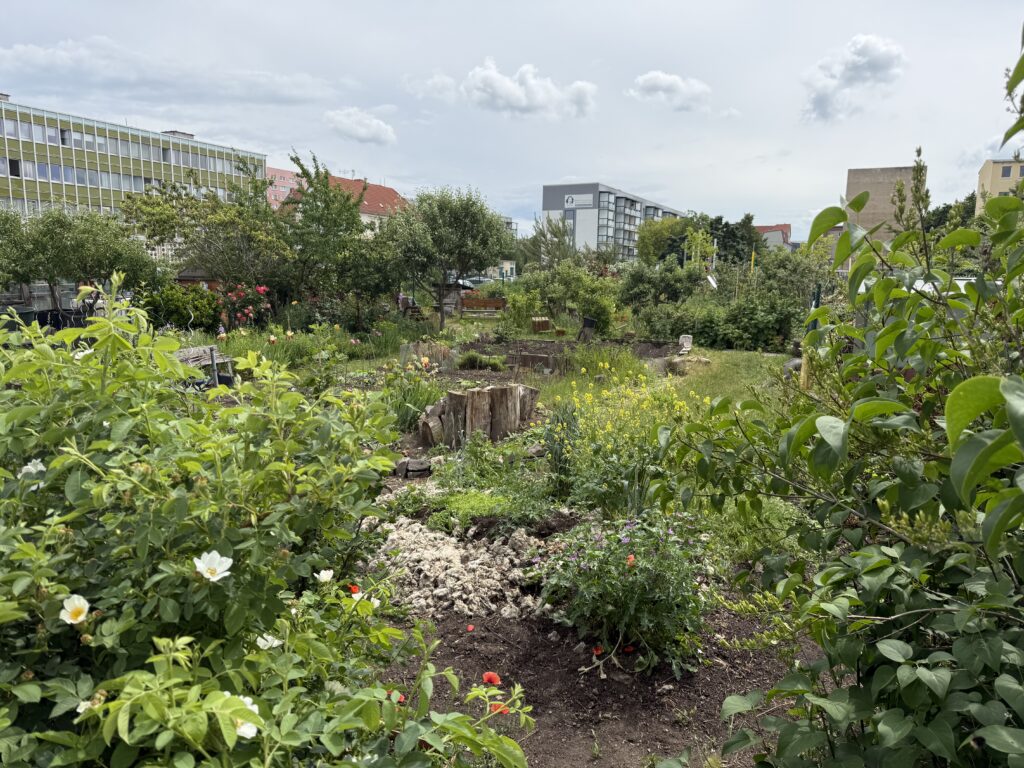
IKUGA – Interkultureller Garten Magdeburg
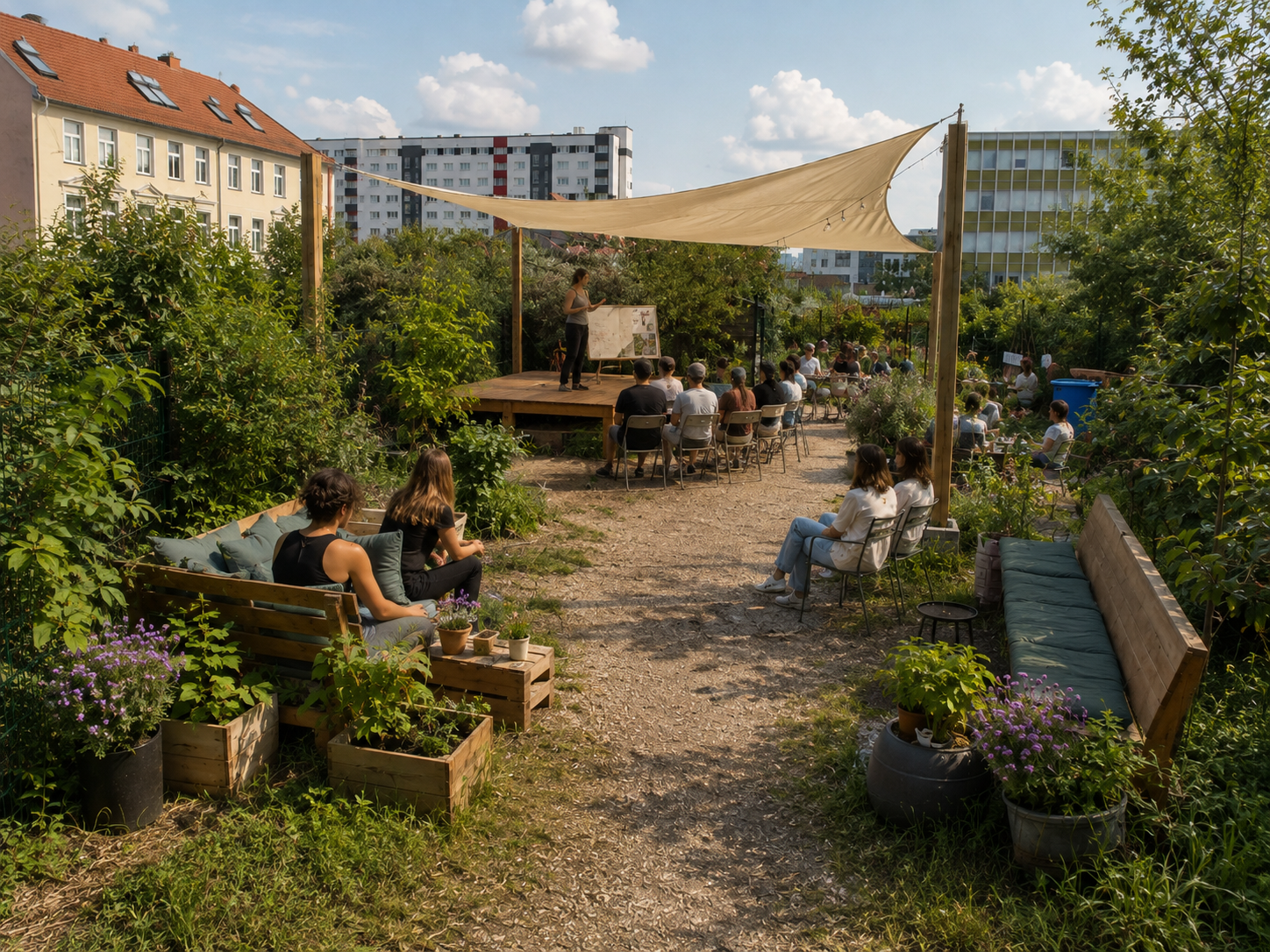
with support of AI generated image
1. SECTOR NAME #
Education: Place-based, experiential, intercultural and sustainability-learning subsystem.
Within the Quintuple Helix framework used for the BeCom learning material, the Educational sector describes how knowledge, practical skills, experience and shared learning can support neighbourhood transformation. At IKUGA, the garden itself becomes a living learning environment that connects formal education with non-formal and informal learning.
2. SECTOR VISION STATEMENT #
IKUGA: Learning Together for a Sustainable Future – A Neighbourhood Learning Hub Rooted in the Garden
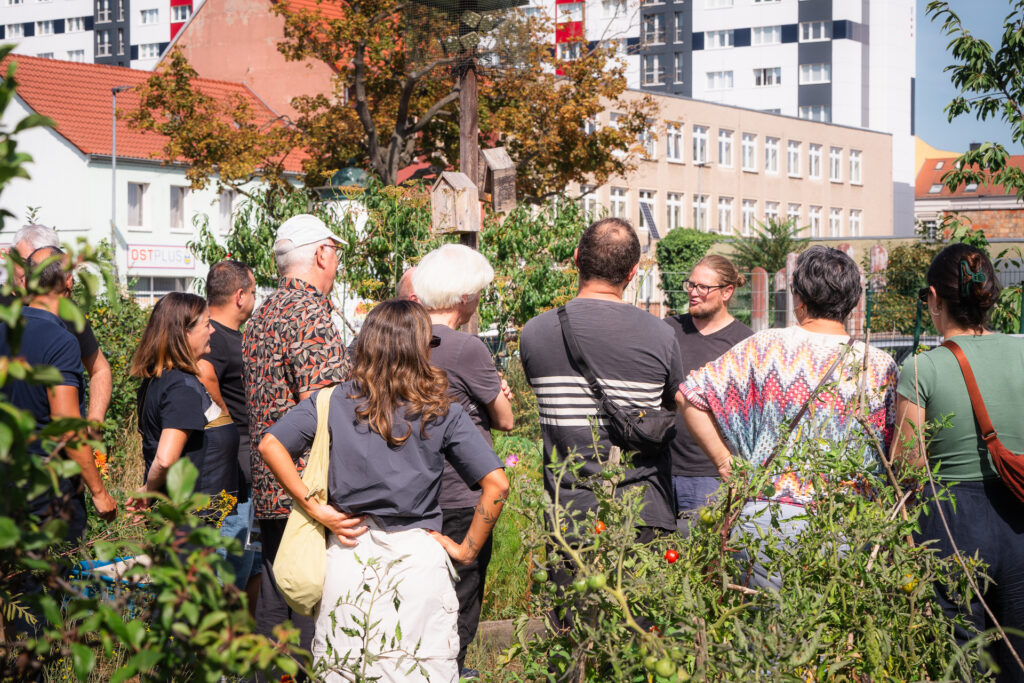
The educational vision for IKUGA is to strengthen the intercultural garden as an open, place-based learning hub where gardening, biodiversity, climate awareness, sustainable food, intercultural exchange and participation become practical learning experiences. The garden can make learning visible, hands-on and accessible to people who may not always be reached by conventional educational settings.
The vision builds on IKUGA’s existing education work rather than creating a separate education centre. Five complementary functions provide the structure: the garden as a living learning laboratory; regular school and youth partnerships; open intercultural and intergenerational learning; educator and facilitator development; and the Green Community Plaza as a flexible outdoor classroom and meeting place.
Together, these functions reflect the NEB approach to learning: knowledge is connected to experience, participation and local action. They support learning across ages and cultural backgrounds, encourage learners to contribute ideas and solutions, and make sustainability a practical part of everyday neighbourhood life. The aim is not to turn IKUGA into a formal school, but to make the garden a durable, inclusive and transferable place of learning.
Learning outcomes for the educational vision:
- Learners can connect gardening practice with biodiversity, climate, food and resource questions.
- Learners can observe, document, discuss and reflect on changes in their local environment.
- Learners can exchange knowledge across generations and cultural backgrounds and contribute their own experience.
- Learners can participate in small practical improvements and take shared responsibility for parts of the garden or programme.
3. CURRENT CHALLENGES AND NEEDS #
Context of IKUGA
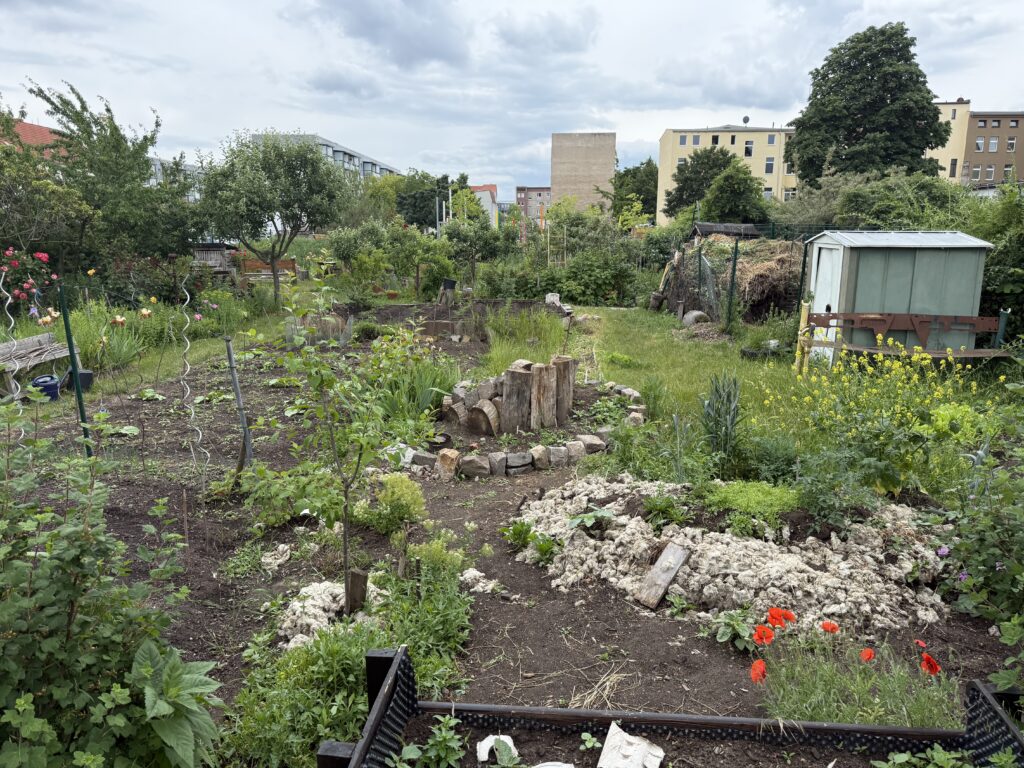
IKUGA describes itself as an intercultural garden and a place for tolerance, cooperation, communication and interaction. The project combines joint gardening with meetings, workshops, cultural activities and urban ecology. Its website presents the garden as a place where people with and without a migrant background, different generations and different social milieus can meet and learn from one another. The garden covers 2,600 m2 and combines community gardening with an educational interest in urban ecology.
Current educational activities
- Since May 2025, IKUGA has been able to expand its work in Bildung fuer nachhaltige Entwicklung (Education for Sustainable Development) with support from the State of Saxony-Anhalt and the City of Magdeburg. The current programme includes regular workshops, project days and practical activities in cooperation with educational institutions in Neue Neustadt.
- The educational themes published by IKUGA include sustainable food production, climate protection and intercultural cooking. Activities are designed to be experience-oriented and are implemented in the community garden or in the school gardens of cooperating institutions.
- Current educational cooperation includes Hort Abenteuerwelt, Gemeinschaftsschule Thomas Muentzer, Kinder- und Jugendhaus “Knast” and Moritzhof. IKUGA also offers open workshops on subjects such as fruit-tree pruning, permaculture, urban gardening and resource conservation.
- Need for continuity. Regular learning formats require reliable coordination, scheduling, materials and communication with partner institutions so that individual activities can become repeatable learning pathways.
- Need for low-threshold access. Educational activities should work for different ages, levels of prior knowledge, languages and abilities, using practical formats that do not depend on specialist knowledge.
- Need for stronger learning documentation. Simple lesson plans, activity sheets, reflection tools and records can help participants, educators and partners understand what was learned and support transfer to other settings.
- Need for participant agency. The garden can be used not only to teach about sustainability, but also to involve learners in identifying problems, proposing improvements and taking responsibility for parts of the garden or community programme.
- Need for transfer and networking. Good practice from IKUGA can be shared with schools, youth organisations, adult-learning and vocational-training providers, community organisations and other community gardens.
- Development challenge: seasonal and spatial limits. Outdoor learning depends on weather, available space and garden cycles, so educational formats need flexible indoor, covered or mobile alternatives and realistic group sizes.
- Development challenge: volunteer and staff capacity. Education requires preparation, facilitation, safeguarding and follow-up; a sustainable model therefore needs a manageable mix of paid coordination, partner expertise and volunteer contributions.
- Development challenge: inclusion in practice. An intercultural learning setting needs accessible communication, clear participation routes and, where useful, multilingual materials so that social or language barriers do not prevent people from taking part.
4. PROPOSED FUNCTIONS OF THE GARDEN AND GREEN COMMUNITY PLAZA #
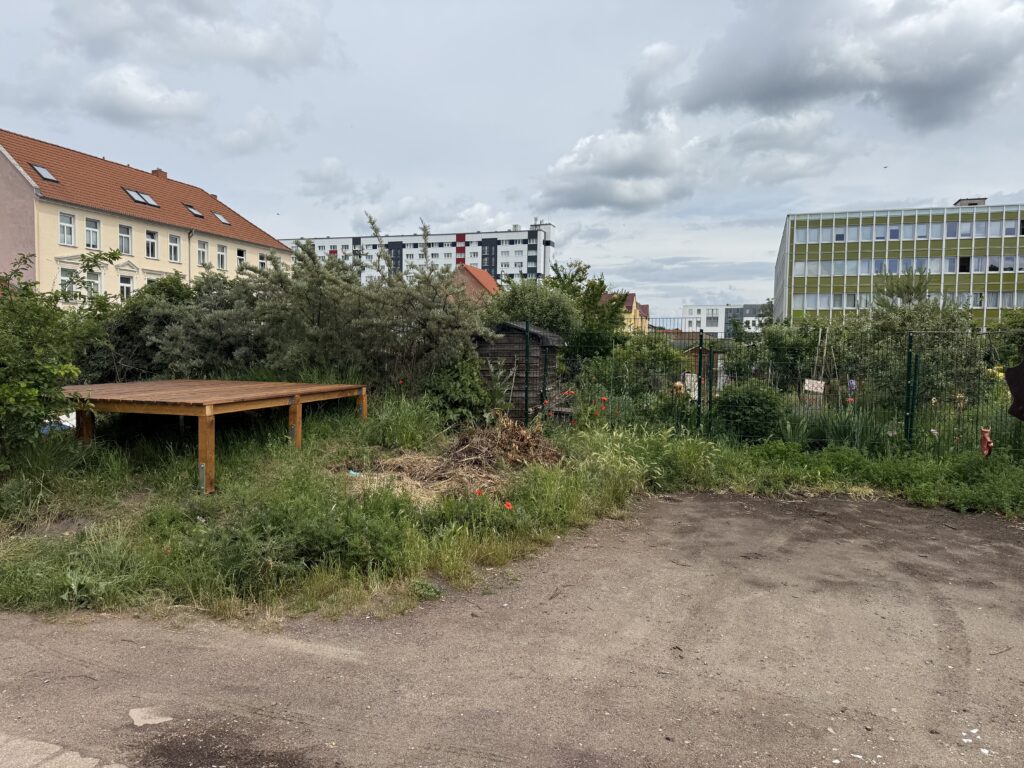
From the educational perspective, IKUGA functions as a five-part neighbourhood learning hub, anchored in the existing garden and complemented by the Green Community Plaza as a flexible outdoor classroom, meeting point and demonstration space.
A. Garden as a Living Learning Laboratory
Main learning activities and services
- Hands-on learning modules on soil, composting, seeds, plant care, food production, biodiversity and water management, using real garden beds and seasonal tasks as learning materials.
- Practical climate and urban-ecology activities that connect gardening with heat, shade, water, biodiversity and resource conservation in a dense urban neighbourhood.
- Observation and small citizen-science activities, such as recording plants, insects, birds or seasonal changes, so participants can learn to observe, document and interpret their surroundings.
Learning approach
- Activities combine short explanations with practical work, reflection and group exchange. The emphasis is on learning by doing, peer exchange and connecting ecological knowledge with everyday decisions.
- Possible target groups: Children, young people, families, adult learners, gardeners and residents with different cultural and educational backgrounds.
- Frequency of use: Seasonal learning cycles, with shorter modules available throughout the year and adapted to garden conditions.
B. School and Youth Learning Partnerships
Main activities and services
- Regular cooperation with schools, after-school programmes and youth organisations, building on the existing partnerships described by IKUGA.
- Project days and multi-session learning sequences on sustainable food, climate action, biodiversity, intercultural cooking, gardening and resource conservation.
Opportunities for learners to design small improvements, maintain garden elements, document results and present what they have learned to others.
Educational value
The garden provides a real-world setting in which subjects can be connected across science, social learning, culture and practical skills. This supports participatory and transdisciplinary learning and gives learners visible outcomes that connect knowledge with action.
Target groups: Schools, after-school care, youth clubs, teachers, educators and youth groups in Neue Neustadt and the wider Magdeburg area.
- Frequency of use: Regular school-year cooperation with repeat visits and project cycles, supported by seasonal gardening activities.
C. Open Community, Intergenerational and Intercultural Learning
Main activities and services
Open workshops on gardening, permaculture, fruit-tree care, resource conservation and sustainable everyday practices, building on the topics already offered by IKUGA.
Intercultural cooking, seed and knowledge exchange, garden days and community gatherings where participants learn from one another and share practical knowledge from different backgrounds.
Peer-learning opportunities in which experienced gardeners, young participants, newcomers and partner organisations can contribute knowledge and skills.
Inclusive learning environment
- The learning offer should remain low-threshold and welcoming. Clear communication, multilingual elements where useful, accessible activities and different ways of participating can help reduce barriers and respect different learning styles.
- Target groups: Neighbours, migrant communities, families, older residents, volunteers, informal learners and community organisations.
- Frequency of use: Open and periodic formats throughout the year, with more intensive gardening and outdoor-learning activities in spring and summer.
D. Educator Development, Documentation and Peer Learning
Across the educational programme, IKUGA can also function as:
- A practice-based learning resource for teachers, educators and community facilitators who want to work with nature, sustainability, participation and intercultural learning in an urban setting.
- A small educational documentation hub, collecting simple lesson plans, activity sheets, observation tasks, multilingual prompts and examples of learner work.
- A peer-learning and mentoring space where volunteers and experienced participants can support newcomers, share facilitation practice and strengthen intergenerational knowledge transfer.
A bridge between formal education, community initiatives, local authorities and cultural actors, translating local experience into learning opportunities and transferable good practice.
These shared functions ensure that education at IKUGA reinforces the social, environmental and participatory character of the garden while creating a reusable knowledge base for future activities.
Target groups: Educational institutions, NGOs, community organisations, trainers, facilitators and other neighbourhood initiatives.
Frequency of use: Ongoing, with documentation, reflection and coordination integrated into the regular programme.
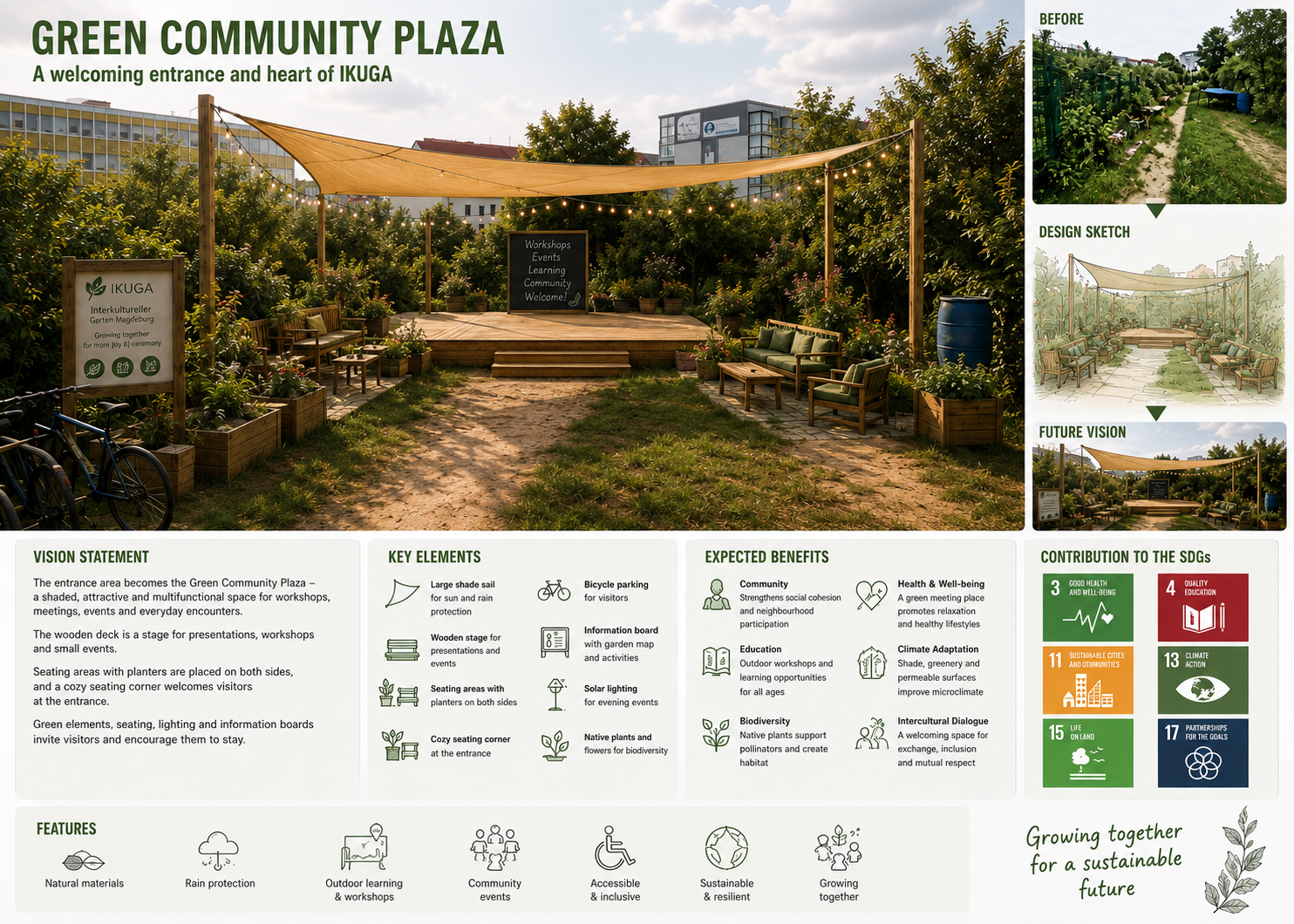
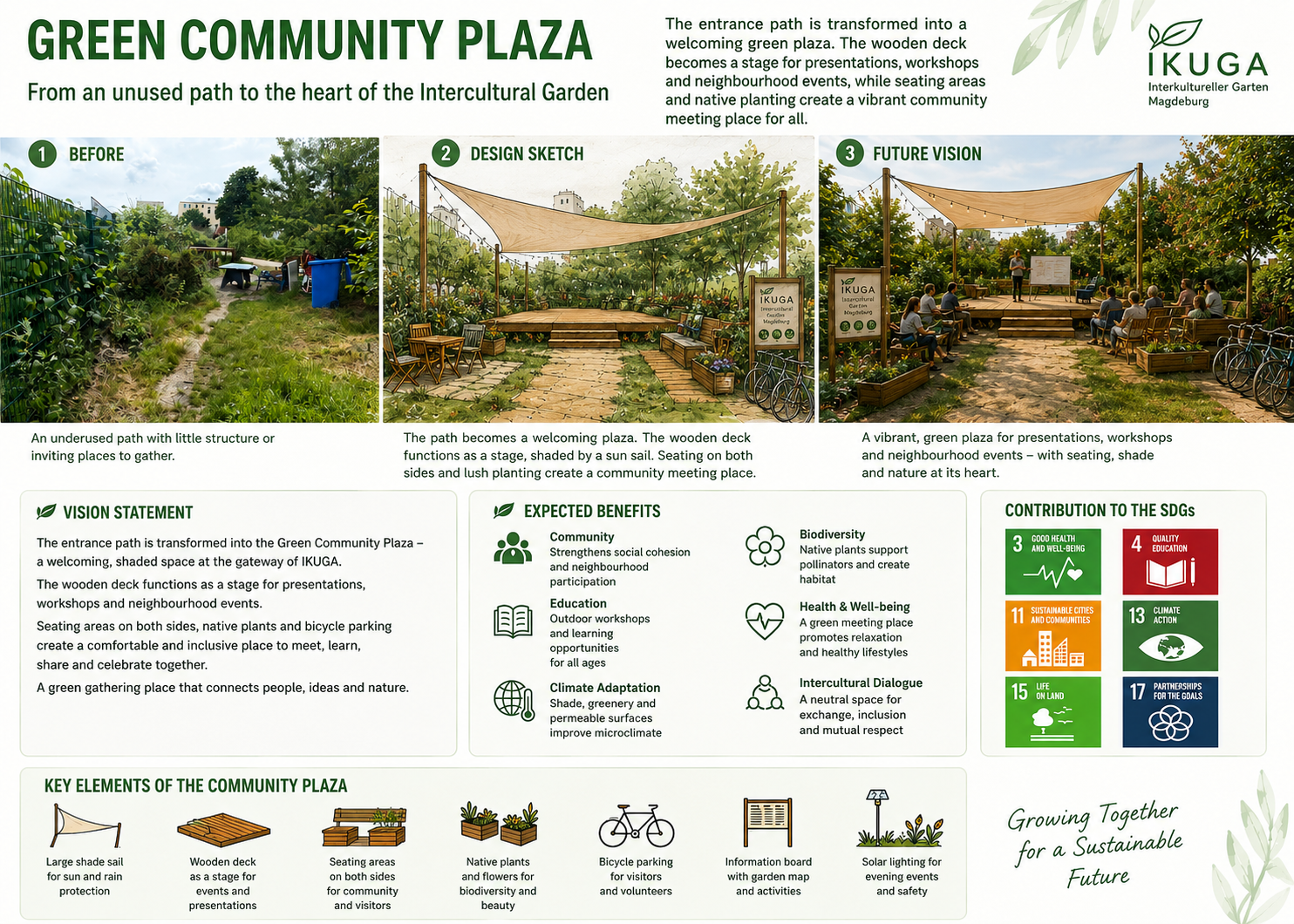
E. Green Community Plaza as a Flexible Outdoor Classroom
The Green Community Plaza can make the educational offer more visible and comfortable by providing a shaded, durable and adaptable place for learning, discussion and small events directly beside the garden.
- A low-maintenance metal-based canopy or pergola can provide shade while remaining simple to inspect, repair and adapt. Under the canopy, a shared table and flexible seating can support workshops, intercultural cooking, reflection rounds, homework support, seed exchanges and meetings between learners and neighbours.
- Demonstration elements can make learning visible: planting containers, seasonal information boards, simple biodiversity observation points, rainwater and soil examples, and multilingual prompts that connect the physical garden with learning activities.
- Possible target groups: School classes, youth groups, neighbourhood residents, migrant communities, families, adult learners, educators and community facilitators.
- Frequency of use: Regular during the gardening season, with covered or sheltered use extending the learning calendar into the shoulder seasons.
5. KEY STAKEHOLDERS AND PARTNERSHIPS
The educational vision depends on a coordinated ecosystem of learners, educators, community members, cultural actors and public institutions rather than on a single educational provider. Cooperation should create clear value for participants and remain transparent, complementary and locally rooted.
- Learning and community partners
- The table combines documented current partners with stakeholder groups that are relevant to the future educational vision.
Supporting actors
Educational partners, community organisations, cultural actors and public institutions can contribute expertise, access, funding, spaces and networks that help the educational programme remain low-threshold and sustainable. #
Partnership principle: cooperation should remain transparent, complementary and focused on learning value for participants rather than on institutional visibility alone.
Target Group | Type | Needs & Interests | Educational Focus |
|---|---|---|---|
Schools and after-school programmes | Local | Curriculum links, practical learning, repeat visits | Project days, garden learning, climate and biodiversity |
Youth organisations | Local | Participation, practical skills, safe outdoor learning | Youth projects, peer learning, learner-led improvements |
Adult-learning providers | Local/Regional | Accessible sustainability learning, practical knowledge | Open workshops, facilitator learning, community education |
Families, neighbours and migrant communities | Local | Low-threshold learning, exchange, social connection | Intercultural cooking, garden days, peer learning |
Teachers and educators | Local/Regional | Methods, materials, real-world learning environments | Co-designed modules, observation tasks, teaching resources |
Cultural partners such as Moritzhof | Local/Regional | Creative engagement, intercultural dialogue | Events, storytelling, exhibitions, interdisciplinary learning |
City of Magdeburg and State of Saxony-Anhalt | Regional | BNE outcomes, local participation, sustainable development | Funding, enabling framework, networking, recognition |
Universities / training providers | Regional | Applied learning, research, student projects | Placements, evaluation, educational material development |
Environmental and civil-society organisations | Local/Regional | Ecological expertise, community outreach | Citizen science, biodiversity and resource learning |
European / BeCom partners | European | Transferable methods and peer learning | Replication, documentation, cross-border exchange |
Vocational training providers | Local/Regional | Practical sustainability skills, community learning and links between vocational and civic education | Project learning, short placements, workshop delivery, green skills |
Libraries / adult-learning providers | Local/Regional | Accessible lifelong learning, multilingual outreach and learning resources | Community education, materials and digital/media support |
Parents and family networks | Local | Safe, accessible learning and practical family activities | Family learning days, intercultural cooking and garden participation |
Additional partners
Potential partners include local environmental organisations, universities, vocational training providers, libraries, adult-education institutions, foundations and other community gardens interested in practical sustainability education.
Transfer principle
Methods developed at IKUGA should be documented in a form that can be adapted by other schools, community gardens, neighbourhood initiatives and training providers without requiring identical local conditions.
6. EXPECTED IMPACT #
Short-term impact (1-2 years)
In the first phase, the priority is to strengthen and document the educational activities that IKUGA is already developing. A coherent set of practical modules can be established for garden learning, climate and biodiversity, sustainable food and intercultural exchange, supported by regular cooperation with existing educational partners. The Green Community Plaza can serve as a demonstrator for learning in a shared public-facing space.
Medium-term impact (3-5 years)
Over the medium term, repeat learning cycles can create stronger continuity for schools, youth groups and community participants. Learners can increasingly take responsibility for small garden tasks, observations or events, while educators and volunteers build a shared pool of learning materials and facilitation experience.
Long-term impact (5-10 years)
Over a longer horizon, IKUGA can develop into a recognised neighbourhood learning hub for urban sustainability, intercultural learning and participation. Documented methods could be shared through local and European networks and adapted by other community gardens, schools and learning initiatives.
7. MONITORING AND KEY PERFORMANCE INDICATORS (KPIs) #
The educational dimension can be monitored with a small set of practical indicators that measure reach, continuity, learning quality, participation and transfer without creating a heavy administrative burden. The targets below are proposed planning targets for a future development period, not reported achievements.
Educational Dimension | KPI | Short-term Target (1-2 yrs) | Long-term Target (5-10 yrs) | Measurement Method |
|---|---|---|---|---|
Learning programme | Learning offers delivered | At least 12 documented formats per year | Stable annual programme with recurring learning cycles | Programme calendar and activity log |
Reach | Participants reached | Baseline established and annual participation tracked | Increasing and stable participation across age groups | Attendance records |
Continuity | Returning groups / repeat visits | At least 3 partner groups with repeat activity | Regular multi-session partnerships | Partner records |
Partnerships | Active educational partners | Existing partnerships maintained and documented | 10+ active educational/community partners | Partner registry |
Learning quality | Participant-reported learning gain | Simple pre/post or end-of-session reflection piloted | Consistent learning evidence across core formats | Short surveys / interviews |
Participation | Learner-led activities or decisions | First learner-led garden activities documented | Regular learner involvement in programme design | Activity records / reflection |
Skills | Volunteer facilitators supported | Introductory facilitation and safeguarding guidance available | Small stable pool of trained facilitators | Training records |
Accessibility | Formats adapted for different ages/languages | Accessibility checklist used for core formats | Inclusive adaptations routine where needed | Format review checklist |
Educational resources | Modules / activity sheets documented | Core set of 6-8 reusable resources | Expanded library with transfer examples | Resource register |
Practical outcomes | Learner-created improvements or outputs | At least 3 documented outputs | Recurring learner-led improvements integrated into the garden | Photo/documentation log |
Transferability | Other organisations using IKUGA methods | Model documented as a case study | Methods adapted by 2+ other sites or partner organisations | Partner feedback / website records |
Outdoor learning | Use of Green Community Plaza / outdoor classroom | Initial uses documented | Regular seasonal use integrated in programme | Programme calendar / activity log |
Facilitator capacity | Facilitators receiving guidance or training | Initial guidance available | Stable pool of trained facilitators | Training records |
Reporting rhythm
- Annual review meeting: coordinators and key educational partners assess participation, learning activities, feedback and partnership development against the agreed targets.
- Seasonal check-ins: review workshop delivery, school visits, outdoor-learning use and participant feedback at the end of each main gardening season.
- Learning documentation: retain short activity records, photos where permitted, examples of learner work and facilitator reflections to support continuous improvement and transfer.
8. SUSTAINABILITY AND RESILIENCE #
Educational resilience at IKUGA should come from a balanced combination of recurring partnerships, flexible learning formats, reliable coordination and diversified support. The model should not depend on one school, one funder or one individual facilitator.
The garden itself provides a durable learning resource, while modular activities can be adapted to weather, age group, season and available capacity. The Green Community Plaza and other covered options can help maintain continuity when outdoor conditions are unsuitable.
Resilience is also supported by cooperation with educational, cultural, municipal and civil-society partners. Shared delivery reduces dependence on a single organisation and allows specialist knowledge to be brought in when needed.
Finally, resilience depends on people. Training volunteer facilitators, recognising contributions and creating clear roles for coordinators and partner educators can help retain knowledge and make the learning offer more stable over time.
9. CONNECTION WITH OTHER HELICES #
The Educational vision for IKUGA works as part of the wider Quintuple Helix. Learning is not a separate activity: it connects ecological practice, social exchange, governance and local economic opportunities and turns knowledge into practical neighbourhood action.
Education <-> Environment
Learning activities make urban ecology tangible: participants can observe biodiversity, practise resource conservation and experience how gardening affects soil, water, heat and habitat quality.
Education <-> Society
The garden creates a shared setting where people with and without migrant backgrounds, different generations and different social milieus can meet, exchange knowledge and learn together.
Education <-> Politics / Governance
By involving learners in observation, discussion and practical decision-making, educational activities can strengthen participation and help people understand how local spaces are planned, maintained and governed.
Education <-> Economy
Practical learning develops gardening, organisational, communication and project skills. Future education formats can also connect participants with local employers, vocational training providers and social-economy initiatives.
Education <-> Integrated NEB transformation
The educational function links knowledge with action and supports the NEB objective of using education, arts and culture to strengthen creativity, innovation, participation and local transformation.
10. ONE KEY MESSAGE #
“IKUGA turns the community garden into a living classroom – where people learn by growing, sharing, experimenting and caring for their neighbourhood, building knowledge, skills and confidence together for a sustainable future.”
11. VISUAL OR SYMBOLIC ELEMENT #
Symbol
As a symbolic sketch, the learning space can be represented as a growing tree rooted in a garden bed. Around it, icons can show a book (knowledge), a seedling (practice), speech bubbles (intercultural exchange), a group of people (community learning), a compass (participation and orientation) and a sun/shade symbol (climate awareness). The Green Community Plaza can be drawn as the shared space where these learning streams meet.
“Learning together, growing together.” #
Source basis: with support of AI (LLM)
Main project source: https://ikuga.de/en – project description, intercultural exchange and urban ecology. Educational source: https://ikuga.de/en/nachhaltigkeitsbildung – Education for Sustainable Development, cooperation with educational institutions, workshops, project days and practical learning formats; current page accessed September 2026.
NEB sources: https://new-european-bauhaus.europa.eu/about/about-initiative_en – NEB values and transformation approach; https://new-european-bauhaus.europa.eu/system/files/2023-01/NEB_Compass_V_4.pdf – participatory process, multi-level engagement and transdisciplinary approach; https://new-european-bauhaus.europa.eu/tools-and-resources/neb-academy_en – knowledge, skills and capacity building; https://new-european-bauhaus.europa.eu/inspiring-projects-and-ideas/neb-lab-transformation-places-learning_en – transformation of places of learning.
Disclaimer / Copyright Notice: Parts of this material were created and structured with the support of AI research tools. The content was created to support analysis, training and project reporting and was adapted and reviewed by the project team. External web sources were consulted for the current project and educational context and are listed above. All trademarks, organisation names and product names mentioned are acknowledged and remain the property of their respective owners.
Disclaimer / Copyright Notice
Parts of this material were created and structured with the support of AI research tools. The content was created to support analysis, training and project reporting and was adapted and reviewed for the BeCom project purpose. Research was conducted using publicly available materials from the project website and European institutional sources.
All trademarks, organisation names and product names mentioned are acknowledged and remain the property of their respective owners. The linked learning materials remain subject to the terms and copyright notices of their respective publishers.
FA Magdeburg, Germany | BeCom Project Team, September 2026