
- 1. SECTOR NAME
- 2. SECTOR VISION STATEMENT
- 3. CURRENT CHALLENGES AND NEEDS
- 4. PROPOSED FUNCTIONS OF THE RESTORED BUILDING
- 5. KEY STAKEHOLDERS AND PARTNERSHIPS
- 6. EXPECTED IMPACT
- Short-Term Impact (1-2 years):
- In the initial phase, the focus is on visibility and establishing the building’s role as a new meeting place.
- Social revitalisation: The building is perceived as an ‘open-door space’; initial social contacts between outdoor tourists and residents arise through the shared basic functions (bicycle repair shop, café, meeting place).
- Economic boost: The hall acts as a tourist attraction, revitalising local accommodation and catering, and strengthening the local value chain in the short term through small events (workshops, craft markets).
- Building identity: The industrial past is valued through the new use; the vacant space is anchored in the public consciousness as a positive ‘place of possibilities’ through cultural initiatives (small festivals, concerts).
- Initial circular economy successes: The ‘repair culture’ (bicycles, outdoor equipment) is established; residents begin to use the hall as a resource for their own craft work and further training.
- Long-Term Impact (5-10 years):
- 7. SUSTAINABILITY AND RESILIENCE
- 8. CONNECTION WITH OTHER HELICES
- Media & Culture → Economy
- Media & Culture → Education
- Learning through ‘lived experience’: Cultural activities (workshops on papermaking, climbing courses) serve as an informal education system that teaches technical skills related to the circular economy (recycling, energy efficiency) in an accessible way.
- Skill-sharing: The Helix’s media expertise helps to document knowledge about architectural history and ecological processes in such a way that it serves as teaching material for schools or research institutions.
- Media & Culture → Environment
- Media & Culture → Politics/Governance
- 9. ONE KEY MESSAGE
- 10. VISUAL OR SYMBOLIC ELEMENT
 Doc Summary

Vision for a Building Restoration and Community Use in Vall del Carme
1. SECTOR NAME #
Society: Media-and culture-based public subsystem
2. SECTOR VISION STATEMENT #
CARME–former Papermill Building is being transformed into a circular community hub for mobility, culture and regional economic development along the network of trails and outdoor activities.
The space is conceived not merely as a building, but as a social hub: an easily accessible base camp for cycling, hiking, climbing and bouldering trips, combined with communal facilities for residents and visitors.
This fits in well with the NEB principles, as it brings together sustainability, beauty and participation, rather than simply creating a purely functional space.
3. CURRENT CHALLENGES AND NEEDS #
Social and medial challenges in Vall del Carme: #
Needs
Social anchoring function: To retain young people, spaces are needed that go beyond simply ‘providing services for cyclists’, such as genuine co-working spaces with a robust infrastructure or studios where traditional skills (paper-making, craftsmanship, woodworking) are combined with modern digital business models.
Bridging generations: There is a great need for mentoring structures. The older generation possesses knowledge of local traditions (Viennese architecture, craftsmanship), whilst young people can contribute digital marketing and sustainable business models.
Infrastructural resilience: As a site situated directly by the river and the road, the building requires robust yet environmentally friendly connections (flood protection, self-sufficient energy supply, connection to the cycle path as a lifeline).
Community-building: The project must start with a ‘low-threshold’ approach. It needs a permanent space for local young people to avoid the feeling that the place is being optimised solely for ‘outsider tourists’
Challenges
The ‘transit trap’: There is a significant risk that the building will function merely as a hotel or ‘stopover’ for cyclists, without really supporting the local economy and social fabric. The town must actively prevent itself from becoming an ‘empty shell’ once the season is over.
Demographic imbalance: If the younger generation is absent, so too is the ‘critical mass’ needed for day-to-day operations. The challenge is to offer a model of work and life that is attractive enough for young people to stay there or move there (‘digital nomads’ combined with local production).
Heritage vs. transformation: Passing on ‘traditional knowledge’ is often difficult because the old structures (businesses, workshops) are no longer fit for purpose. The challenge lies in translating this knowledge into modern, circular products as an intangible asset, rather than simply clinging to the old form.
Legal & Physical Isolation: The location by the river/road outside the town requires close coordination with the local council to actively shape and secure the route between the factory and the village, so that the hall does not remain isolated as an ‘island’.
How the building’s current state reflects these challenges: #
To turn these challenges into opportunities for success, the concept of the ‘Transfer Academy’ should take centre stage: the hall becomes a place where traditional knowledge and youthful innovative energy come together in person. If young people not only work there but also play an active role in preserving their local identity and shaping the tourism infrastructure, a sense of belonging is fostered that actively helps to stem the exodus.
4. PROPOSED FUNCTIONS OF THE RESTORED BUILDING #
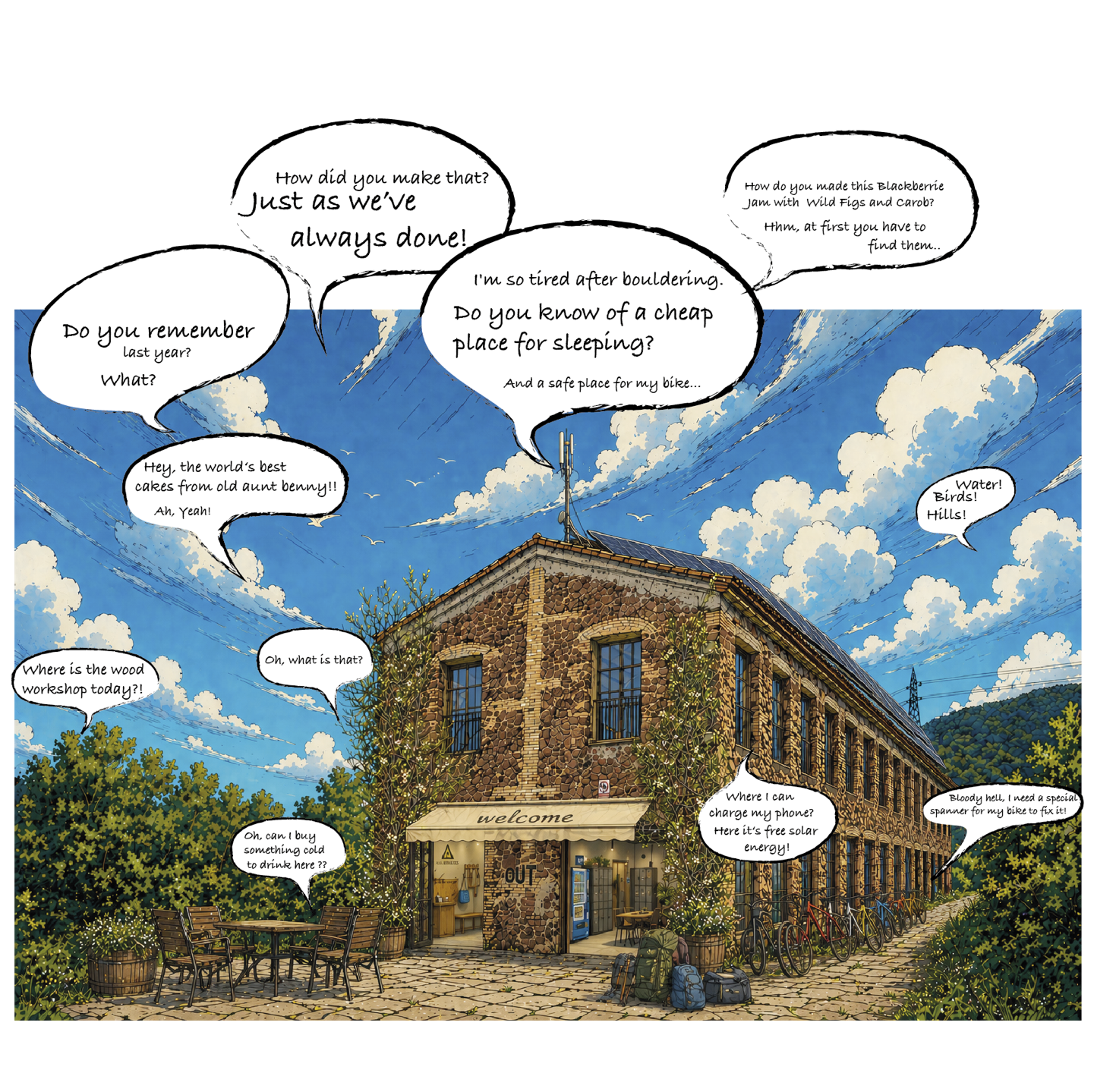
From the media and cultural perspective, the building operates as a Hub with five interconnected dimensions: #
In line with the principles of the circular economy, the building itself should serve as a learning and demonstration space. This means: visible material cycles, making repairs visible, using reused components, strengthening local supply chains, and creating programmes that empower people to use things for longer.
The hall will be divided into clearly defined zones:
Mobility and service zone: #
e.g. bicycle repair workshop, tools, washing area, charging points, luggage storage.
Basic accommodation: #
simple sleeping areas, showers, secure lockers, drying rooms.
Community zone: #
e.g. meeting point, information desk, small kitchen, provision of basic necessities.
Production and learning zone: #
e.g. workshops on paper-making, repairs, upcycling, local craft techniques, woodworking.
Event and multi-purpose zone: #
space for small festivals, music, talks, climbing and hiking community events.
Use as a circular space
This mix makes the space resilient, as it functions effectively in everyday life and can scale up for events.
Target groups
Regional, craftspeople & creatives
Local residents, Local charitable organisations and initiatives
Culture enthusiasts
Sport enthusiast
Cultural NGOs and arts councils
Spanish and European Outdoor networks
- Frequency of use
Seasonal or everyday for accommodation
Weekly events (like a day of knitting/cooking/wood making)
Monthly exhibitions or events (lectures/ workshops)
Seasonal festivals
5. KEY STAKEHOLDERS AND PARTNERSHIPS #
Target Group | Type | Needs & Interests | Project Focus |
|---|---|---|---|
Outdoor Enthusiasts | Transient | Climbers, boulderers, hikers, cyclists | Accommodation, gear maintenance, route info, charging |
Local Residents | Local | Social interaction, culture, participation | Meeting point, local craft, education, social integration |
Creatives & Craftspeople | Local/Hybrid | Workshop space, prototyping, exchange | Co-working, paper-making, upcycling, skill-sharing |
Culture enthusiasts | Regional | Festivals, music, culinary arts, workshops | Event hosting, regional tradition, community building |
Educational institutions | Local | Field trips, sustainability education | Teaching circular economy & industrial heritage |
Please add which specific schools/institution can help disseminate the vision
Media Partners:
Regional press and online platforms
Educational Institutions
Schools contributing to workshop projects
Universities integrating cultural activities into curricula
Civil Society
e.g. el risell as regional NGO anchor
Local sports clubs
Networks of amateur sports enthusiasts national/international
Local associations and informal cultural groups
Diaspora ambassadors promoting ACTIVA abroad
Please add more information
6. EXPECTED IMPACT #
Short-Term Impact (1-2 years): #
Immediate benefits after restoration:
In the initial phase, the focus is on visibility and establishing the building’s role as a new meeting place. #
Social revitalisation: The building is perceived as an ‘open-door space’; initial social contacts between outdoor tourists and residents arise through the shared basic functions (bicycle repair shop, café, meeting place). #
Economic boost: The hall acts as a tourist attraction, revitalising local accommodation and catering, and strengthening the local value chain in the short term through small events (workshops, craft markets). #
Building identity: The industrial past is valued through the new use; the vacant space is anchored in the public consciousness as a positive ‘place of possibilities’ through cultural initiatives (small festivals, concerts). #
Initial circular economy successes: The ‘repair culture’ (bicycles, outdoor equipment) is established; residents begin to use the hall as a resource for their own craft work and further training. #
Long-Term Impact (5-10 years): #
In the long term, the site establishes itself as a structural element of sustainable regional development.
Social resilience: The hall has developed into a permanent ‘third place’ that fosters social cohesion among different age groups and interest groups and helps to mitigate rural depopulation by offering attractive opportunities and employment for creative professionals.
Circular Economy: The building serves as a model for the circular economy; through the exchange of knowledge, materials and skills, a local ecosystem has emerged that extends beyond the building (e.g. through regional collaborations in the fields of craftsmanship and sustainable tourism).
Cultural anchoring: The ‘paper tradition’ has once again become part of the regional identity in a contemporary form (as an art, research or product sector); the festivals have grown to become fixed fixtures in the events calendar.
Role model: The project serves as a regional benchmark for ‘low-tech industrial conversion’ based on NEB principles and attracts knowledge transfer, research and environmentally conscious investment to the Vall del Carme region.
The structure follows the logic that short-term activation leads to long-term transformation, whereby the hall is no longer merely a building but an active part of the region’s social infrastructure.
Please add more information
7. SUSTAINABILITY AND RESILIENCE #
The appeal of the location stems from the mix of different groups.
Transient users (athletes) bring footfall, tourism revenue and an international vibe to the building.
Residents ensure a sense of community, authenticity and long-term operation beyond the tourist season.
Creatives and craftspeople act as a bridge group: they use the hall as a workshop (crafts) whilst also offering activities for athletes and residents (culture/education).
This structure aligns with the NEB principles, as it combines inclusion (involvement of residents) with sustainability (reuse of the hall) and aesthetics (industrial culture as an experiential space). The aim is a ‘third place’ that is neither purely a home nor purely a workplace, but forms the social hub for both worlds.
Please add other funding opportunities?
8. CONNECTION WITH OTHER HELICES #
Media & Culture → Economy #
Narratives as value creation: Culture and media create a ‘story’ around the project, placing local products (e.g. handmade paper, local food) within a broader context and thereby increasing their value for tourists and locals alike.
Circular economy as a brand: The Media Helix communicates the building’s sustainability performance (e.g. energy, upcycling) not in a dry manner, but as part of a lifestyle worth living, which makes economic collaborations (local craft businesses) attractive.
Media & Culture → Education #
Learning through ‘lived experience’: Cultural activities (workshops on papermaking, climbing courses) serve as an informal education system that teaches technical skills related to the circular economy (recycling, energy efficiency) in an accessible way. #
Skill-sharing: The Helix’s media expertise helps to document knowledge about architectural history and ecological processes in such a way that it serves as teaching material for schools or research institutions. #
Media & Culture → Environment #
Aesthetics as awareness: The Media & Culture Helix translates the protection of nature into aesthetic experiences (e.g. nature photography, climbing festivals), thereby increasing visitors’ appreciation for the surrounding ecosystem of the Vall del Carme.
Awareness-raising: Through ‘systemic narratives’, the hall becomes a place that demonstrates how human activity is embedded within the natural environment – the transition from pure consumption to regenerative use.
Media & Culture → Politics/Governance #
Democratic participation: Here, the media act as an interface between the planning level (local authority, region) and civil society.
Project as a ‘lighthouse’: Through extensive media coverage, the project becomes a tangible showcase for local politicians of EU-funded NEB principles, which facilitates access to further funding and structural support.
Please add other connections.
9. ONE KEY MESSAGE #
“The former paper mill building is becoming a regenerative community hub – a place where regional identity, circular craftsmanship and international outdoor culture come together to shape the sustainable future of Vall del Carme.”
This message links the three cornerstones of your concept: the historic site, the social benefits (community/residents) and the ecological focus (circular economy/NEB principles).
10. VISUAL OR SYMBOLIC ELEMENT #
Symbol: #
Disclaimer / Copyright Notice for ALL #
© Parts of this material were created and structured with the support of Artificial Intelligence (LLM) (Perplexity, ChatGPT-5); other parts were searched and created using CoPilot. The content was created to support analysis and reporting and was adapted and reviewed by the project team. Research was conducted using Bing and/or Google searches.
All trademarks and product names mentioned are acknowledged and remain the property of their respective owners.