- 1. SECTOR NAME
- 2. SECTOR VISION STATEMENT
- 3. CURRENT CHALLENGES AND NEEDS
- 4. PROPOSED FUNCTIONS OF THE RESTORED BUILDING
- 5. KEY STAKEHOLDERS AND PARTNERSHIPS
- Local Residents and Community Members
- Local Businesses, Craftspeople and Circular Economy Actors
- Nature Guides, Outdoor Communities and Territorial Knowledge Holders
- Schools, Training Providers and Educational Institutions
- Museums, Cultural and Heritage Institutions
- Municipalities and Public Institutions
- Universities, Research Institutions and NGOs
- 6. EXPECTED IMPACT
- 7. SUSTAINABILITY AND RESILIENCE
- 8. CONNECTION WITH OTHER HELICES
- 9. ONE KEY MESSAGE
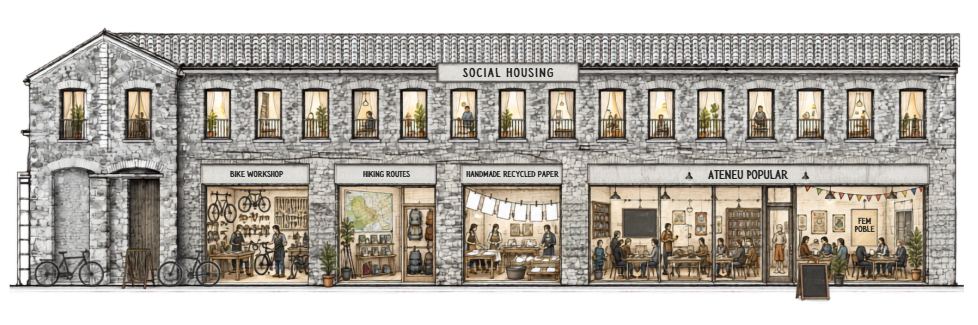
- 10. VISUAL OR SYMBOLIC ELEMENT
 Doc Summary

Vision for the Restoration and Community Use of Can d’en Pont in Vall de Carme
1. SECTOR NAME #
Natural environment
2. SECTOR VISION STATEMENT #
Our vision for Can d’en Pont is that the restored former paper mill becomes a reference point for reconnecting Vall de Carme with its natural systems, industrial memory, and future regenerative economy. Located in Orpí, within a valley shaped by the Orpinell and Collbàs mountain ranges, the building can act as a gateway to the river landscape, forests, terraces, vegetable gardens, dryland environments, and active mobility routes that define the territory.
Can d’en Pont is imagined as a place where the valley’s ecological richness is made visible, understood, and cared for. Through interpretation resources, landscape mapping, citizen observation, and community-led activities, the building will help residents and visitors understand the coexistence of riverside, Mediterranean, and dryland habitats, as well as the birdlife and biodiversity associated with this microclimate. Environmental learning will be linked to everyday experience through seasonal walks, bird observation, river and forest interpretation days, workshops, and school activities.
The restored building will also function as a starting point for healthy, low-impact, nature-based routes. Cycling, hiking, climbing, bouldering, and walking activities will be connected to the building through route information, bike services, repair facilities, charging points, washing and drying areas, and coordination with local guides. This role should not turn Can d’en Pont into a simple stopover for visitors; instead, it should use outdoor activity as an entry point into deeper local engagement, longer stays, local spending, and participation in the life of the valley.
Special emphasis will be placed on the former paper mill identity of the building. The environmental vision links the historical use of water, paper, textile reuse, and local materials with contemporary circular economy practices. Traditional rag paper, artistic paper production, repair culture, reuse of materials, and circular design can become practical ways to explain resource cycles and to connect industrial heritage with climate and ecological awareness.
Beyond the building itself, the vision includes the ecological enhancement of the immediate surroundings of Can d’en Pont and its connection with the village and the river landscape. Outdoor areas should be restored as spaces for learning, gathering, biodiversity, and low-impact mobility. The rehabilitation of the building can demonstrate bioclimatic renovation, energy self-sufficiency, solar production, water-saving systems, and flood-aware design, making Can d’en Pont a practical example of how heritage buildings can support ecological transition.
Ultimately, this vision benefits the whole valley by transforming Can d’en Pont into a shared space where nature, circularity, culture, mobility, housing, and community life intersect. By combining environmental education with active mobility, paper heritage, local work opportunities, and first-floor housing, the project can help attract and retain people who do not only visit Vall de Carme, but also live, work, learn, and participate in its long-term regeneration.
3. CURRENT CHALLENGES AND NEEDS #
Vall de Carme has significant environmental assets, including forests, terraces, gardens, the riera landscape, and a combination of climatic and vegetation conditions that make the valley especially valuable for biodiversity and birdlife. However, many of these values remain under-recognised or insufficiently connected to everyday community life, local education, and sustainable economic opportunities.
The valley also faces social and territorial challenges. It is a dispersed rural area with several settlements, where services and social life are concentrated mainly in Carme, while Orpí and Santa Maria de Miralles are more scattered. The ageing of the population, the difficulty of accessing some basic services, and the dependence on private vehicles create barriers to daily life and reduce the attractiveness of the valley for younger people and new residents.
Another key challenge is the need to generate a development model that goes beyond short-term tourism. Outdoor activities, cycling, climbing, and cultural visits can bring visitors to the area, but there is a risk that Can d’en Pont becomes only a transit point or a seasonal accommodation facility. The building needs to become a place that supports local residents, creates work and learning opportunities, strengthens local businesses, and helps make the valley attractive as a place to live.
The transformation of the former paper mill must also address heritage and environmental resilience. The building’s location near the river and the road requires careful planning: safe access, connection with routes and settlements, flood-aware design, low-impact mobility, and environmentally robust infrastructure. At the same time, the industrial heritage of paper production should not be treated only as a memory of the past; it can become a living resource for circular innovation, artistic production, and environmental education.
The project also needs to respond to the housing challenge. The planned housing on the first floor can support the objective of attracting residents, young people, creative professionals, researchers, or people connected to the activities of the hub. However, this housing dimension should be carefully linked to the public and community functions of the building, so that the balance between new and existing residents is positive and socially rooted.
How the building’s current state reflects these challenges #
Can d’en Pont is an isolated former paper mill located in the municipality of Orpí. Its elongated stone structure, brick-arched gallery windows, two-storey configuration, and relationship with the river landscape express both the industrial history and the environmental potential of the site. Because the building is separated from other constructions, it has the capacity to become a distinctive landmark, but it also requires strong physical, social, and programmatic connections with the rest of the valley.
The rehabilitation of Can d’en Pont offers an opportunity to respond directly to these needs. Through low-impact renovation, reuse of materials, energy-efficient systems, solar production, and careful treatment of the outdoor spaces, the building can become a visible example of circular and regenerative restoration. As a community and environmental hub, it can support education, route-based activities, services for active mobility, cultural heritage, housing, and local entrepreneurship while helping Vall de Carme move towards a more resilient relationship with its landscape.
4. PROPOSED FUNCTIONS OF THE RESTORED BUILDING #
From the perspective of the natural environment sector, the restored Can d’en Pont building is conceived as a multifunctional hub that connects people, landscape, water, heritage, circular economy, and sustainable local development. Its uses combine environmental education, nature-based activities, active mobility, cultural production, research, and community life throughout the year.
Nature Routes and Active Mobility Hub #
One of the core functions of Can d’en Pont will be to act as a starting point and service base for nature routes and active mobility. The building can support cycling, e-bike use, walking, hiking, climbing, and bouldering activities by offering information, equipment, repair and maintenance services, charging points, water and washing facilities, and coordination with local guides and clubs. This function should encourage healthy lifestyles and low-carbon mobility while generating local employment and strengthening links between visitors and the valley.
Actions:
Starting point for hiking, cycling, e-bike, climbing, bouldering, and nature discovery routes
Bike and e-bike rental, with special attention to the repair and electrification of older bicycles
Self-repair and maintenance workshop with tools, pumps, washing area, charging points, lockers, and drying space
Information point with maps, route panels, natural heritage interpretation, and safety recommendations
Coordination with local guides, cycling groups, climbing communities, and responsible tourism providers
Seasonal outdoor programs linked to cycling events, family routes, school outings, and nature observation days
Riera, Biodiversity and Landscape Interpretation #
Can d’en Pont should make the natural systems of Vall de Carme visible and understandable. Permanent and temporary interpretation spaces can explain the valley’s microclimate, the coexistence of riverside, Mediterranean, and dryland habitats, the importance of birdlife, and the role of forests, terraces, gardens, and water systems. The building can become a living classroom where residents, schools, researchers, and visitors learn to observe and care for the territory.
Actions:
Permanent exhibition on the riera, forests, terraces, dryland landscapes, gardens, and birdlife of Vall de Carme
Rotating seasonal displays on birds, water, fire prevention, edible landscapes, local agriculture, and climate adaptation
Citizen science activities such as bird counts, water observation, biodiversity mapping, and landscape photography
Outdoor learning areas for schools, families, and local associations
Guided walks connecting Can d’en Pont with river, forest, paper mill, and heritage routes
Environmental talks and community sessions on responsible use of the valley’s natural resources
Circular Paper, Water and Material Lab #
The former paper mill identity of Can d’en Pont offers a powerful opportunity to connect environmental education with circular economy. The building can host a practical laboratory focused on traditional paper-making, textile reuse, water cycles, upcycling, and artistic innovation. In this way, the site returns to its origins not as a museum only, but as a place where old knowledge is translated into contemporary ecological and creative practices.
Actions:
Workshops on traditional rag paper and the reuse of textile waste as a resource
Interpretation of the historical relationship between paper mills, water, the riera, and the aquifer system
Collaboration with paper heritage institutions, especially the Museu Molí Paperer de Capellades
Residencies and events for artists working with handmade paper, natural fibres, reused materials, and ecological design
Demonstrations on repair, upcycling, low-tech production, and circular material flows
Creation of small local products or prototypes linking paper heritage, landscape identity, and contemporary craft
Energy Sovereignty and Regenerative Building Demonstrator #
Can d’en Pont can function as a demonstrator of how heritage buildings in rural areas can be renovated for climate resilience. The rehabilitation should make environmental performance visible: solar production, low-energy systems, passive comfort, water saving, reused materials, ecological landscaping, and flood-aware design. These elements can reduce operating costs while serving as learning tools for residents, technicians, schools, and visitors.
Actions:
Solar energy production and self-consumption strategy adapted to the building’s heritage character
Visible monitoring of energy use, water use, and environmental performance
Rainwater management, water-saving devices, and nature-based treatment of outdoor spaces
Flood-aware design and safe connection between the building, river, road, and active mobility routes
Use of reused, local, durable, and low-impact materials in the renovation and furniture
Training activities on bioclimatic renovation, repair culture, and circular construction
Living, Coworking and Community Stewardship Spaces #
To avoid becoming only a seasonal tourist facility, Can d’en Pont should combine visitor services with permanent local use. The first-floor housing can help attract people linked to the project, while flexible spaces on the ground floor can host coworking, workshops, meetings, local service days, community meals, and stewardship activities. This mix supports everyday life, intergenerational exchange, and long-term governance of the building.
Actions:
Housing on the first floor linked to the objective of attracting and retaining residents and active project users
Coworking and study areas for local entrepreneurs, researchers, students, creative professionals, and digital workers
Community meeting point for residents of Carme, Orpí, Santa Maria de Miralles, and the wider valley
Multipurpose spaces for workshops, talks, local food activities, training sessions, and small events
Shared governance structure involving municipal actors, local entities, residents, and activity providers
Programs that balance the needs of local residents, newcomers, second-home users, and visitors
Target Groups #
Primary: Residents of Vall de Carme, including Carme, Orpí and Santa Maria de Miralles; children and youth; young adults aged 16–30; families; older residents; local craftspeople; paper, wood, food, and repair practitioners; farmers; forest owners and workers; local guides; and people interested in living and working in the valley.
Secondary: Cyclists, e-bike users, hikers, climbers, boulderers, nature tourists, artists, researchers, students, local entrepreneurs, cultural organisations, environmental NGOs, public authorities, universities, and responsible tourism networks.
Frequency of Use #
- Daily: Housing use, information point, coworking, self-repair workshop, exhibitions, route support, and informal community use
- Weekly: Guided routes, repair sessions, environmental workshops, citizen science activities, paper and craft workshops, local service days, and community meetings
- Monthly: Talks, exhibitions, creative residencies, small markets, thematic route days, and public sessions linked to the valley’s strategic plan
- Seasonal: Cycling events, summer and winter outdoor programs, bird and biodiversity monitoring, festivals, research stays, artistic residencies, and tourism programs
5. KEY STAKEHOLDERS AND PARTNERSHIPS #
Local Residents and Community Members #
Residents of Carme, Orpí, Santa Maria de Miralles, and the wider Vall de Carme as key knowledge holders of the territory
Older residents contributing memory of the paper mills, local landscapes, water systems, agriculture, food, and traditional practices
Young people and families participating in environmental education, outdoor activities, repair culture, and local entrepreneurship
New residents, second-home users, and potential inhabitants contributing to year-round use and long-term community life
Local Businesses, Craftspeople and Circular Economy Actors #
Paper-related craftspeople, artists, and makers working with handmade paper, fibres, textile reuse, and ecological materials
Bicycle repairers, outdoor service providers, guides, accommodation operators, local food producers, and small businesses
Woodworkers, builders, and artisans contributing to repair, upcycling, furniture, and low-impact renovation
Emerging cooperatives or social enterprises using the building as a workspace, meeting point, or production laboratory
Nature Guides, Outdoor Communities and Territorial Knowledge Holders #
Local guides specialised in hiking, cycling, e-bike routes, climbing, bouldering, bird observation, and landscape interpretation
Sports clubs and informal outdoor networks that can activate the building through regular activities and events
Farmers, forest owners, and people with knowledge of fire prevention, forest management, water, and rural land stewardship
Participants in citizen science and environmental monitoring programs
Schools, Training Providers and Educational Institutions #
Local primary education actors, including Escola Serra de Coll-Bàs in Carme and schools serving Orpí and Santa Maria de Miralles
Secondary schools and vocational training centres in Igualada and Anoia that can connect students to sustainability, heritage, mobility, and rural innovation
Art, design, architecture, environmental sciences, and vocational training programs that can use Can d’en Pont for fieldwork and applied projects
Educational partners developing teaching materials on paper heritage, water, biodiversity, circular economy, and active mobility
Museums, Cultural and Heritage Institutions #
Museu Molí Paperer de Capellades as a key reference for handmade paper, paper mill heritage, and educational programming
Local and regional heritage associations working on paper mills, medieval routes, rural memory, industrial heritage, and landscape identity
Artists, cultural NGOs, and creative networks using the building for residencies, exhibitions, and circular material experimentation
Municipalities and Public Institutions #
Municipalities of Carme, Orpí, and Santa Maria de Miralles as promoters of the territorial vision for Vall de la Riera de Carme
Consell Comarcal de l’Anoia and Diputació de Barcelona as potential partners for strategic planning, tourism, environment, youth, and local development
Generalitat de Catalunya departments or agencies related to rural development, environment, culture, housing, mobility, and energy transition
Public programs supporting climate adaptation, heritage regeneration, active mobility, circular economy, and rural revitalisation
Universities, Research Institutions and NGOs #
Universities and research groups in Catalonia working on architecture, heritage restoration, rural development, biodiversity, water, forestry, and circular economy
Environmental NGOs and social innovation organisations, including el Risell as a regional anchor for participatory and community-based processes
Outdoor, cycling, climbing, and slow tourism networks at regional, national, and European scale
Diaspora and ambassador networks able to communicate the project beyond the valley while remaining linked to local governance
6. EXPECTED IMPACT #
Short-Term Impact (1–2 years) #
In the first years after restoration, Can d’en Pont will generate immediate and visible benefits by transforming an isolated former paper mill into an active public reference point. The opening of route information, repair services, exhibitions, workshops, and community spaces will help residents and visitors rediscover the valley as a living environmental and cultural landscape.
The building will quickly become a base for nature-based activities and low-impact mobility. Cycling, hiking, climbing, and walking programs will increase the use of the territory in a structured and responsible way, while also supporting local guides, small businesses, and service providers. The presence of repair and circular economy activities will introduce practical habits of reuse, maintenance, and resource awareness.
In the short term, Can d’en Pont will also strengthen local identity. The paper mill history, the riera, birdlife, forests, and rural landscapes will become visible through exhibitions, workshops, and storytelling. School visits, citizen science activities, and collaborations with cultural and environmental partners will activate the building as a place for learning and shared pride.
Indicators:
- Number of visitors to Can d’en Pont per year
→ 1,500–2,500 visitors/year, including local residents, schools, outdoor users, artists, and first responsible tourists
- Number of nature-based and circular economy activities organised per year
→ 35–50 activities/year, including guided routes, repair sessions, exhibitions, paper workshops, biodiversity activities, and talks
- Number of local actors actively involved
→ 20–35 local actors, including residents, guides, craftspeople, teachers, NGOs, businesses, and municipal staff
- Number of school, training, and university activities hosted
→ 10–20 activities/year, including field trips, workshops, applied projects, and student visits
- Number of active mobility service uses
→ 300–600 uses/year, including bike repair, charging, rental, route information, and washing/drying services
- Surface restored or activated with sustainable solutions
→ 200–500 m² of building and immediate outdoor areas, depending on the final rehabilitation program
Long-Term Impact (5–10 years) #
Over the long term, Can d’en Pont is expected to become a structural element of Vall de Carme’s ecological and social regeneration. The building will consolidate its role as a permanent hub for environmental education, circular production, active mobility, community life, and rural innovation. This will help shift the valley from a model based mainly on visitors and dispersed services towards a model based on year-round activity, local knowledge, and regenerative use of resources.
The continuous use of the building as a place for housing, coworking, workshops, route services, research, and cultural production will contribute to local economic diversification. New activities linked to active mobility, handmade paper, circular design, environmental interpretation, local food, repair culture, and responsible tourism can generate stable income and make the valley more attractive for young people, creative professionals, and people seeking to live and work in rural environments.
In the long term, the integration of environmental monitoring, river and landscape interpretation, ecological outdoor spaces, and community stewardship will support a stronger culture of care for the territory. Partnerships with schools, museums, universities, NGOs, municipalities, and local businesses will ensure continuity, helping Can d’en Pont become a regional reference for the circular reuse of industrial heritage in a rural valley.
Indicators:
- Number of stable jobs or income-generating activities supported
→ 8–15 sustained jobs or regular income sources linked to guiding, repair services, workshops, accommodation, cultural production, local food, and hub management
- Number of people hosted or attracted through housing, coworking, or residencies
→ 6–12 regular residents, residents-in-project, or long-stay users per year, depending on the housing and management model
- Number of long-term partnerships established
→ 10–18 formal partnerships with municipalities, schools, museums, NGOs, universities, public authorities, outdoor networks, and local businesses
- Area of land monitored, interpreted, or improved through programs
→ 20–60 hectares of river, forest, route, terrace, or immediate landscape areas involved in monitoring, stewardship, interpretation, or restoration
- Annual number of participants in responsible tourism, learning, and circular economy activities
→ 3,000–5,000 participants/year across routes, workshops, exhibitions, festivals, educational programs, and residencies
- Adoption of alternative and low-impact practices
→ 30–50 households, entities, or regular users adopting or participating in active mobility, repair culture, solar energy awareness, reuse, paper upcycling, or local stewardship practices
7. SUSTAINABILITY AND RESILIENCE #
The vision for Can d’en Pont contributes to long-term sustainability by combining multiple uses, diverse income streams, community governance, and strong partnerships. The building should not depend on a single seasonal market. Its resilience will come from the combination of daily local use, housing, coworking, route services, repair activities, workshops, cultural programming, environmental education, and responsible tourism.
The maintenance of the building can be supported through a hybrid economic model. Income may come from housing or residency arrangements, coworking and room rental, bike and e-bike services, guided activities, workshops, repair services, small events, local product sales, and collaboration with tourism and cultural partners. At the same time, certain functions, such as basic exhibitions, environmental interpretation, community meetings, and school activities, should remain free or low-cost to preserve the public and inclusive character of the building.
Additional funding opportunities could include municipal and supramunicipal support, Diputació de Barcelona programs, Generalitat de Catalunya funds related to rural development, energy transition, housing, culture, and environment, and European funding linked to rural innovation, circular economy, heritage, climate adaptation, active mobility, and the New European Bauhaus. Private sponsorships, cooperative investment, crowdfunding for specific equipment, and partnerships with outdoor brands or cultural foundations could also support targeted elements such as the bike workshop, paper lab, solar installation, or biodiversity interpretation.
From an environmental perspective, Can d’en Pont should reduce long-term operating costs through solar energy, passive climate strategies, water-saving systems, robust maintenance, durable materials, reuse, and low-impact landscaping. Its location near the river and road makes resilience especially important: flood-aware design, safe access, active mobility connections, and careful outdoor planning should be central to the project.
From a social perspective, the building’s resilience depends on local ownership. A multidisciplinary management team should link municipal actors, local entities, residents, craftspeople, outdoor providers, and environmental partners. The first-floor housing, if well integrated, can help provide continuity beyond events and tourism seasons. The objective is to create a third place that is neither only a tourist facility nor only a workplace, but a shared social and ecological infrastructure for Vall de Carme.
8. CONNECTION WITH OTHER HELICES #
Natural Environment – Education #
The Natural Environment sector strengthens education by transforming the valley into a living classroom. Can d’en Pont can host field trips, citizen science, bird observation, water monitoring, paper-making workshops, active mobility learning, and circular economy demonstrations. These activities connect formal education with experiential, place-based learning and reinforce intergenerational knowledge transfer.
Natural Environment – Economy #
Environmental activities are directly connected to local economic diversification. Nature-based tourism, route services, bicycle repair and rental, paper workshops, artistic residencies, local products, and circular design can create income while promoting responsible use of resources. By linking heritage, environment, and entrepreneurship, Can d’en Pont can support livelihoods that are rooted in the valley rather than extractive or purely seasonal.
Natural Environment – Governance #
The Natural Environment sector supports governance by offering practical tools for territorial care, route management, water and biodiversity monitoring, and public participation. Data and knowledge generated through activities at Can d’en Pont can inform local strategies related to natural resources, energy transition, mobility, tourism, fire prevention, and rural regeneration. Collaboration with the municipalities of the valley is essential to ensure alignment with the broader strategic plan.
Natural Environment – Society and Civil Community #
By offering inclusive outdoor activities, accessible exhibitions, community workshops, and shared spaces, the Natural Environment sector strengthens social cohesion. Residents, visitors, new inhabitants, and second-home users can participate in caring for the landscape, learning from local knowledge, and building relationships across generations. This helps avoid the perception that the building serves only outsiders.
Natural Environment – Culture and Media #
Culture and media can translate environmental care into attractive narratives and experiences. The story of water, paper, forests, birds, and mobility can become a shared identity for the project. Exhibitions, photography, storytelling, festivals, and media communication can increase appreciation for the valley’s ecosystems and position Can d’en Pont as a visible example of circular heritage regeneration.
Natural Environment – Housing and Infrastructure #
The environmental vision is connected to housing and infrastructure because the building must support everyday life, not only visits. The first-floor housing, safe access, active mobility connections, energy self-sufficiency, flood-aware design, and shared services all contribute to making the valley more liveable. Can d’en Pont can become a pilot for how rural infrastructure can combine ecological transition, social use, and local residence.
9. ONE KEY MESSAGE #
Can d’en Pont reimagines a former paper mill as a living gateway to Vall de Carme, where water, forests, paper heritage, active mobility, circular economy, and community life come together to regenerate the landscape and strengthen long-term attachment to the valley.
10. VISUAL OR SYMBOLIC ELEMENT #
Disclaimer / Copyright Notice for ALL #
© Parts of this material were created and structured with the support of ChatGPT (OpenAl, GPT-5); other parts were searched and created using CoPilot. The content was created to support analysis and reporting and was adapted and reviewed by the project team. Research was conducted using Bing and/or Google searches.
All trademarks and product names mentioned are acknowledged and remain the property of their respective owners.