
 Doc Summary

GP1 Title: L’Horta Alliberada de Sants #
📍 Location: Barcelona, Spain
🔗 https://www.horta-alliberada.cat/
Source https://www.horta-alliberada.cat/
Introduction #
L’Horta Alliberada is a neighbourhood space in Sants that is open 24/7 and free for everyone to access. The plot is squatted and collectively self-managed by the local residents who take part in the project. Decisions concerning the work and maintenance of the space, as well as the organisation of activities, are made collectively at an assembly held every Tuesday at 8 p.m. on site.
The project was launched in 2016 by the Sants Neighbourhood Assembly with the aim of providing the area with a free, community-run green space. Sants is a neighbourhood that keeps its historical memory alive, as it was once closely connected to farmland and agricultural life.
Everything grown in L’Horta’s cultivation beds is shared between the Can Vies Food Network and those who take part in the collective work sessions. In 2023, due to the low yields caused by the drought, the group began a new phase of the project. This involves reducing the number of cultivation beds and planting more trees in order to turn the space into a climate refuge.
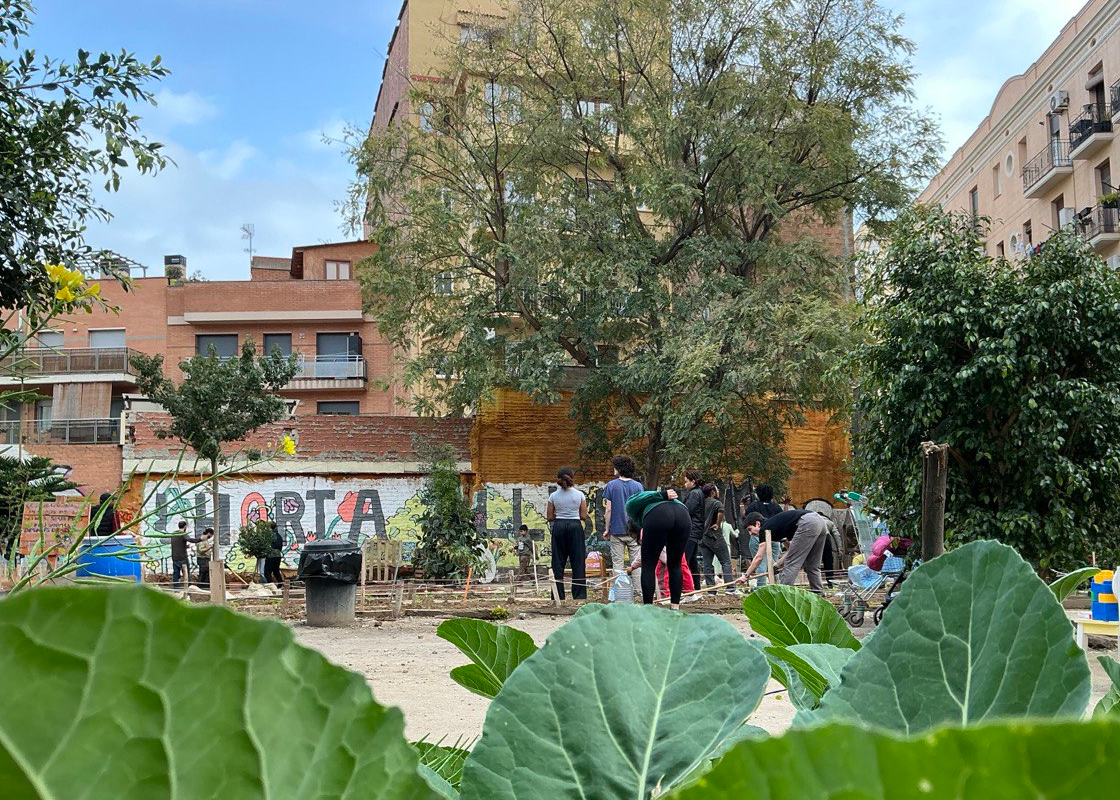
Source: Horta alliberada’s web
Context
L’Horta Alliberada de Sants is located in the Sants neighbourhood of Barcelona, on a plot owned by a bankrupt property company that had been abandoned for ten years. It covers more than 850 square metres of permeable ground, with trees, cultivation beds, aromatic and ornamental plants, as well as natural and artificial shaded areas.
More than 9,000 people live within a five-minute walk of L’Horta Alliberada, which serves as the main green space for many Sants residents living around the Sants Market and Rambla de Badal.
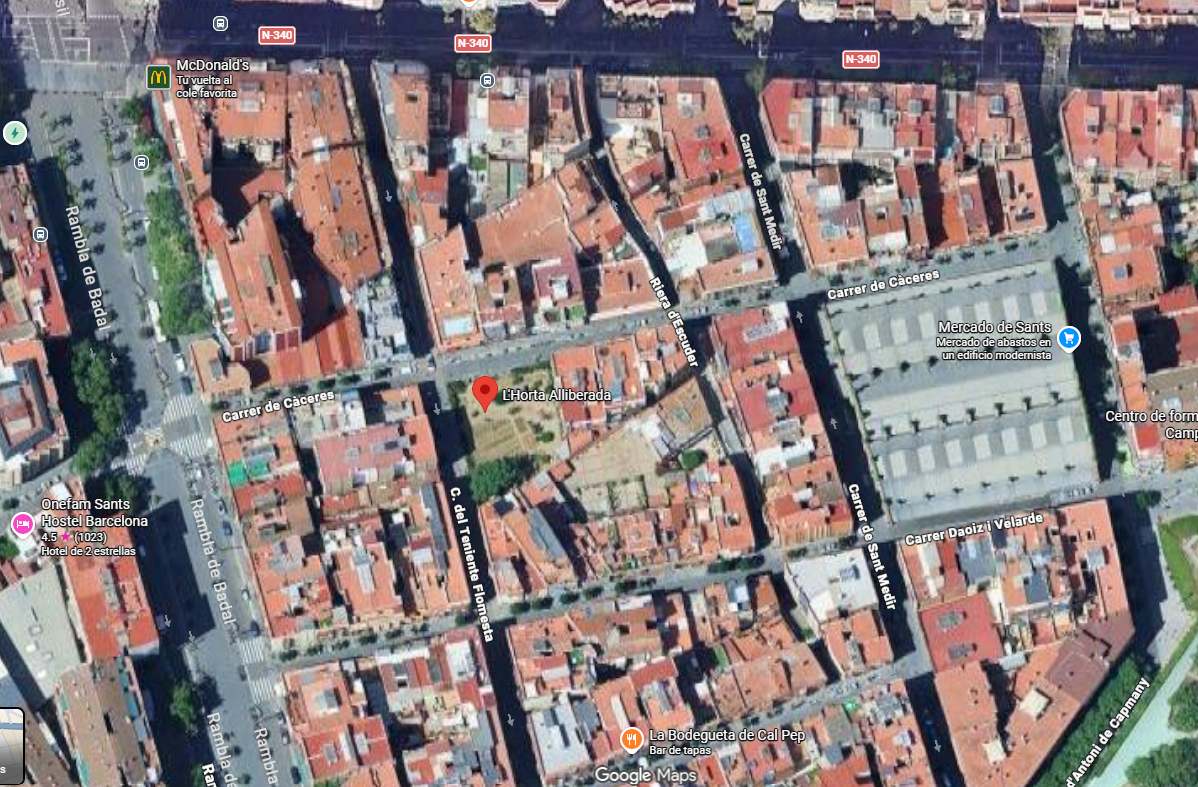 Source: Google maps
Learning Objectives
- Understand how a community garden can transform an abandoned urban space.
- Identify its environmental, social, economic and educational benefits.
- Explain the role of collective participation and community governance.
- Recognise the main steps needed to develop a similar initiative.
Session Plan
New European Bauhaus Principles in L’Horta Alliberada de Sants #
L’Horta Alliberada de Sants can be analysed through the framework of the New European Bauhaus (NEB). The NEB is based on three core values—Beautiful, Sustainable and Together—and three working principles: participatory process, multi-level engagement and a transdisciplinary approach. In this framework, beauty includes quality of experience and sense of belonging, sustainability includes climate adaptation and biodiversity, and together refers to accessibility, inclusion, solidarity and community building. (New European Bauhaus)
1. Beautiful: quality of experience and sense of place
L’Horta Alliberada transforms an abandoned urban plot into a green, welcoming and meaningful neighbourhood space. Trees, vegetable beds, aromatic and ornamental plants, shaded areas, tables and spaces for children improve the physical and sensory experience of the site. (Menu Of Good Governance)
The garden also contributes to mental and social well-being by offering residents a place to rest, meet other people, participate in activities and maintain contact with nature. Its value therefore goes beyond conventional visual aesthetics: its beauty comes from the relationships, experiences and sense of belonging produced within the space.
The project also reinforces local identity by reconnecting Sants with its agricultural history. It preserves the memory of the neighbourhood’s former relationship with farmland while giving this history a contemporary environmental and community function.
Level of alignment: Strong in relation to sense of place, well-being and collective experience. However, the available information provides limited evidence of a formal artistic, architectural or professional design process.
2. Sustainable: environmental regeneration and climate resilience
Sustainability is one of the project’s strongest NEB dimensions. L’Horta Alliberada has converted neglected land into approximately 850–885 square metres of permeable green space. The presence of soil, trees, shrubs and cultivated areas prevents further soil sealing and supports vegetation and urban biodiversity. (Menu Of Good Governance)
Its community agriculture model promotes pesticide-free cultivation, seasonal food production and short local food chains. Food is grown and distributed within the neighbourhood, reducing dependence on long-distance commercial systems and strengthening local food resilience.
The project has also responded directly to climate change. After drought reduced agricultural yields, the community decided to decrease the number of cultivation beds and plant more trees. This adaptation increases shade, reduces heat absorption and strengthens the garden’s function as a neighbourhood climate refuge.
These actions correspond closely to NEB sustainability objectives such as:
- Restoring and expanding nature.
- Supporting biodiversity.
- Adapting public spaces to climate change.
- Reducing environmental impacts.
- Developing more local and regenerative systems.
Level of alignment: Very strong, particularly in nature restoration, climate adaptation, permeable land, biodiversity and local food production.
3. Together: inclusion, accessibility and solidarity
L’Horta Alliberada strongly represents the NEB value of Together. The space is free, open to everyone and accessible without membership fees or previous gardening experience. This removes economic and administrative barriers and allows residents with different backgrounds and levels of knowledge to participate.
Community relationships are reinforced through gardening, maintenance work, workshops, meetings and informal leisure. The space functions not only as a garden but also as a neighbourhood meeting point where people can cooperate, exchange knowledge and develop a shared sense of responsibility.
Solidarity is also reflected in the distribution of the harvest. Produce is shared with participants in collective work sessions and with the Can Vies Food Network. The garden therefore connects environmental activity with mutual aid and neighbourhood food support.
The project emerged partly as a response to property speculation and the shortage of public space in Sants. It prioritises collective social and environmental value over the financial value of abandoned land. (BCN Sostenible)
Level of alignment: Very strong in affordability, open access, community building, cooperation and food solidarity.
✅ What the sector can learn: Community Garden
🌍 Environment #
L’Horta Alliberada has a positive environmental impact on Sants by transforming an abandoned urban plot into more than 850 square metres of permeable green space with trees, vegetable beds, and aromatic and ornamental plants. Its permeable soil, new trees, shrubs, and shaded areas help reduce heat absorption and local temperatures, making the garden a small climate refuge in a densely built neighbourhood. The project also supports ecological cultivation without chemical pesticides, encourages local food production, and helps preserve urban vegetation and biodiversity while preventing the site from being covered by further concrete and construction.
Green spaces in densely populated urban areas
Lesson: Transforming abandoned or underused plots into community-managed green spaces can provide essential environmental and social benefits where public green areas are scarce.
→ Adaptation: Prioritize the temporary or permanent conversion of vacant urban land into accessible, permeable, and community-managed green spaces.
→ Example Implementation: L’Horta Alliberada transformed an abandoned 850 m² plot in Sants into a public green space with trees, cultivated beds, aromatic plants, and shaded areas.
→ Practical Step: Identify vacant plots in densely populated neighbourhoods and assess their potential for community-led greening projects.
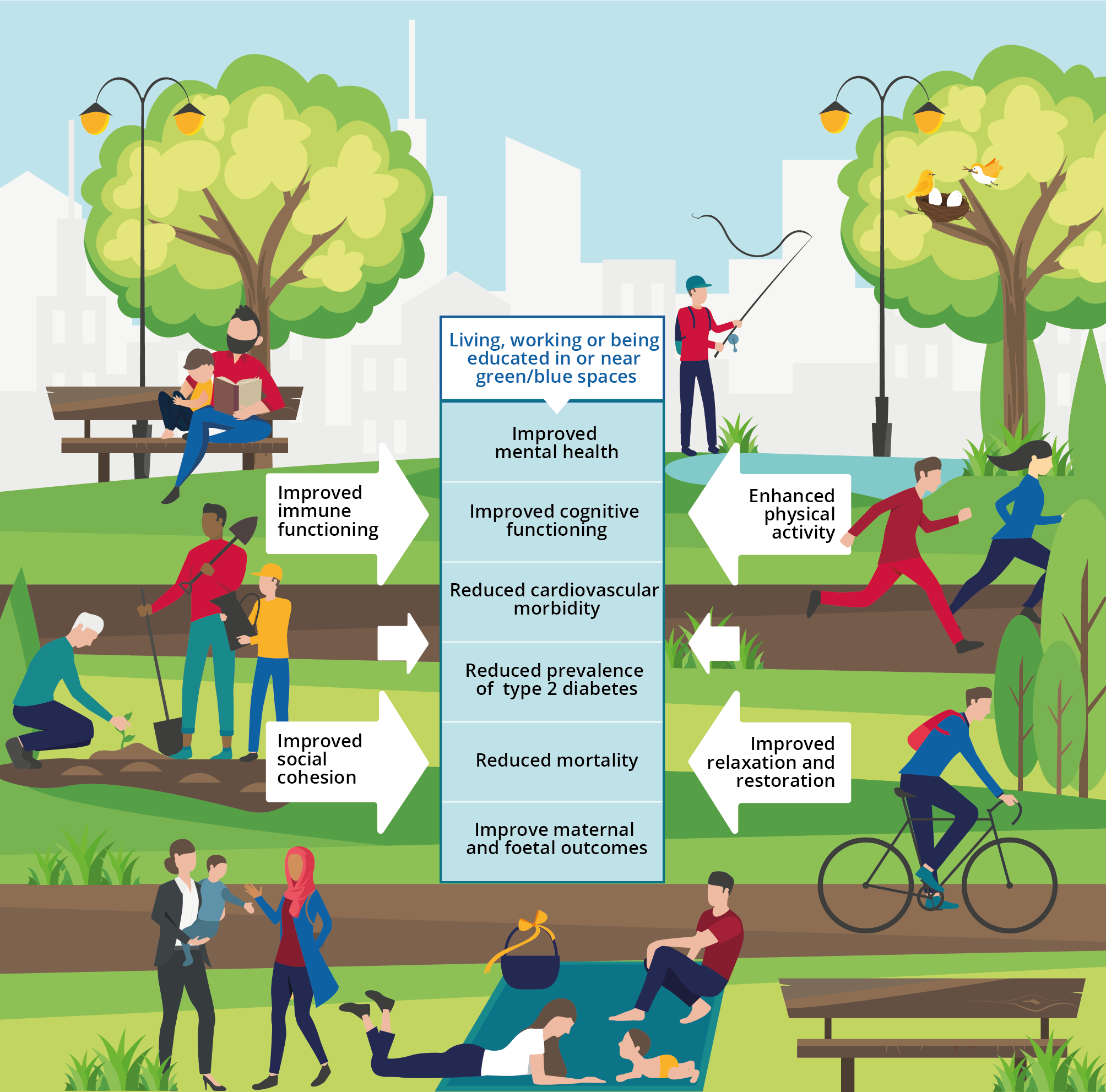
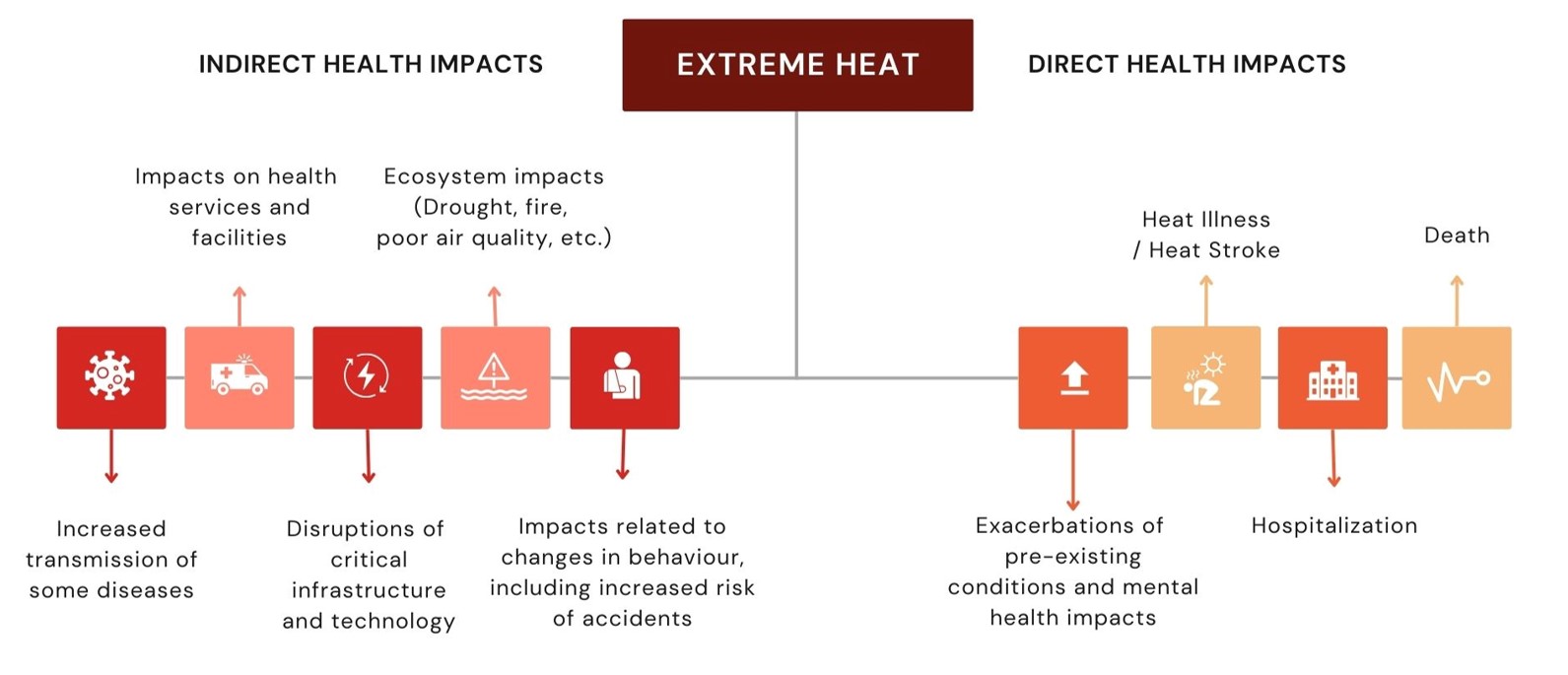
Climate refuges during heatwaves
Lesson:. Small neighbourhood green spaces can function as local climate refuges by providing shade, permeable soil, and vegetation during increasingly frequent heatwaves.
→ Adaptation: Redesign urban gardens to increase tree cover, shaded areas, and heat-resistant vegetation, especially in neighbourhoods with limited access to parks.
→ Example Implementation: In response to drought and rising temperatures, L’Horta Alliberada reduced the number of cultivated beds and planted more trees to strengthen its role as a climate refuge.
→ Practical Step: Map areas with high heat exposure and low tree coverage, and prioritize them for tree planting, shade structures, and accessible resting areas.
 Source:https://www.who.int/multi-media/details/scale-and-nature-of-the-health-impacts-of-heat
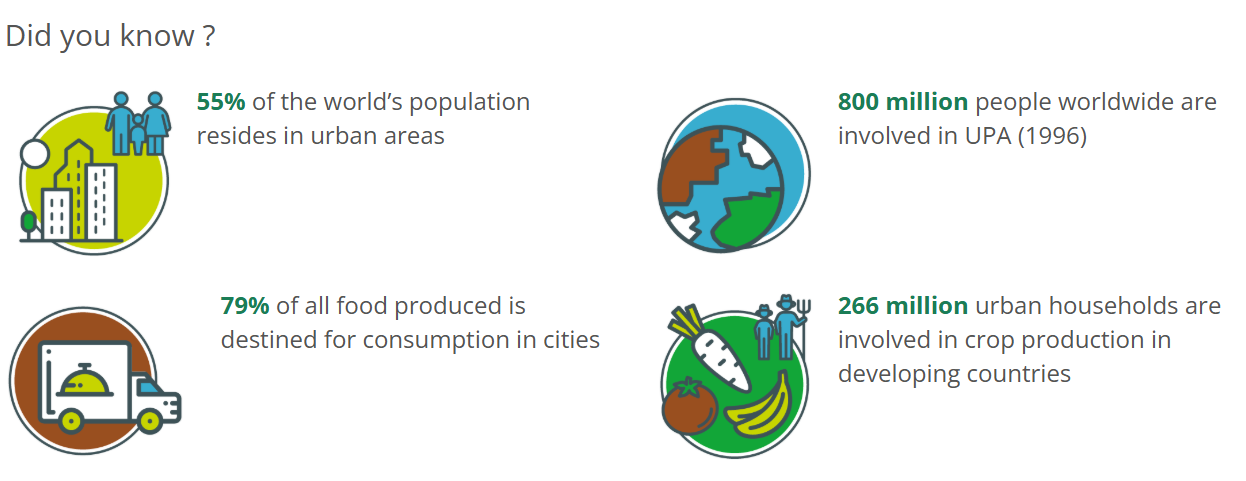
Organic urban agriculture
Lesson:. Community gardens can produce food while promoting ecological cultivation, collective learning, and more sustainable relationships with urban land.
→ Adaptation: Introduce low-water, pesticide-free cultivation methods adapted to local climate conditions and available resources.
→ Example Implementation: L’Horta Alliberada uses community-managed cultivation beds to grow food that is shared with local food-support networks and participants in collective work sessions.
→ Practical Step: Establish a seasonal cultivation plan using organic practices, drought-resistant crops, composting, and efficient irrigation systems.
 Source: Home | Urban and peri-urban agriculture | Food and Agriculture Organization of the United Nations
👥 Society #
L’Horta Alliberada has a significant social impact by providing an open, free, and collectively managed space in a densely populated neighbourhood. It strengthens community ties through shared decision-making, weekly assemblies, gardening activities, and collective maintenance, while encouraging participation, mutual support, and neighbourhood ownership. The project also promotes food solidarity by sharing its harvest with local food networks and participants, and it preserves the agricultural memory of Sants by reconnecting residents with cultivation, ecological knowledge, and community life.
Community building and stronger neighbourhood networks
Lesson:.Shared management, regular assemblies, and collective activities can turn an urban green space into a meeting point where residents build trust, cooperation, and a stronger sense of belonging
→ Adaptation: Include participatory governance and community-led maintenance in the design of urban green-space projects.
→ Example Implementation: L’Horta Alliberada holds weekly assemblies where participants collectively decide how to maintain the space, organize activities, and develop the project.
→ Practical Step: Establish regular open meetings and shared working sessions where residents can participate in decisions and practical tasks.
Social inclusion and open participation
Lesson: Removing financial, administrative, and social barriers allows people of different ages, backgrounds, and circumstances to participate in community life.
→ Adaptation: Design urban green spaces as open, accessible, and welcoming places that do not require membership fees or prior experience.
→ Example Implementation: L’Horta Alliberada is open to everyone, and residents can join assemblies, gardening activities, work sessions, and community events.
→ Practical Step: Clearly communicate that participation is free, provide different ways to get involved, and ensure activities are accessible to people with diverse needs and abilities.
Free leisure and recreational opportunities
Lesson:. Community gardens can offer informal recreation, relaxation, social interaction, and contact with nature without requiring residents to spend money.
→ Adaptation: Combine environmental functions with spaces for rest, cultural activities, workshops, and neighbourhood gatherings.
→ Example Implementation: L’Horta Alliberada provides shaded areas, vegetation, gardening activities, workshops, and community events that residents can enjoy free of charge.
→ Practical Step: Create a regular programme of free activities and reserve areas for resting, meeting, playing, and informal community use.
.
🏛️ Politics #
At the policy level, L’Horta Alliberada highlights the gap between formal urban planning and locally identified needs. As an independent grassroots initiative, it shows how community action can complement public intervention and contribute to more responsive, inclusive, and locally grounded urban policies.
Community governance can activate neglected urban land
Lesson:. Open assemblies and shared responsibilities enable residents to transform abandoned plots into valuable community spaces, even when public or private actors have failed to maintain or develop them.
→ Adaptation: Introduce participatory governance models that allow residents to take part in the management, maintenance, and programming of vacant or underused urban spaces.
→ Example Implementation: L’Horta Alliberada uses weekly open assemblies to make collective decisions about maintenance, gardening, activities, and the future development of the space.
→ Practical Step : Create a neighbourhood management group and establish regular open meetings with clear responsibilities and transparent decision-making procedures.
Urban policies should recognize and protect community-managed green spaces
Lesson: Informal grassroots initiatives can provide environmental and social services comparable to public infrastructure. Local authorities can support them through legal recognition, access agreements, funding, and protection from real-estate development.
→ Adaptation: Develop municipal frameworks that support community-managed spaces through temporary-use agreements, grants, technical assistance, or legal recognition.
→ Example Implementation: A local authority could sign a renewable land-use agreement with a community group, allowing it to manage a vacant plot while ensuring public access and environmental benefits.
→ Practical Step : Map existing community-managed green spaces and assess which legal, financial, or technical measures are needed to support their continuity.
.
Vacant land policies should prioritize social and environmental value
Lesson:.Decisions about unused urban land should consider community needs, climate resilience, and access to green space—not only its financial or development potential. Temporary-use policies can allow abandoned plots to serve a public function while their long-term status is resolved.
→ Adaptation: Include social and environmental criteria in planning decisions concerning vacant privately or publicly owned plots.
→ Example Implementation: An abandoned development site can be temporarily converted into a community garden and climate refuge until a permanent planning decision is made.
→ Practical Step:Create an inventory of vacant plots and evaluate them according to population density, lack of green space, heat exposure, and potential community use.
💶 Economy #
L’Horta Alliberada contributes to a more accessible, local, and solidarity-based economy. Its model shows how community-managed resources can generate shared economic benefits and strengthen neighbourhood resilience beyond conventional market-based approaches.
Local production supports short food supply chains
Lesson: Growing food within the neighbourhood reduces the distance between production and consumption and promotes more local and resilient food systems.
→ Adaptation: Support small-scale urban agriculture and connect community gardens with neighbourhood markets, food cooperatives, and local organisations.
→ Example Implementation: Vegetables and herbs grown at L’Horta Alliberada are cultivated and consumed within the same neighbourhood rather than transported through long commercial supply chains.
→ Practical Step: Identify local organisations and community groups that could receive, exchange, or distribute locally grown produce.
Community food production can reduce household expenses
Lesson:.Shared urban agriculture can complement household food supplies and help participants reduce part of the cost of their shopping basket.
→ Adaptation: Integrate productive growing areas into community green spaces and establish fair systems for distributing the harvest among participants.
→ Example Implementation:Produce from L’Horta Alliberada is shared with people who participate in collective gardening and maintenance sessions.
→ Practical Step: Record annual production and distribute harvested food according to transparent criteria agreed by the community.
Urban gardens can strengthen food solidarity networks
Lesson: Community gardens can contribute to food security by directing part of their production to local mutual-aid and food-distribution networks.
→ Adaptation: Include solidarity-based distribution as a core objective of community agriculture projects.
→ Example Implementation: Part of L’Horta Alliberada’s harvest is donated to the Can Vies Food Network, which supports food redistribution within the neighbourhood.
→ Practical Step: Establish a formal collaboration with a local food-support network and agree on collection, distribution, and food-safety procedures.
🎓 Education #
L’Horta Alliberada provides an informal learning environment where knowledge is shared through participation, experimentation, and collective practice. Its educational value lies in connecting environmental awareness with everyday community life and making learning accessible outside formal institutions.
Urban gardens support practical environmental education
Lesson: Direct contact with cultivation, soil, water, and biodiversity helps participants understand environmental processes through practical experience.
→ Adaptation: Integrate hands-on ecological learning into community green spaces and urban environmental programmes.
→ Example Implementation: Participants at L’Horta Alliberada learn about organic cultivation, seasonal cycles, composting, biodiversity, and water management while maintaining the garden.
→ Practical Step: Organise regular practical workshops linked to seasonal gardening tasks and local environmental challenges.
Peer-to-peer learning strengthens community knowledge
Lesson: Open and collaborative spaces allow participants to exchange skills and knowledge regardless of their previous experience or educational background.
→ Adaptation: Use horizontal learning methods in which residents can act as both learners and knowledge holders.
→ Example Implementation: Experienced participants share gardening techniques, ecological practices, and maintenance skills with newcomers during collective work sessions.
→ Practical Step: Create a simple mentoring system that pairs experienced participants with people joining the project for the first time.
Community gardens connect education with local history and identity
Lesson: Educational activities can preserve local knowledge and help residents understand the historical relationship between their neighbourhood, agriculture, and the urban environment.
→ Adaptation: Include local history, cultural memory, and traditional practices in environmental education programmes.
→ Example Implementation: L’Horta Alliberada reconnects residents with Sants’ agricultural past and promotes awareness of how the neighbourhood has changed through urbanisation.
→ Practical Step: Develop guided activities, exhibitions, or oral-history sessions involving local residents, schools, and neighbourhood organisations.
🔧 Practical Steps for Implementation for complete GP #
Practical Steps for Implementation
· Identify suitable urban land: Map abandoned, vacant, or underused plots in densely populated neighbourhoods, prioritising areas with limited access to green space and high exposure to urban heat.
· Assess land conditions and ownership: Review soil quality, permeability, access, current planning status, and ownership in order to determine whether the site can be used temporarily or permanently.
· Build a neighbourhood management group: Involve residents, local associations, environmental organisations, food networks, and other community actors from the beginning of the project.
· Establish participatory governance: Create regular open assemblies, transparent decision-making procedures, and working groups responsible for cultivation, maintenance, activities, communication, and finances.
· Secure access to the site: Explore temporary-use agreements, municipal leases, community land arrangements, or other legal mechanisms that protect the project and clarify responsibilities.
· Design a multifunctional green space: Combine trees, permeable surfaces, cultivated beds, aromatic and ornamental plants, shaded areas, resting spaces, and areas for collective activities.
· Strengthen its role as a climate refuge: Prioritise tree cover, natural and artificial shade, drought-resistant vegetation, drinking water where possible, and accessible seating for periods of extreme heat.
· Introduce ecological cultivation methods: Use pesticide-free practices, composting, seasonal crops, soil regeneration, mulching, efficient irrigation, and species adapted to local climate conditions.
· Plan water use carefully: Assess available water resources, install rainwater collection or low-consumption irrigation systems where feasible, and adapt cultivation levels during drought periods.
· Define a fair harvest distribution system: Agree transparently on how produce will be shared among participants and how much will be allocated to local food-support or mutual-aid networks.
· Connect with local food initiatives: Establish partnerships with neighbourhood food networks, cooperatives, markets, community kitchens, or social organisations to strengthen local and solidarity-based food systems.
· Ensure open and inclusive participation: Keep access and activities free, offer different levels of involvement, and remove barriers related to age, experience, income, language, mobility, or administrative status.
· Create free leisure opportunities: Reserve areas for rest, informal meetings, cultural activities, workshops, children’s activities, and other non-commercial uses.
· Develop an educational programme: Organise practical workshops on organic farming, biodiversity, composting, water management, climate adaptation, local food systems, and neighbourhood history.
· Promote peer-to-peer learning: Encourage experienced participants to share knowledge with newcomers through collective work sessions, mentoring, and practical demonstrations.
· Connect with schools and local organisations: Invite educational centres, youth groups, senior organisations, and community services to participate in visits, workshops, and joint activities.
· Integrate the project into public policy: Present the initiative to local authorities for inclusion in urban greening, climate adaptation, food, health, education, or neighbourhood development strategies.
· Secure basic resources: Prepare a modest operational budget covering tools, irrigation, plants, soil improvement, insurance, accessibility measures, communication, and activity costs.
· Monitor environmental and social impact: Track indicators such as permeable surface created, trees planted, food produced, participants involved, activities organised, beneficiaries reached, and partnerships established.
· Communicate results and community value: Share achievements, challenges, and lessons with residents, public authorities, funders, and partner organisations to strengthen recognition and long-term support.
GP2 Disclaimer / Copyright Notice #
Parts of this material were created and structured with the support of AI research tools. The content was created to support analysis and reporting and was adapted and reviewed by the project team. Research was conducted using publicly available sources, UNDP Serbia databases, and institutional reports.
All trademarks and product names mentioned are acknowledged and remain the property of their respective owners.