
 Doc Summary

GP5 Title: La Fàbrica del Sol – digital Fabrication Centre (Spain) #
📍 Location: Barcelona, Spain
🔗 https://ajuntament.barcelona.cat/ateneusdefabricacio/ca/ateneus-de-fabricacio/ateneu-la-fabrica-del-sol
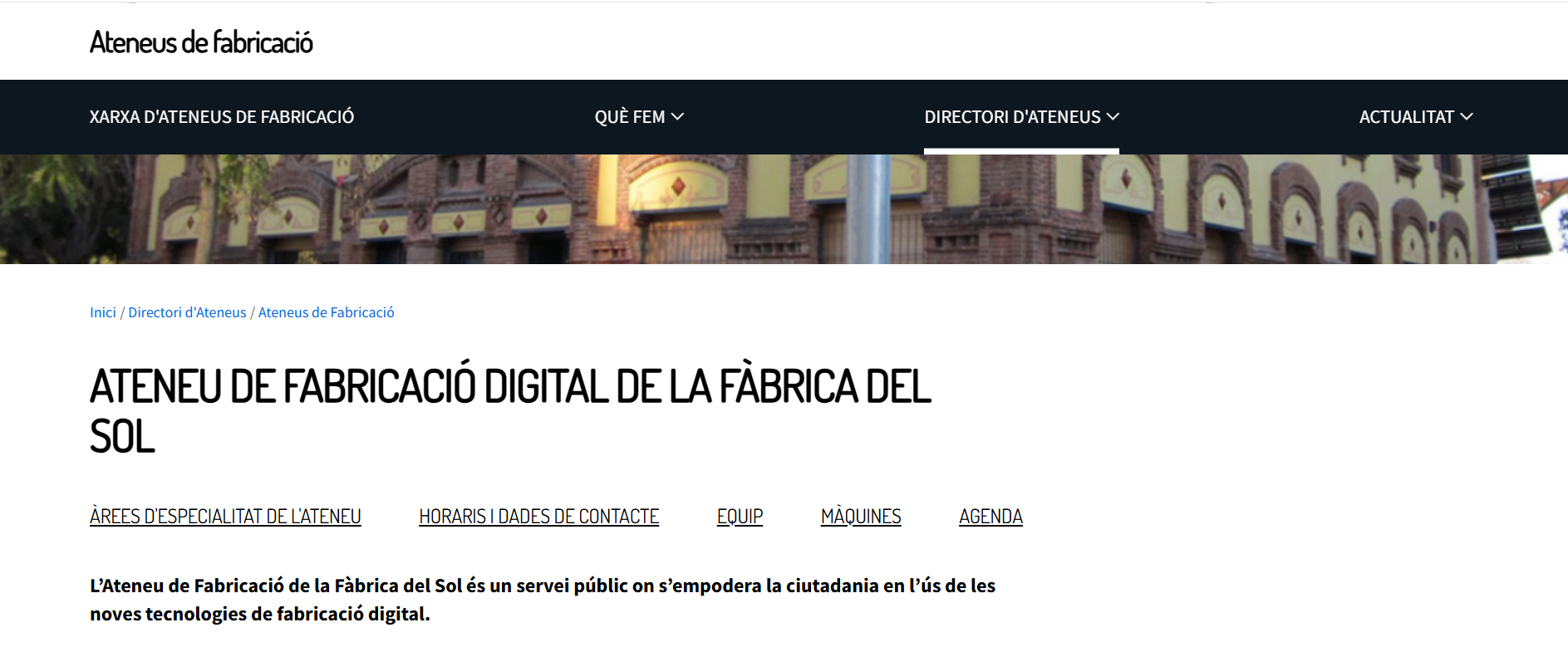
Source EN: La fàbrica del Sol | Ateneus de fabricació | Barcelona City Hall
Introduction #
La Fàbrica del Sol Digital Fabrication Centre is a public space in Barcelona that promotes learning, experimentation and innovation through digital fabrication. As part of the city’s network of Ateneus de Fabricació, it offers citizens access to tools, knowledge and collaborative spaces where they can develop creative projects with a strong focus on sustainability.
The centre works especially on issues such as energy self-sufficiency, circular economy and the responsible use of resources. Its aim is not only to introduce people to technologies such as 3D printing, laser cutting or textile fabrication, but also to encourage them to think critically about how objects are designed, produced and reused.
In this sense, La Fàbrica del Sol invites participants to rethink their ideas from an ecological perspective, applying eco-design criteria and looking for ways to reduce waste and energy consumption. It is a place where technology becomes a tool for environmental awareness, social innovation and community learning.
Context
La Fàbrica del Sol is located in a historic building owned by Barcelona City Council, originally linked to the former Catalan Gas Factory. The transformation of this industrial site into a centre for sustainability and digital fabrication reflects Barcelona’s transition from an old industrial model to a more ecological, technological and community-based vision of the city.
Learning Objectives
Session Plan
✅ What the sector can learn: Zero Waste & Circular Consumption
🌍 Environment #
La Fàbrica del Sol shows how digital fabrication can become a practical tool for sustainability, circular economy and environmental education. Its approach encourages citizens, organisations and local sectors to rethink how objects are designed, produced, repaired and reused. Instead of promoting technology only as a means of production, the centre uses it to reduce environmental impact, improve resource efficiency and support more responsible consumption models.
Waste prevention reduces environmental impact
Lesson: The environmental impact can be reduced when projects are designed from the beginning with sustainability criteria. By applying eco-design principles, you can avoid unnecessary waste, reduce material use and rethink production processes before waste is generated.
→ Adaptation: Sectors can move from managing waste after production to preventing it during the design phase.
→ Example Implementation: Businesses, schools or public institutions can redesign products, activities or services to use fewer materials and generate less waste.
→ Practical Step: Identify the main sources of waste in a project or organization and redesign them using eco-design criteria, prioritizing durability, repairability and material reduction.
Resource efficiency improves sustainability
Lesson: The centre promotes the responsible use of materials, energy and digital fabrication technologies. Tools such as 3D printers, laser cutters, CNC machines and textile equipment allow users to create prototypes and objects more precisely, helping to optimize resources and avoid unnecessary consumption.
→ Adaptation: Sectors can use digital tools to improve efficiency in production, reduce material losses and develop more sustainable solutions.
→ Example Implementation: A company or community organization could use digital fabrication to create only the parts that are needed, repair broken objects or test prototypes before large-scale production.
→ Practical Step: Analyses how materials and energy are used in existing processes and introduce digital fabrication or repair strategies to reduce waste, costs and environmental impact.
Circular consumption closes material loops
Lesson: La Fàbrica del Sol supports circular economy by encouraging the reuse of materials and the transformation of discarded resources into new products or projects. This approach helps close material loops because objects are not simply thrown away, but repaired, adapted or given a new function.
→ Adaptation: Sectors can promote circular consumption models based on reuse, repair, sharing and local production.
→ Example Implementation: Municipalities, educational centres or organizations can create material banks, repair workshops or community fabrication spaces where citizens learn to reuse resources.
→ Practical Step: Set up a system to collect, classify and reuse leftover materials, and combine it with workshops where participants design new objects from existing resources.
👥 Society #
La Fàbrica del Sol fosters social awareness by helping citizens use digital fabrication technologies in a more sustainable way. Its work connects environmental education, collaborative learning and circular economy, encouraging people to rethink how they design, produce, repair and reuse objects. The centre is a public service focused on sustainability within Barcelona’s network of Digital Fabrication Centres.
Consumer awareness drives behavioural change
Lesson: La Fàbrica del Sol encourages citizens to understand the environmental impact of production and consumption through eco-design, energy saving and material reuse.
→ Adaptation: Integrate sustainability awareness into educational, community and public innovation activities.
→ Example Implementation: Schools, NGOs and community centres can organize workshops on eco-design, repair, reuse and responsible consumption.
→ Practical Step: Develop simple educational materials and activities that show how everyday objects can be redesigned, repaired or reused instead of discarded.
Community engagement strengthens sustainability culture
Lesson: The centre acts as a collaborative space where citizens can learn, experiment and develop sustainable projects together.
→ Adaptation: Create community spaces that combine practical learning, digital fabrication and environmental education.
→ Example Implementation: Municipalities can organise talks, exhibitions, fabrication workshops and repair sessions linked to circular economy topics.
→ Practical Step: Establish regular community events where participants share ideas and create projects using reused materials and sustainable design principles.
Inclusive participation enables wider impact
Lesson: As a public service, La Fàbrica del Sol makes digital fabrication and sustainability knowledge more accessible to citizens.
→ Adaptation: Ensure that sustainable innovation spaces are open, affordable and accessible to different social groups.
→ Example Implementation: Public institutions can offer free or low-cost training sessions, open days and collaborative workshops for residents, schools and local organizations.
→ Practical Step Design inclusive participation strategies that allow people with different ages, backgrounds and skill levels to take part in circular economy and digital fabrication activities.
🏛️ Politics #
La Fàbrica del Sol highlights the importance of public institutions in promoting sustainable innovation, circular economy and environmental education. As a public service within Barcelona’s network of Digital Fabrication Centres, it shows how local governments can support citizens in using technology for ecological and social purposes.
Policy frameworks support waste reduction
Lesson: Municipal policies can make digital fabrication accessible while linking it to sustainability, eco-design and energy saving.
→ Adaptation: Integrate sustainability and circular economy goals into public innovation policies.
→ Example Implementation Municipalities can create public fabrication centres where citizens, schools and organizations develop sustainable projects.
→ Practical Step: Identify local funding or public programmes that support eco-design, digital fabrication and circular economy initiatives.
Regulation can enable circular business models
Lesson: The center shows that circular practices become easier when public frameworks support reuse, repair, local production and responsible material management.
→ Adaptation: Promote regulations and incentives that make circular business models more accessible for organisations, entrepreneurs and local communities.
→ Example Implementation: Local governments can support businesses or social initiatives that use reused materials, offer repair services or produce locally through digital fabrication.
→ Practical Step: Review local rules and barriers that affect reuse, repair or shared production spaces, and propose measures that make circular initiatives easier to implement.
Local governments can act as facilitators
Lesson: La Fàbrica del Sol demonstrates that municipalities can create spaces where citizens, schools, organisations and professionals learn and collaborate around sustainability.
→ Adaptation: Encourage local governments to provide infrastructure, training and partnerships that support circular economy initiatives.
→ Example Implementation: City councils can offer public fabrication spaces, workshops and pilot projects focused on eco-design, repair, reuse and resource efficiency.
→ Practical Step: Engage with local authorities to integrate circular economy into urban strategies.
💶 Economy #
La Fàbrica del Sol demonstrates how sustainable digital fabrication can create economic value by reducing material use, encouraging reuse and supporting local production. As a public digital fabrication centre focused on sustainability, it helps citizens and organisations rethink projects through eco-design, energy saving and circular economy principles.
Zero-waste models create new business opportunities
Lesson: circular economy and eco-design can inspire new services, products and projects based on reuse, repair and sustainable fabrication.
→ Adaptation: Develop business models that use digital fabrication to create sustainable products, repair existing objects or transform discarded materials into new resources.
→ Example Implementation: Entrepreneurs or local organisations can create repair services, upcycling workshops, sustainable product prototypes or small-scale circular production initiatives.
→ Practical Step: Design a circular business plan that identifies available waste materials, possible reuse strategies and the digital fabrication tools needed to create new value.
Cost savings through reduced packaging
Lesson: The centre promotes avoiding unnecessary material purchases and reusing existing resources, which can reduce production costs and waste.
→ Adaptation: Focus on reducing material consumption, unnecessary packaging and avoidable production expenses.
→ Example Implementation: Businesses can use reusable containers, reduce single-use packaging and produce only the parts or materials they need through digital fabrication.
→ Practical Step: Compare the costs of buying new materials and packaging with reuse, repair or refill-based alternatives.
Local supply chains enhance resilience
Lesson: La Fàbrica del Sol supports local and collaborative production by giving citizens access to digital fabrication tools and shared workspaces.
→ Adaptation: Strengthen local value chains by producing, repairing and prototyping closer to the community.
→ Example Implementation: Local businesses, schools or community groups can use fabrication spaces to create prototypes, repair objects or develop small-scale sustainable products without depending entirely on external suppliers.
→ Practical Step: Build partnerships with local makers, public fabrication centres, repair initiatives and material reuse networks to support circular local production.
🎓 Education #
La Fàbrica del Sol serves as a platform for learning, experimentation and knowledge transfer around sustainability, digital fabrication and circular economy. It offers citizens access to tools, workshops and collaborative spaces where they can learn how to design, produce, repair and reuse objects in a more responsible way.
Practical learning supports sustainable lifestyles
Lesson: La Fàbrica del Sol shows that people learn sustainability more effectively when they can experiment directly with materials, tools and real projects.
→ Adaptation: Use practical environments such as fabrication centres, schools or community spaces as learning spaces for sustainability.
→ Example Implementation: Organize guided visits and hands-on workshops. Educational institutions can organize guided visits, eco-design workshops and hands-on activities using reused materials.
→ Practical Step: Develop practical learning activities where participants design or repair an object while applying waste prevention and resource efficiency principles.
Education enables long-term behavioural change
Lesson: The centre helps citizens understand how everyday decisions about design, production and consumption affect the environment.
→ Adaptation: Integrate sustainability, circular economy and responsible consumption into formal and informal education.
→ Example Implementation: Schools can include activities on eco-design, material reuse, energy saving and digital fabrication in their learning programmes.
→ Practical Step: Create educational modules that connect circular economy concepts with daily practices, such as repairing objects, reducing waste and reusing materials.
Lifelong learning fosters circular economy transition
Lesson: La Fàbrica del Sol promotes continuous learning by making sustainability and digital fabrication accessible to different groups of citizens.
→ Adaptation: Offer training programmes for children, young people, adults, professionals and community organisations.
→ Example Implementation: Community centres, public institutions or local organisations can host courses on repair, reuse, sustainable design and digital fabrication.
→ Practical Step: Develop modular training programmes adapted to different levels, from introductory workshops for citizens to more specialised sessions for professionals.
🔧 Practical Steps for Implementation for complete GP #
Analyse local consumption patterns
Identify major waste streams
Develop zero-waste retail concept
Introduce refill and reusable systems
Engage community
Organize awareness campaigns and workshops
Build partnerships
Collaborate with local suppliers and stakeholders
Align with policy
Use funding and regulatory frameworks
Implement and scale
Monitor impact and expand the model
Disclaimer / Copyright Notice for ALL
Parts of this material were created and structured with the support of ChatGPT (OpenAI, GPT-5); other parts were searched and created using CoPilot. The content was created to support analysis and reporting and was adapted and reviewed by the project team. Research was conducted using Bing and/or Google searches.
All trademarks and product names mentioned are acknowledged and remain the property of their respective owners.
17.04.2026 Europe, BeCom Project Team