
 Doc Summary

Vision for Băiuț Anima Building Restoration and Community Use #
Sector Vision Statement #
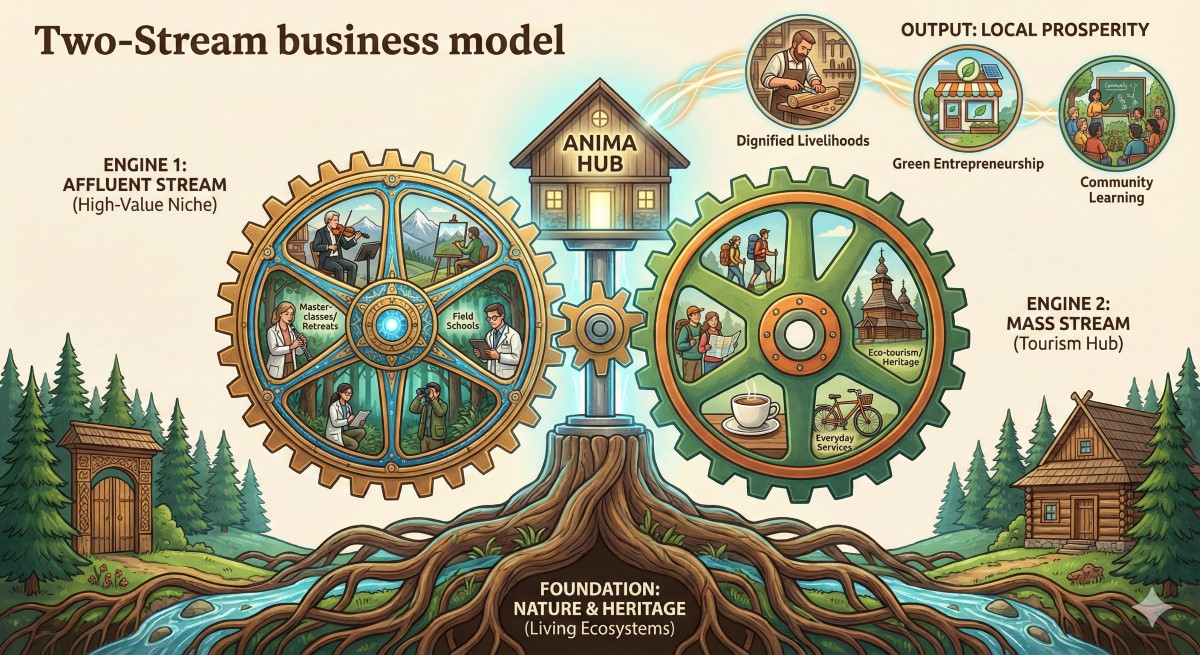 ANIMA: Where Heritage Meets Opportunity – A Dual Engine for Sustainable Rural Prosperity
The economic vision for ANIMA is to transform a dormant heritage asset into a vibrant, self-sustaining economic engine that drives local prosperity without compromising the region’s ecological or cultural integrity.
Adopting a Two-Stream business model will allow ANIMA to simultaneously cater to two distinct markets: a high-value niche market of experts and creatives seeking immersive retreats and field schools in a unique Carpathian setting rich in forests, mineral springs, and wooden heritage (“the Affluent Stream”), and a broader market of eco-tourists seeking authentic nature, wellness, and cultural experiences in Maramureș (“the Mass Stream”).
This hybrid approach ensures financial resilience, enabling the cross-subsidization of community and educational programs while creating diverse local employment and fostering a new ecosystem of green entrepreneurship in Băiuț.
Current Challenges and Needs #
Needs:
- Need for sustainable livelihoods. Creating year-round income opportunities beyond traditional extraction or seasonal agriculture, by activating assets such as forests, wooden villages, wellness routes, and cultural heritage.
- Need for financial autonomy. Reducing dependence on municipal budgets or sporadic grants for heritage maintenance by generating stable own revenues through educational programs, masterclasses, guided tours, and eco‑tourism services hosted in ANIMA.
- Need for market visibility. Placing Băiuț on the map as a destination for high-quality cultural, scientific, and nature-based tourism linked to Maramureș’ wooden churches, mining and geology heritage, and Carpathian wellness resources.
Challenges:
- Low purchasing power. The local market alone cannot sustain high maintenance heritage infrastructure or pay for specialized programs, making it essential to attract visitors and learners from outside the immediate area.
- Seasonality. Tourism in mountain regions is often limited to peak seasons, leading to unstable income and underused infrastructure for much of the year, unless combined with educational retreats, offseason wellness stays, and year-round training.
- Skill gaps. There is a lack of local expertise in high‑end hospitality, cultural management, guiding, green entrepreneurship, and eco‑tourism services, as well as limited access to training that could turn natural and cultural capital into quality economic offers.
Proposed Functions of the Restored Building #
From the economic perspective, ANIMA operates as a dual-engine hub with two main revenue streams plus shared support functions.
A. “Affluent Stream” – High-Value Retreats, Masterclasses, and Field Schools
Main activities and services
- Expert masterclasses and retreats in:
- Classical music, chamber music, composition, and voice.
- Creative writing, storytelling, acting, and performance labs.
- Visual arts and crafts: plein-air painting, woodcarving, textile arts, pottery, restoration of wooden elements.
- Ecology, environmental protection, and Green building: deep ecology seminars, field courses on forests, rivers, mineral springs, and bioconstruction using ANIMA as a living lab.
- Geology and mining heritage: field schools exploring the metalliferous mountains and mining history of Baia Mare–Băiuț.
- Residency programs: Medium-term residencies for artists, writers, scientists, and social innovators who use the Carpathian landscape and local communities as inspiration and research field.
- Professional and “congress” retreats
- Work meetings, team retreats and strategic seminars for companies, NGOs, municipalities and universities who want an intensive working atmosphere in a quiet Carpathian setting.
- Trainings and workshops on business, leadership, project management and innovation, designed for small groups that combine focused indoor work sessions with curated local experiences (heritage tours, wooden churches and villages, forest walks, local gastronomy).
- EU and international and Romanian donor-funded programmes for rural businesses, youth and start-ups (e.g., entrepreneurship bootcamps, green business acceleration, digitalisation of rural SMEs), where ANIMA serves as the training venue and gateway to the wider Maramureș territory.
In all these formats, what makes the offer “affluent” is not only the content and expert trainers but the all-inclusive experience: high-quality facilitation and hosting, carefully designed encounters with local heritage and nature, and tailored programmes that cannot be replicated in a standard conference hotel.
Target groups
- International and Romanian professionals, advanced students, and enthusiasts in arts, ecology, geology, architecture, and heritage.
- Universities, academies, conservatories, and research institutes seeking intensive field-based modules and off campus schools.
- Companies, NGOs, public institutions, rural business networks and startup communities looking for high-quality retreats, trainings or project meetings in a distinctive environment, often financed through EU, Romanian or global development funds.
Frequency of use
- Seasonal (peak): 1–2 week retreats and summer schools (spring–autumn).
- Periodic (year-round): Long weekend or week-long meetings, masterclasses, thematic residencies.
B. “Mass Stream” – Tourism Hub, Visitor Services, and Everyday Economy
Main activities and services
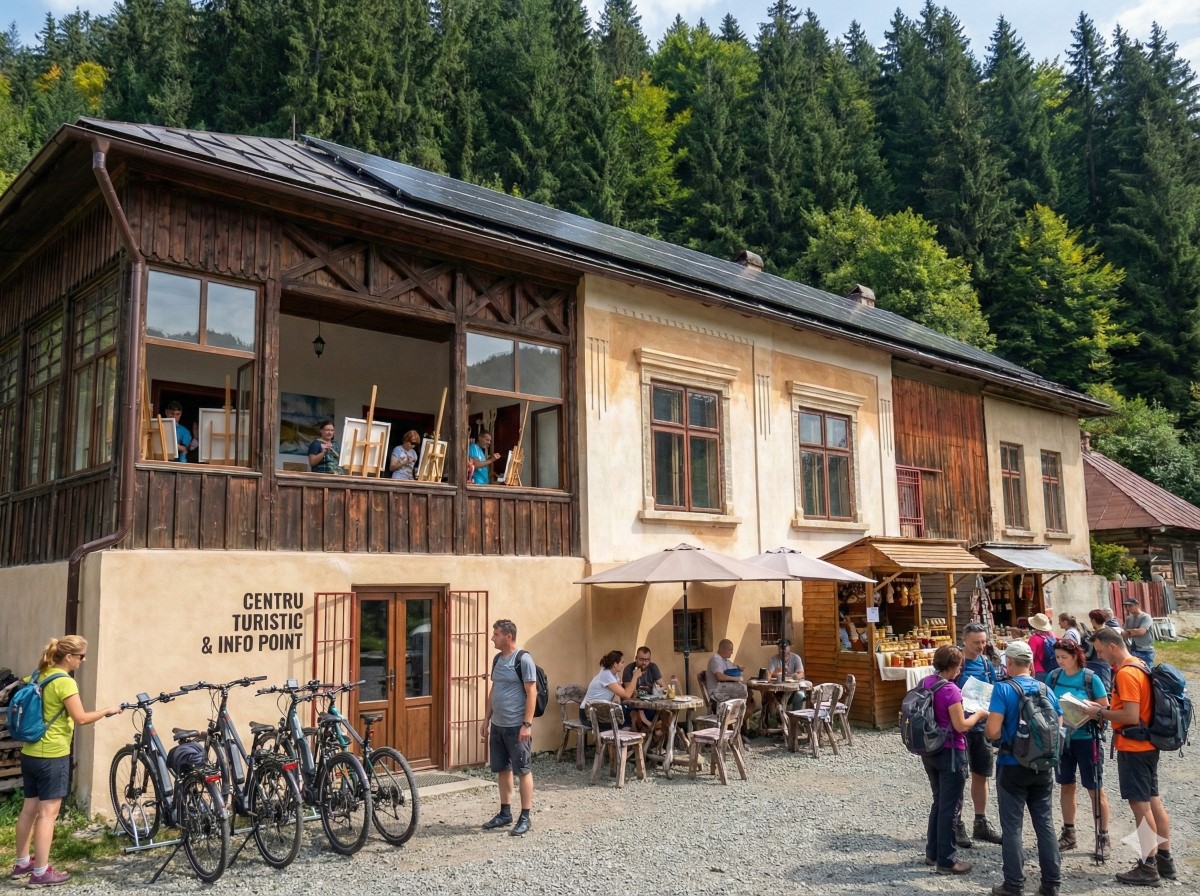
- Tourist Guidance Centre and Info Point
- Central orientation hub for Maramureș visitors: maps, curated routes, interpretation of mining and wooden heritage.
- Booking desk for tours, accommodation, and local experiences.
- Guided tours and nature-based experiences
- Heritage tours: Wooden churches circuits, traditional wooden villages, monumental gates, and village life.
- Mining & geology tours: “Gold Mine & Minerals Trail” linking former mines, geology sites, and the mineralogy museum.
- Wellness & forest walks: Routes focused on clean mountain air, spruce forests, mineral springs, and “sleep better in the Carpathians” packages.
- Services and micro-economy
- Rental of bikes/e-bikes, hiking gear, and audio guides.
- Small café / bistro and local products corner (honey, jams, crafts).
- Short “taster workshops” for tourists: 2–3 hour introductions to crafts, music, or nature interpretation.
Target groups
- Day-trippers and multi-day tourists in Maramureș.
- Families, small groups, organized tours (domestic and international).
- Visitors from Baia Mare and the wider region seeking weekend nature and culture escapes.
Frequency of use
- Daily (in season): Info point, café, rentals, short tours.
- Weekly / weekend-based: Longer guided tours, workshops.
C. Shared Economic Support Functions
Across both streams, ANIMA also provides:
- Co-working and micro-business incubation spaces for guides, artisans, digital workers, and eco-tourism operators.
- Market and fair events (craft fairs, local product markets, festival-related activities) activating the courtyard and surroundings.
- Training and mentoring programs in hospitality, guiding, small business development, and digital marketing (in tight collaboration with the Educational sector).
These functions ensure that economic activity at ANIMA directly reinforces environmental stewardship and continuous learning, rather than competing with them.
Key Stakeholders and Partnerships #
From the economic perspective, ANIMA’s success depends on a networked ecosystem rather than a single operator. Key actors include:
Local Businesses and Producers
- Guesthouses and small hotels in Băiuț, Baia Mare, and wider Maramureș providing accommodation packages for retreats and tours.
- Local food producers and artisans (farmers, beekeepers, cheese makers, woodcarvers, textile makers) supplying the café, local products corner, and markets.
- Tour guides and transport providers (local guides, minibus/taxi operators) partnering on heritage, geology, and wellness tours.
Educational and Cultural Institutions
- Schools and vocational centres whose students can train as guides, hospitality workers, or cultural operators.
- Universities and research institutes (e.g. Baia Mare university centre, Technical University of Cluj-Napoca, art and music academies) using ANIMA as a base for field schools, residencies, and study programs.
- Cultural organisations, arts councils, and conservatories co-organising masterclasses, residencies, and festivals.
Environmental and Heritage Organisations
- Environmental NGOs and forestry / nature agencies co-designing eco-tours, wellness routes, and educational content about forests, biodiversity, and mineral waters.
- Heritage and church authorities involved in wooden churches and village heritage circuits, ensuring respectful and well-managed visitor flows.
Public Authorities and Development Agencies
- Municipality of Băiuț and Maramureș County authorities supporting infrastructure, permitting, promotion, and co-financing.
- Regional and national tourism boards / destination management organisations integrating ANIMA into broader Maramureș and Carpathian tourism strategies.
Civil Society and Community Groups
- Rogepa as the leading regional NGO
- Local associations and informal groups (youth, elders, craftspeople) co-creating events, fairs, and storytelling components of tours.
- Diaspora networks helping to promote ANIMA’s offers abroad and attract participants to retreats and masterclasses.
These stakeholders collectively anchor ANIMA in the local economy while linking it to regional, national, and international circuits of education, culture, and eco-tourism.
Expected Impact #
Short-term impact (1–2 years)
In the first years after ANIMA’s reopening, the economic vision translates into visible, concrete changes in the daily life of Băiuț.
A first curated annual calendar of 3–5 high-value retreats and masterclasses is established, bringing small groups of musicians, writers, artists, ecologists, and students to work intensely in and around the building.
At the same time, 2–3 pilot guided tour products are launched – such as wooden churches and village circuits, mining and geology excursions, and forest-and-springs wellness walks – using ANIMA as their main departure and arrival point.
These activities generate the first 3–5 full-time equivalent local jobs in coordination, guiding, visitor services, and café/visitor centre roles, plus part-time and seasonal opportunities for drivers, hosts, and craftspeople.
Within this period, ANIMA begins to cover a substantial share of its own operating costs (utilities, basic staff, minor repairs) from direct revenues, and a first network of at least 10 local partners – guesthouses, food producers, artisans, and guides – can clearly associate part of their income with ANIMA-driven visitors.
Long-term impact (5–10 years)
Over a longer horizon, ANIMA evolves into a financially self-sustaining hub whose diversified income streams not only maintain the building but also fund an expanding portfolio of community and educational programmes.
Băiuț gains a distinct reputation within Maramureș as a niche destination for cultural, scientific, and wellness-oriented tourism that complements the region’s more famous attractions such as UNESCO wooden churches, traditional villages, and the Merry Cemetery.
By this stage, a local ecosystem of green entrepreneurs has emerged: certified guides, homestay hosts, craft producers, outdoor activity providers, and micro‑enterprises in creative and digital fields who use ANIMA as their professional base or showcase. For young people, this ecosystem offers a realistic alternative to permanent migration, providing meaningful, future‑oriented work connected to the landscape and culture they know best.
The economic model tested in ANIMA is documented and adapted to at least one other heritage building in the wider region, showing how a single successful pilot can inspire broader rural regeneration.
Sustainability and Resilience #
The economic vision for ANIMA is deliberately designed so that the building, the local economy, and the surrounding environment reinforce each other over decades, rather than create a short boom-and-bust cycle.
At its core is the Two‑Stream business model. The Affluent Stream of high‑value retreats, masterclasses, and field schools, generates relatively stable, higher-margin income from small groups of visitors who come specifically for intensive learning and creative work in a unique Carpathian setting. These guests are attracted precisely because ANIMA is embedded in an authentic landscape of forests, mineral springs, wooden villages, and intact rural life, not in a mass-tourism resort.
The Mass Stream of eco‑ and heritage tourism, guided tours, rentals, café and local product sales – brings a broader flow of visitors and smaller, more frequent transactions, tied to the region’s existing tourism circuits and day‑trip patterns.
Together, the two streams balance each other: when one is weaker (for example, fewer international guests in a given year), the other can be strengthened (domestic tourism, local training programs, seasonal events), ensuring financial resilience across seasons and shocks.
Crucially, economic sustainability is inseparable from environmental sustainability in this model. Every major revenue source depends on the long‑term quality of local ecosystems and heritage: clean, oxygen‑rich mountain air and conifer forests for wellness retreats and forest walks; the integrity of wooden churches and village architecture for heritage tours; the health of springs, rivers, and soils for eco‑education and outdoor learning; and the preserved character of ANIMA itself as a bioconstruction showcase. This means that over‑exploitation – clear‑cutting forests, uncontrolled construction, or polluting activities – would directly undermine ANIMA’s economic base.
By making conservation the foundation of income generation, the economic vision creates strong local incentives to protect rather than deplete natural and cultural assets.
Resilience is also built through a diversified skills and knowledge base, closely linked to the Educational sector. Training in guiding, hospitality, digital marketing, small business management, and Green building ensures that multiple people – not just one operator – can run and renew ANIMA’s activities over time.
Partnerships with schools, vocational centres, and universities mean that new cohorts of young people and professionals’ cycle through ANIMA each year, bringing fresh ideas and keeping offers up to date with shifting markets and technologies.
If external conditions change – new regulations, climate impacts, or tourism trends – this constant learning loop allows ANIMA to adapt its programmes: for example, pivoting from international masterclasses to more domestic health retreats, or from classic mining tours to broader “regeneration and restoration” curricula.
Finally, the model includes practical financial buffers and governance mechanisms. Part of the surplus from the Affluent Stream is earmarked for a dedicated maintenance and renewal fund, covering long‑term upkeep of the building, gradual upgrades (e.g. new energy technologies), and emergency repairs. Clear agreements with the municipality and partners define how revenues are allocated between operating costs, community programmes, and reserves, reducing the risk of ad‑hoc decisions or political swings undermining ANIMA’s stability.
 A multistakeholder governance body – bringing together economic, educational, environmental, social, and political actors – reviews financial performance annually and can adjust prices, offers, and investment priorities in a transparent way, ensuring that economic choices remain aligned with social equity and environmental limits over the long run.
Connection with Other Helices #
The economic vision for ANIMA only works if it is deeply interwoven with the other helices; income is not an isolated goal but the engine that powers education, social cohesion, good governance, and environmental care.
Economy <==> Environment
The economic model depends on living ecosystems rather than on extraction: forest walks, wellness retreats, eco‑tours, and field schools all require healthy spruce forests, clean mountain air, unpolluted mineral springs, and well‑managed wooden landscapes. By turning these natural qualities into the core value proposition of both the Affluent and Mass Streams, ANIMA creates a direct financial incentive to protect forests, water, soil, and biodiversity, and to adopt bioconstruction and energy‑efficient renovation in the building itself as a permanent learning exhibit. In this way, every euro earned through nature‑based activities becomes an argument for long‑term environmental stewardship rather than short‑term exploitation.
Economy <==> Education
The Affluent Stream is intentionally designed as an extension of the educational helix: masterclasses, retreats, and field courses in arts, ecology, geology, Green building, and crafts are all educational products first, and economic products second. Universities, conservatories, schools, and vocational centres use ANIMA as a temporary campus or laboratory, paying fees that sustain the building while giving students and professionals access to real‑world learning in a post‑mining, rural context.
At the same time, the Mass Stream offers continuous on‑the‑job learning for local guides, hosts, and entrepreneurs, who improve their language skills, digital skills, and service quality as part of their daily economic activity.
This mutual reinforcement ensures that economic growth goes hand in hand with raising the community’s knowledge and skills base.
Economy <==> Society
Economically, ANIMA is designed to spread benefits widely: by prioritising local hiring, supplier contracts with nearby producers, and collaboration with village artisans, it channels visitor spending into many households rather than a single operator.
The revenue surplus from higher‑end activities is explicitly used to subsidise inclusive community uses – free or low‑cost events, youth programmes or elderly gatherings, so that residents who cannot pay full prices still access the building, its services, and its symbolic value.
This helps rebuild trust, pride, and a sense of shared ownership over the building, countering the social fragmentation and loss of confidence that followed the decline of mining.
Economy <==> Politics / Governance
From the governance side, a financially robust ANIMA strengthens the case for public–community–private partnerships and for policies that see heritage and environment as development assets, not as burdens.
Stable own revenues reduce long‑term pressure on municipal budgets while offering co‑financing capacity for future grants (PNRR, PNDR, Horizon Europe, etc.), making it easier for local authorities to back ambitious regeneration projects. In return, supportive governance – through clear rules, transparent management, and long‑term agreements on ownership and roles – gives entrepreneurs and educators the confidence to invest time, reputation, and resources into ANIMA’s programmes.
Thus, the economic vision both depends on and reinforces a democratic, transparent governance culture in Băiuț.
Economy <==> Natural Environment (feedback loop)
Finally, by explicitly measuring and communicating how many jobs, enterprises, and learning opportunities are created because the environment is protected (not despite it), ANIMA becomes a persuasive local example of how the green transition can produce tangible economic benefits.
Monitoring indicators and case stories are shared back into regional and national debates, influencing wider policies on rural regeneration, mining transitions, and landscape management.
One Key Message #
ANIMA transforms a once-abandoned heritage building into a self-sustaining rural engine where nature, culture, and learning generate dignified local livelihoods through a dual model of high-value retreats and inclusive eco‑tourism