
- GP1: Elbauenpark Magdeburg and the Millennium Tower - Experiential Learning in a Green Urban Park
- Introduction
- NEB Principles Identified in the Example
- 🌍 Environment
- 👥 Society
- 🏛️ Politics
- 💶 Economy
- 🎓 Education
- 🔧 Practical Steps for Implementation
- GP2: Baštalište - Citizen-Led Community Gardening and Land Reclamation in Peri-Urban Belgrade
- Introduction
- NEB Principles Identified in the Example
- 🌍 Environment
- 👥 Society
- 🏛️ Politics
- 💶 Economy
- 🎓 Education
- 🔧 Practical Steps for Implementation
- GP3: GUST – Someș Urban Garden Transilvania
- Introduction
- NEB Principles Identified in the Example
- 🌍 Environment
- 👥 Society
- 🏛️Politics
- 💶 Economy
- 🎓 Education
- 🔧 Practical Steps for Implementation
- GP4: Urban Regeneration and Community Gardening at the Butcher’s Bastion
- Introduction
- NEB Principles Identified in the Example
- 🌍 Environment
- Community gardening as a low-impact nature-based solution in heritage areas
- Urban community gardens as biodiversity and micro-climate refuges
- Connecting biodiversity with local cultural heritage
- Closing local organic-resource loops through composting
- Rainwater harvesting and efficient water management
- A low-impact model that can be transferred to other places
- 👥 Society
- 🏛️Politics
- 💶 Economy
- Community gardening as a source of local value and circular economic opportunities
- Circular economy through local organic resources
- Connecting community gardening with local crafts and cultural production
- Heritage sites as platforms for local economic activity
- Low-cost approaches to local economic development
- 🎓 Education
- 🔧 Practical Steps for Implementation
- GP5 Title: Neapoli Food Forest – Community-Based Edible Forest
- Introduction
- NEB Principles Identified in the Example
- 🌍 Environment
- 👥 Society
- 🏛️Politics
- 💶 Economy
- 🎓 Education
- 🔧 Practical Steps for Implementation
- GP6 Title: L’Horta Alliberada de Sants
- Introduction
- New European Bauhaus Principles in L’Horta Alliberada de Sants
- 🌍 Environment
- 👥 Society
- 🏛️ Politics
- 💶 Economy
- GP7 Title: NIRGENDWO Berlin - Urban Nature, Community Gardening and Environmental Learning
- Introduction
- NEB Principles Identified in the Example
- 🌍 Environment
- 👥 Society
- 🏛️ Politics
- 💶 Economy
- 🎓 Education
- 🔧 Practical Steps for Implementation
- ✅ Transferability
- Disclaimer / Copyright Notice for ALL
 Doc Summary

Experiential Learning in a Green Urban Park in Magdeburg (Germany)
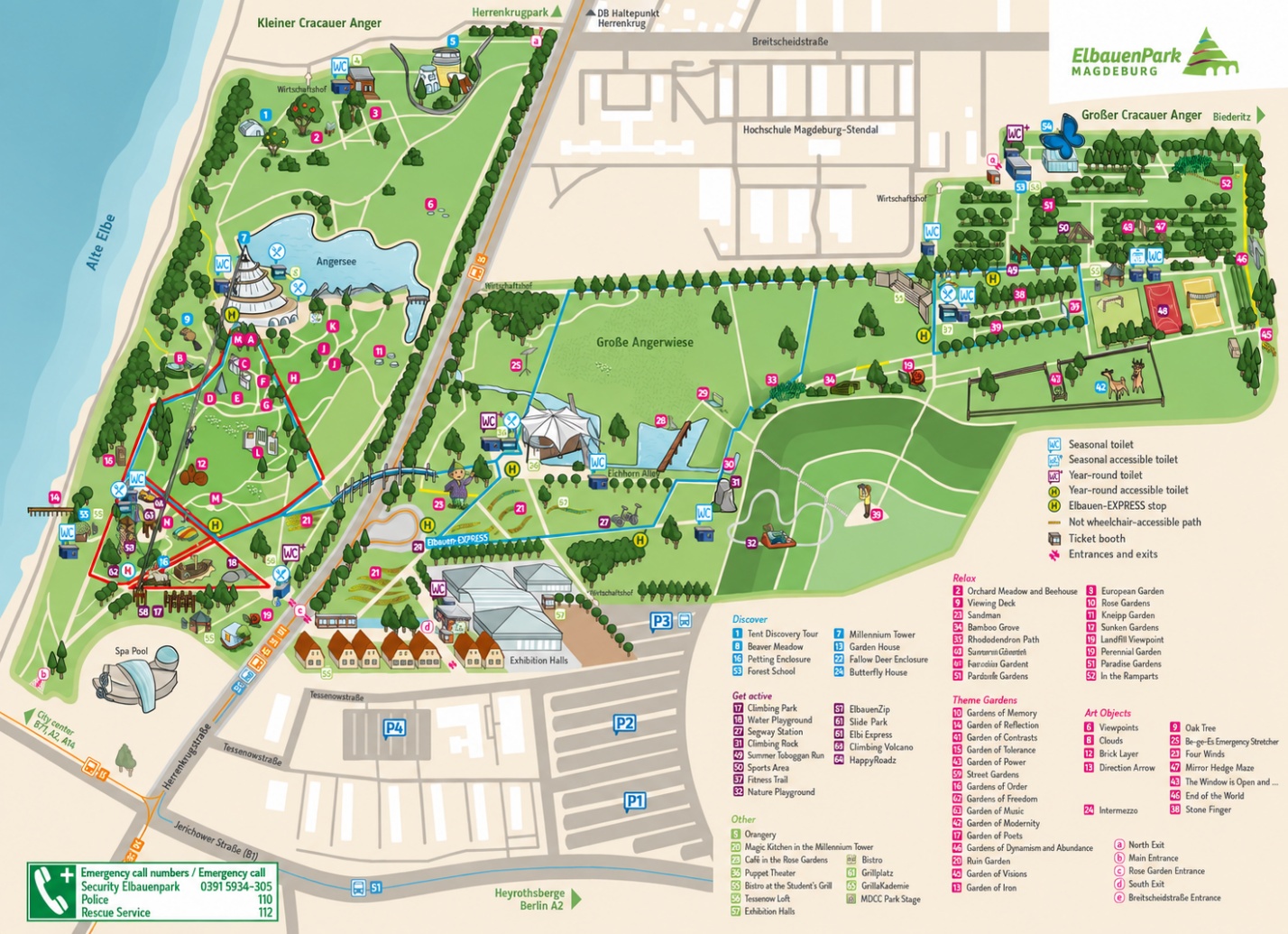
GP1: Elbauenpark Magdeburg and the Millennium Tower – Experiential Learning in a Green Urban Park #
📍 Location: Tessenowstraße 7, 39114 Magdeburg, Saxony-Anhalt, Germany
🔗 Main source: https://www.elbauenpark.de/de/home/
🔗 Millennium Tower: https://www.elbauenpark.de/de/attraktion/jahrtausendturm/de/home/
🔗 Offers for schools and childcare groups: https://www.elbauenpark.de/de/kita-schulen/
Introduction #
The Elbauenpark Magdeburg is a large urban nature, leisure and learning park created on a former military and industrial site and developed for the 1999 Federal Garden Show. Today it combines landscape design, recreation, culture, biodiversity, movement and science education in one accessible public destination. Its most recognisable landmark is the 60-metre-high Millennium Tower (Jahrtausendturm), a timber structure whose exhibition presents around 6,000 years of human, scientific and technological history.
The tower is more than an exhibition building. Across several levels, visitors encounter around 200 exhibits, models and experiments. Many stations are deliberately interactive: touching, testing, moving, listening and observing are part of the learning process. Children, school classes, families and adults can explore topics from ancient civilisations and mechanics to medicine, astronomy, electricity and space travel.
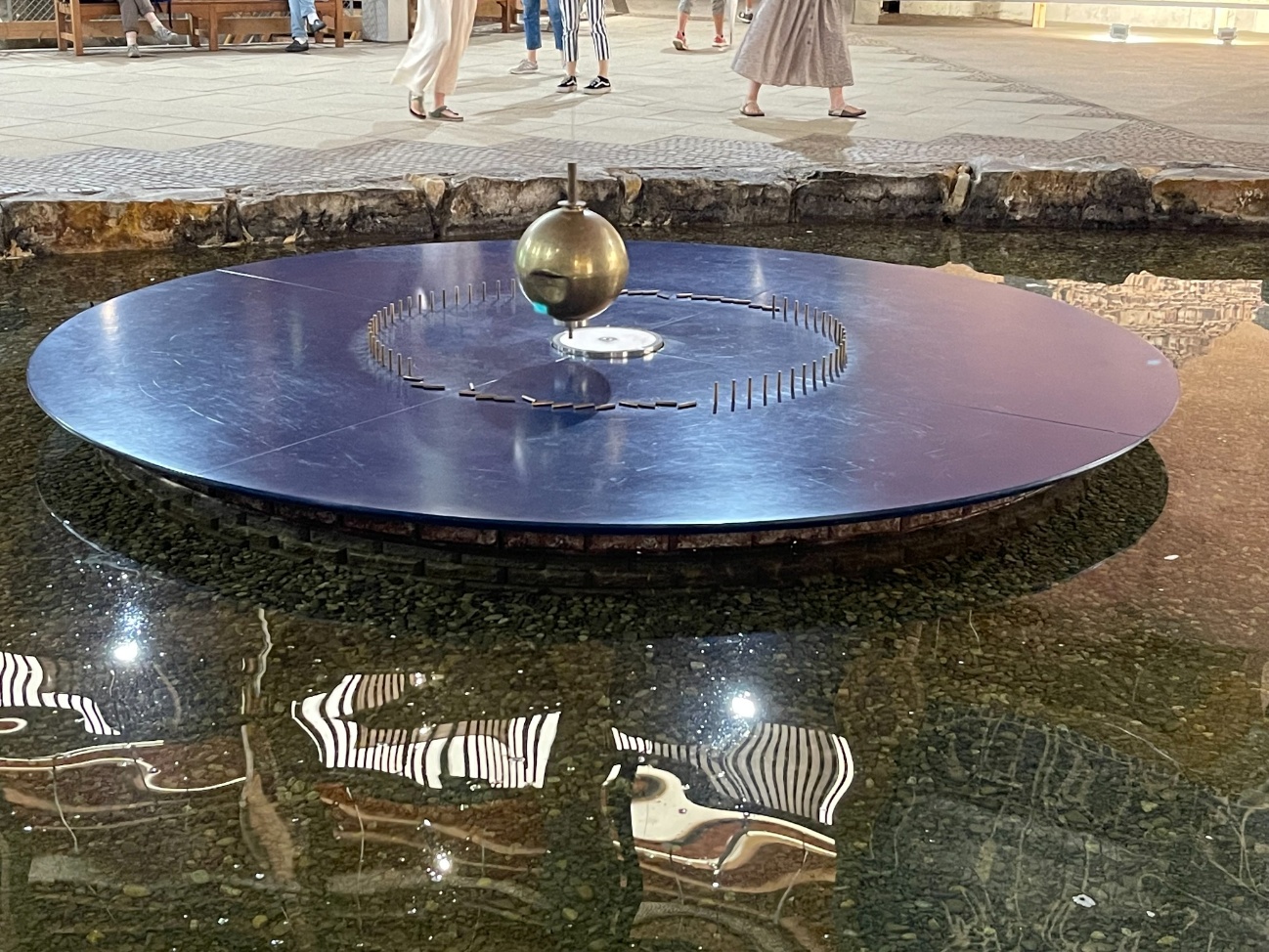
Interactive science in the Millennium Tower: the Foucault pendulum makes physical principles visible.
A particular strength of the example is the combination of formal knowledge and informal discovery. Guided tours and discovery programmes are available for school classes and children’s groups, while individual visitors can explore the exhibition independently. The tower therefore supports different learning styles and ages and turns a park visit into a memorable learning experience beyond the classroom.
The Elbauenpark complements the tower with outdoor educational spaces, nature experiences and opportunities for movement and recreation. This combination supports holistic learning: scientific understanding, environmental awareness, social interaction, curiosity and physical activity are connected in one place.
Context: #
The Elbauenpark demonstrates how a regenerated urban site can become a multifunctional learning landscape. The Millennium Tower acts as a visible educational anchor, while the surrounding park provides green space, biodiversity, cultural events and outdoor activities. This makes the example directly relevant to the New European Bauhaus principles and to the Quintuple Helix Model, in which environment, society, politics, economy and education interact.
Learning Objectives: #
Understand how an urban park can combine ecological regeneration, recreation and science education
Explore how interactive exhibits support experiential and intergenerational learning
Analyse the role of public institutions and municipal investment in maintaining accessible learning infrastructure
Develop ideas for transferring hands-on science and nature learning to other cities and communities
Session Plan: #
Introduction to learning landscapes and urban regeneration (15 min)
Case study analysis: Elbauenpark and Millennium Tower, Magdeburg (30 min)
Workshop: designing an interactive learning station for a local park or community space (45 min)
Reflection and feedback (30 min)
NEB Principles Identified in the Example #
Sustainability
The Elbauenpark is an example of long-term urban regeneration. A formerly restricted and heavily altered site was transformed into a publicly accessible green park. The result is not only an attractive landscape but also a durable ecological and social resource. Outdoor learning, biodiversity, walking and cycling, cultural use and recreation are integrated rather than separated.
Inclusion
The park offers learning and leisure opportunities for different generations and visitor groups. The Millennium Tower is designed for independent exploration as well as guided learning. Special programmes for schools and children’s groups make the scientific exhibition usable as an extension of classroom teaching. Adults and families benefit from the same interactive approach, which reduces barriers to complex scientific topics.
Aesthetics
The landmark timber architecture of the Millennium Tower gives the park a strong identity. Inside, the spatial experience, historical reconstructions, mechanical installations and hands-on exhibits turn knowledge into an aesthetic and sensory encounter. The surrounding landscape links the architecture with open green space and views across Magdeburg.
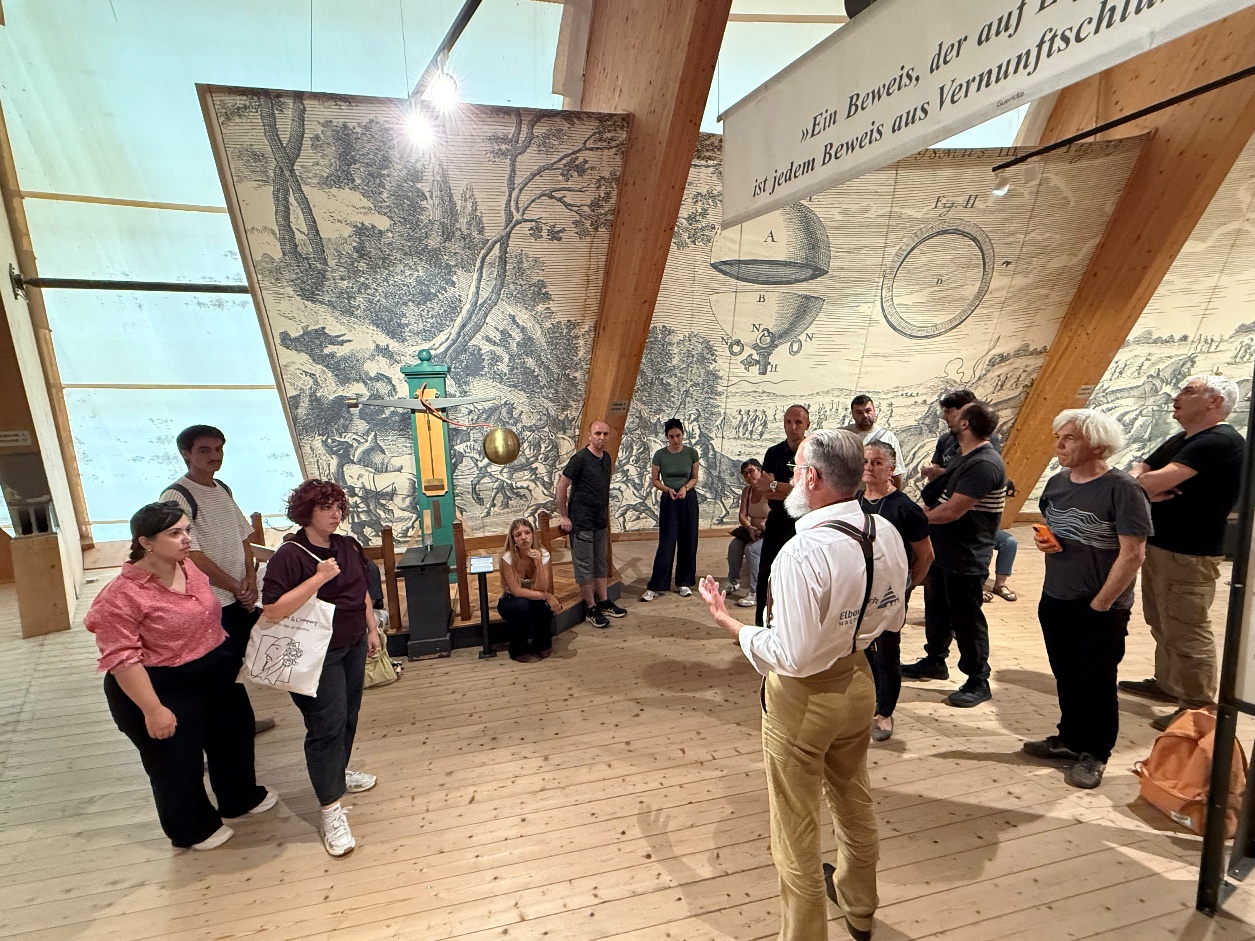
Guided learning in the Millennium Tower: explanation, observation and discussion take place directly at the exhibits.
✅ What the Sectors Can Learn: Urban Learning Park (QHM-Oriented) #
🌍 Environment #
The Elbauenpark shows how urban regeneration can create ecological, recreational and educational value at the same time.
Regenerated land can become long-term green learning infrastructure
Lesson: The park demonstrates that a previously restricted or degraded urban area can be redesigned as a green public space with lasting environmental and educational functions.
Indoor and outdoor learning strengthen environmental awareness
Lesson: Scientific exhibits in the tower are complemented by direct experiences in the park landscape. Visitors can move between technical history, natural systems and outdoor recreation.
👥 Society #
The Elbauenpark functions as a shared civic space where learning, recreation and culture bring together people of different ages and backgrounds.
Hands-on experiences create shared learning across generations
Lesson: The experiments in the Millennium Tower invite children and adults to test scientific principles together. Knowledge is not presented only as text; it becomes a shared activity and topic of conversation.
A park can combine education with social participation and recreation
Lesson: Visitors can learn in the tower, attend events, relax in the landscape and take part in outdoor activities during the same visit.
🏛️ Politics #
The Elbauenpark illustrates the importance of sustained municipal commitment. Large public learning landscapes require long-term planning, maintenance, programming and cooperation between park management, education partners and the city.
Major urban regeneration projects need a long-term public strategy
Lesson: The value of the park did not end with the 1999 Federal Garden Show. Continued operation transformed a temporary major event into permanent public infrastructure.
Education becomes stronger through institutional cooperation
Lesson: School programmes, guided tours, events and changing exhibitions require coordination between municipal bodies, educators, guides and cultural partners.
💶 Economy #
The Elbauenpark creates economic value through a combination of public infrastructure, tourism, education, events and local services.
Educational attractions strengthen the attractiveness of a city destination
Lesson: The Millennium Tower gives visitors a distinctive reason to come to Magdeburg and extends the park beyond conventional leisure use.
Continuous programming protects the value of public investment
Lesson: Guided tours, school offers, holiday activities and special exhibitions keep the site relevant for repeat visitors and different target groups.
🎓 Education #
Education is the central strength of the Millennium Tower. It turns scientific and technological history into direct experience and encourages visitors to learn through curiosity, action and discussion.
Interactive experiments make complex knowledge understandable
Lesson: Many exhibits allow visitors to reproduce principles in a simplified form. The Foucault pendulum, optical effects, sound, mechanics and the vacuum experiments associated with Otto von Guericke demonstrate that abstract ideas become memorable when they can be observed or tested.
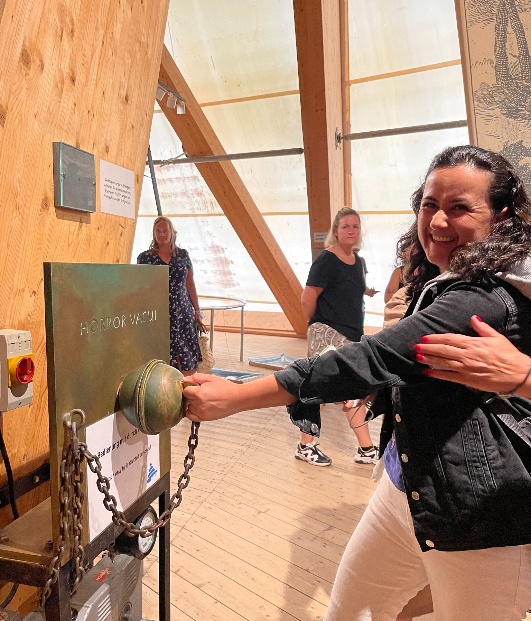
Visitors test the force of a vacuum themselves.
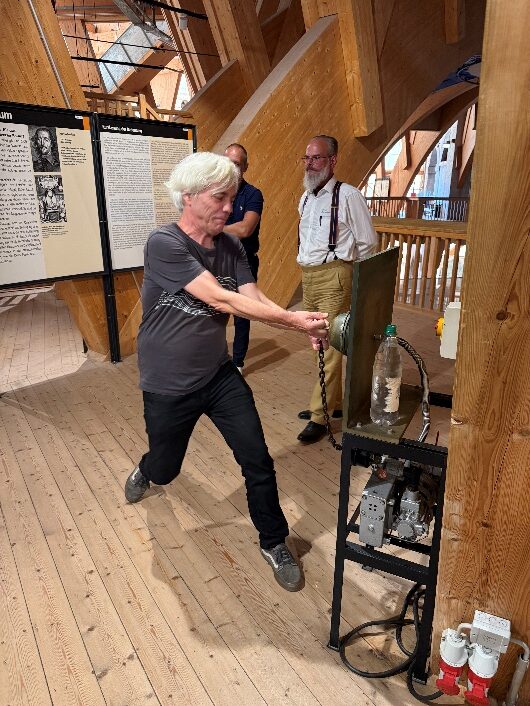
The same exhibit creates a memorable group learning experience.
🔧 Practical Steps for Implementation #
Identify a visible and accessible site that can connect green space with learning activities
Define a clear educational narrative, for example a journey through science, local history or environmental change
Combine permanent exhibits with hands-on stations that visitors can operate independently
Design programmes for school classes, families, adults and organised groups
Link indoor explanation with outdoor observation, movement and nature experience
Use local scientific and historical references to strengthen identification with the place
Provide active web links, booking information and practical visit guidance for teachers and group leaders
Communicate the site as both a leisure destination and a learning environment
✅ Transferability #
This model is transferable to:
Municipal parks seeking to add structured educational value
Former industrial or military sites being regenerated for public use
Science centres and museums wishing to connect exhibitions with outdoor learning
Schools and adult education providers seeking experiential learning destinations
Community organisations creating smaller interactive learning trails or mobile experiment stations
Official sources:
- Elbauenpark Magdeburg
- Millennium Tower – History and Science to Touch
- Offers for schools and childcare groups
- Guided tours for children and school classes
GP2: Baštalište – Citizen-Led Community Gardening and Land Reclamation in Peri-Urban Belgrade #
📍 Location: Slanci, Palilula Municipality, City of Belgrade, Serbia (peri-urban settlement, approx. 8–10 km from Belgrade city centre)
🔗 Main source: https://www.facebook.com/Bastaliste/
🔗 Additional sources:
- https://una.city/nbs/belgrade-fua/organic-community-gardening-belgrade
- https://prviprvinaskali.com/clanci/gmo/gradoviopstine/bastaliste-slanci-beograd.html
- https://www.energetskiportal.com/healthy-energy-is-created-in-bastaliste/
- https://www.urbanallotments.eu/case-studies/serbia.html
- https://www.danas.rs/vesti/klimatske-promene/urbane-baste-beograd-gradske-bastenske-zajednice-klimatske-promene-urbanizam/
- https://www.gradnja.rs/bastenske-zajednice-srbija/
- https://www.instagram.com/bastaliste_beograd/
Introduction #
Baštalište is a citizen-founded community garden established in April 2013 in Slanci, a peri-urban settlement within Belgrade’s Palilula municipality, roughly 8–10 km from the city centre. It was created through a partnership between two civil society organisations, Ama – Centre for the Care of People and Nature and the Belgrade Flower Festival, and is widely recognised as the first formal garden community in Belgrade and Serbia, at a time when the very concept of a “community garden” was virtually unknown in the country.
The initiative was led by Katarina Milenković, a communications graduate with no prior agricultural background, who taught herself organic growing techniques through online research, volunteering on organic farms abroad, and conversations with elderly Slanci residents who still remembered pre-industrial farming methods practiced by their grandparents. The garden began modestly, on a small plot in front of Milenković’s own house, with just five founding members in its first season.
A defining feature of Baštalište’s early development was the direct support it received from local authorities. In its second season, the president of the Slanci local community council (Savet Mesne zajednice) helped the group secure access to a larger plot — a former vineyard that had been abandoned for roughly 30 years and was overgrown with garbage, shrubs, and thorns. This early, informal backing from a local self-government body was decisive: without it, the initiative could not have expanded beyond its original micro-scale pilot. Members then spent three months of intensive volunteer labour clearing the land before it could be subdivided into individual growing plots, today comprising 14 to 22 parcels (sources vary between 40 m² and 50 m² per plot) sharing common infrastructure, including a drip irrigation system and a communal pavilion used for workshops and gatherings.
Despite this local-level support, Baštalište has never received a formal land grant or legal status from the City of Belgrade itself. Katarina Milenković and later advocates, including Sabina Kerić of the association Ekonaut, have campaigned since 2014 for the City to formally recognise and regulate garden communities — an initiative that generated public visibility but, as of 2025, had still not produced binding municipal policy. A City Planning Institute study has nonetheless identified 70 potential sites across Belgrade for future urban gardens, and researchers estimate around 100 hectares of city land is already informally used for gardening without legal status.
Context: #
Baštalište combines organic food production, land reclamation, and civic self-organisation into a single grassroots model. Its non-commercial, membership-funded structure and its reliance on early, informal local-government cooperation make it a distinctive counterpoint to corporate- or donor-funded green projects, and a strong illustration of circular economy principles applied to land, food, and community resource loops, directly relevant to New European Bauhaus and Quintuple Helix Model frameworks.
Learning Objectives: #
Understand how derelict urban and peri-urban land can be reclaimed for organic food production through citizen action
Analyse the role of informal local-government support in enabling grassroots green initiatives to scale
Explore the governance and land-tenure challenges facing community gardens without formal municipal recognition
Develop strategies for building citizen-led circular food and land-use models transferable to other communities
Session Plan: #
Introduction to community gardening as a circular land-use and food-resilience strategy (15 min)
Case study analysis: Baštalište – Slanci, Belgrade (30 min)
Workshop: designing a community garden model for your own locality, including local-authority engagement strategy (45 min)
Reflection and feedback (30 min)
NEB Principles Identified in the Example #
Sustainability
Sustainability underpins the entire Baštalište model. The garden reclaims previously derelict, weed-and-waste-covered land and returns it to productive organic use, applying a strict ban on synthetic fertilisers and chemical pesticides for all members. Composting of organic waste and the use of natural, macerate-based sprays replace chemical inputs, while members have discussed future additions of rainwater harvesting for irrigation and renewable energy, since the site is not connected to the electricity grid. A professional organic-agriculture association visits monthly to inspect plots and advise members, embedding continuous ecological improvement into the garden’s operating culture.
Inclusion
Inclusion is expressed through Baštalište’s open, non-commercial membership model. New members are admitted annually through a public call, an open-house day, and an interview process run by an admissions committee of experienced members, ensuring accessibility to newcomers regardless of background. The garden draws in a mixed group of city dwellers, WWOOF volunteers, Slanci villagers, and local schoolchildren from the “Ivan Milutinović” primary school, bridging urban and rural participants around a shared, low-cost activity that builds food security and social connection.
Aesthetics
Aesthetics at Baštalište is expressed through the transformation of an abandoned, thorn-covered vineyard into an ordered, cared-for productive landscape, and through the communal pavilion and shared spaces that give the garden a distinct sense of place. Public events such as “Delicatessen Monday”, held at the Cultural Centre “Grad” for World Food Day, showcase dishes made entirely from the garden’s own harvest, turning the aesthetics of home-grown food into a public celebration of craft, care, and seasonal produce.
✅ What the Sectors Can Learn: Community Gardening (QHM-Oriented) #
🌍 Environment #
Baštalište demonstrates that neglected peri-urban land can be ecologically restored and made productive through citizen labour alone, without large capital investment or industrial inputs.
Derelict land can be reclaimed into productive organic ecosystems #
Lesson: A 30-year-abandoned vineyard, overrun with garbage and thorns, was cleared and converted into a fully functioning organic growing site within three months of volunteer labour.
A strict organic-only rule keeps ecological integrity central without heavy enforcement cost #
Lesson: The garden’s single binding rule for all members — no synthetic fertilisers or chemical pesticides — is simple to communicate and monitor, yet ensures consistent ecological outcomes across many independently managed plots.
Off-grid and water-scarce conditions can drive future circular innovation #
Lesson: Because the site lacks electricity grid connection, members have identified rainwater harvesting and renewable energy as necessary next steps for garden resilience.
👥 Society #
Baštalište shows that community gardening builds durable social bonds and knowledge transfer across generations and between urban and rural residents, functioning as a genuine civic commons.
Open, transparent membership processes build legitimacy and trust #
Lesson: Baštalište’s annual public call, open-house day, and peer-review admissions committee create a fair, transparent path to membership that avoids the perception of insider control.
Intergenerational and urban-rural knowledge exchange strengthens resilience #
Lesson: Elderly Slanci residents shared traditional farming knowledge with urban newcomers, while local schoolchildren and WWOOF volunteers also participate, creating a rich mix of local, traditional, and international knowledge.
Public food events turn private practice into shared civic culture #
Lesson: Baštalište’s public “Delicatessen Monday” event for World Food Day showcased dishes made entirely from the garden’s harvest, extending the initiative’s social value beyond its own membership.
🏛️ Politics #
Baštalište illustrates both the enabling power and the limits of local-government engagement — early, informal support from a local community council was decisive for the garden’s growth, yet the absence of formal city-level policy has left the initiative structurally vulnerable.
Early informal support from local self-government can be the decisive factor enabling scale-up #
Lesson: The president of the Slanci local community council personally helped Baštalište secure access to the larger, abandoned vineyard plot in its second season — without this local-level intervention, the garden could not have grown beyond its original five-member pilot on a private residential plot.
Without formal city-level recognition, grassroots gardens remain structurally vulnerable #
Lesson: Despite a decade of advocacy since 2014, Belgrade has still not created a legal framework or formal land allocation policy for community gardens; a sister initiative in Šabac, which did receive a full hectare of public land, later collapsed due to persistent vandalism and theft, showing that informal or partial support alone is not sufficient for long-term security.
Grassroots advocacy can generate policy visibility even without binding outcomes #
Lesson: Baštalište’s founders launched Serbia’s first “Initiative for Formalisation of Garden Communities” in 2014, generating sustained public and media interest even though it did not yet produce binding city policy.
💶 Economy #
Baštalište operates on a minimal-cost, membership-funded model that generates food security and shared resource value without relying on commercial revenue or corporate sponsorship.
Membership-fee funding enables independence from corporate or donor control #
Lesson: Baštalište is financed purely through member fees covering shared infrastructure (irrigation, tools, the communal pavilion), rather than corporate sponsorship or public grants, giving members full control over the garden’s rules and direction.
Reclaiming idle land turns a liability into a productive local food asset #
Lesson: The abandoned vineyard plot, previously a neglected liability attracting waste dumping, was converted into a source of food production and shared value for dozens of households at negligible land cost.
Scaling requires stronger institutional and financial backing than membership fees alone provide #
Lesson: The Šabac sister-garden’s collapse despite receiving a full hectare of public land shows that land access alone is insufficient; without further institutional, security, and possibly financial support, even well-resourced replications can fail.
🎓 Education #
Baštalište operates as an experiential learning site where organic growing knowledge is transmitted through direct practice, mentorship, and intergenerational and international exchange, rather than formal instruction.
Self-taught, practice-based learning can substitute for formal agricultural training #
Lesson: Founder Katarina Milenković had no agricultural background and instead learned through online research, volunteering abroad, and direct conversations with elderly local residents — demonstrating that formal credentials are not a prerequisite for launching a successful learning-centred initiative.
International volunteer networks bring fresh practical knowledge into local communities #
Lesson: Baštalište’s connection to Ama Centre’s WWOOF Serbia network brings international volunteers with varied organic-farming experience directly into the garden, creating a continuous inflow of practical technique exchange.
School partnerships embed circular food literacy in the next generation #
Lesson: Students from the local “Ivan Milutinović” primary school participate directly in garden maintenance, giving children first-hand exposure to organic food production and land stewardship.
🔧 Practical Steps for Implementation #
Identify a founding core group: start small, even with as few as five members, on a modest available plot before scaling
Engage the local community council or lowest tier of self-government early, requesting introductory support for land access
Map nearby derelict or abandoned land (vacant lots, former agricultural plots) as candidate sites for reclamation
Organise a volunteer land-clearing phase, budgeting realistically for several months of labour on heavily neglected sites
Subdivide reclaimed land into individual member plots sharing common infrastructure (irrigation, tools, communal pavilion)
Establish a simple, enforceable organic-only cultivation rule, supported by periodic expert or peer inspection
Design a transparent annual membership process: public call, open-house day, written application, and a peer admissions committee
Set a modest annual membership fee calibrated only to cover shared infrastructure costs
Build partnerships with local schools, volunteer exchange networks (e.g., WWOOF), and cultural centres for education and outreach
Advocate consistently for formal municipal recognition and legal land-use protection, learning from both enabling and failed replication cases
Document and communicate impact (plots cultivated, members involved, events held) to strengthen the case for institutional support
✅ Transferability #
This model is transferable to:
Municipalities and local communities with derelict or underused peri-urban or urban land
Citizen groups and NGOs seeking low-cost, non-commercial food-security initiatives
Local self-government bodies (community councils, ward boards) seeking low-cost civic engagement projects
Schools and volunteer exchange networks seeking hands-on sustainability education partnerships
Cities developing municipal community-garden policy frameworks, using both Baštalište’s successes and the Šabac collapse as evidence
Regional community-gardening networks seeking to document and scale grassroots land-reclamation models
GP3: GUST – Someș Urban Garden Transilvania #
Citizen-Led Community Gardening and Urban Nature-Based Learning in Cluj-Napoca #
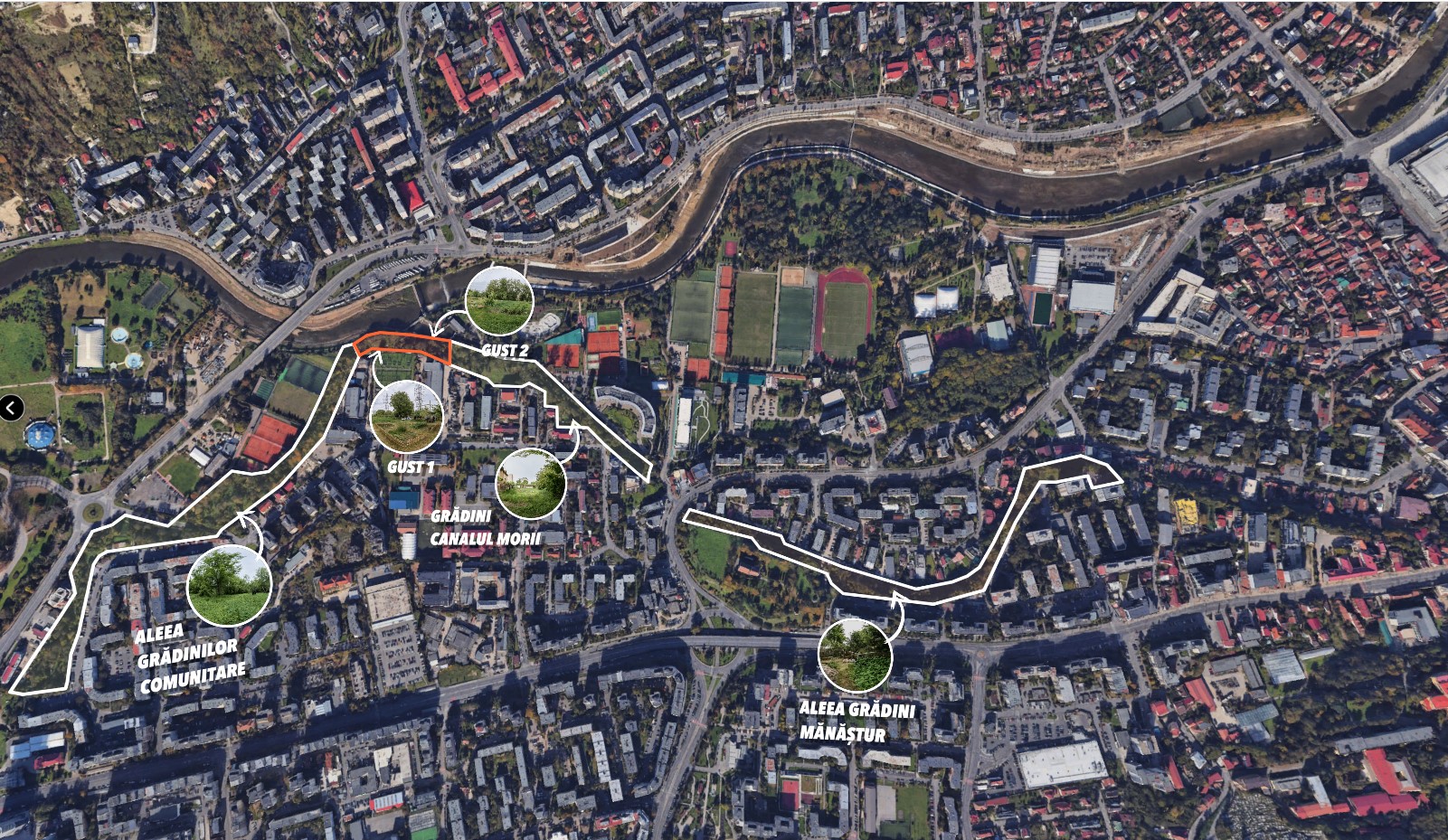
Location: Cluj-Napoca, Romania – near the Someș River, Canalul Morii and Parcul Rozelor
Main source: Sustainably Organized Society – Community Gardening (S.O.S) https://sustenabilorg.ro/gradinarit-comunitar/
Additional source:
- https://www.fundatiacomunitaracluj.ro/in-zona-ta/grila-proiecte-editie-pilot-2025-in-zona-ta/gradinarit-comunitar-in-zona-ta/
- https://www.clujlife.com/eveniment/1-mai-gradinaresc/
- https://www.transilvaniabusiness.ro/2026/01/21/a-aparut-reteaua-gradinilor-comunitare/
- https://gradinicomunitare.ro/harta/
Photos and videos: https://gradinirevendicate.ro/
Introduction #
GUST – Grădina Urbană Someșeană Transilvania is a pilot community garden developed in Cluj-Napoca by the Societatea Organizată Sustenabil (S.O.S.), together with residents living near the area and other civic activists. The garden was established in July 2023 as a practical demonstration of how community gardening could be introduced and developed within the urban environment.
The initiative emerged from concerns about the disappearance of informal gardens as urban development and new infrastructure projects transformed green spaces. Before the creation of GUST, civic actors had already been working to draw attention to informal gardens along the Someș and to promote their preservation and recognition.
The site has an important local history. Residents had been cultivating vegetables in the area for decades; historical accounts indicate that local cultivation activities began as early as 1984. The area was previously associated with the Agronomic Institute in Cluj and had been used as a feed-storage area for a teaching farm.
GUST therefore does not represent the creation of a completely new practice. Instead, it builds upon existing local gardening knowledge and community use of urban land, transforming an informal practice into a visible pilot for community gardening.
The garden has been accepted by the municipality as part of the development and extension of the Rozelor Park area, although the involvement of the municipality has remained limited. The pilot has consequently been used by civic organisations to demonstrate the potential of community gardening and to advocate for a broader local framework.
An important dimension of the GUST experience is its connection with public policy. S.O.S., together with other partners, contributed to a proposal for a local public policy on community gardens within the Cluj Metropolitan Area. The policy proposal was developed through a participatory process and addresses community gardens as nature-based solutions, tools for urban regeneration, ways of connecting communities with nature and components of green infrastructure.
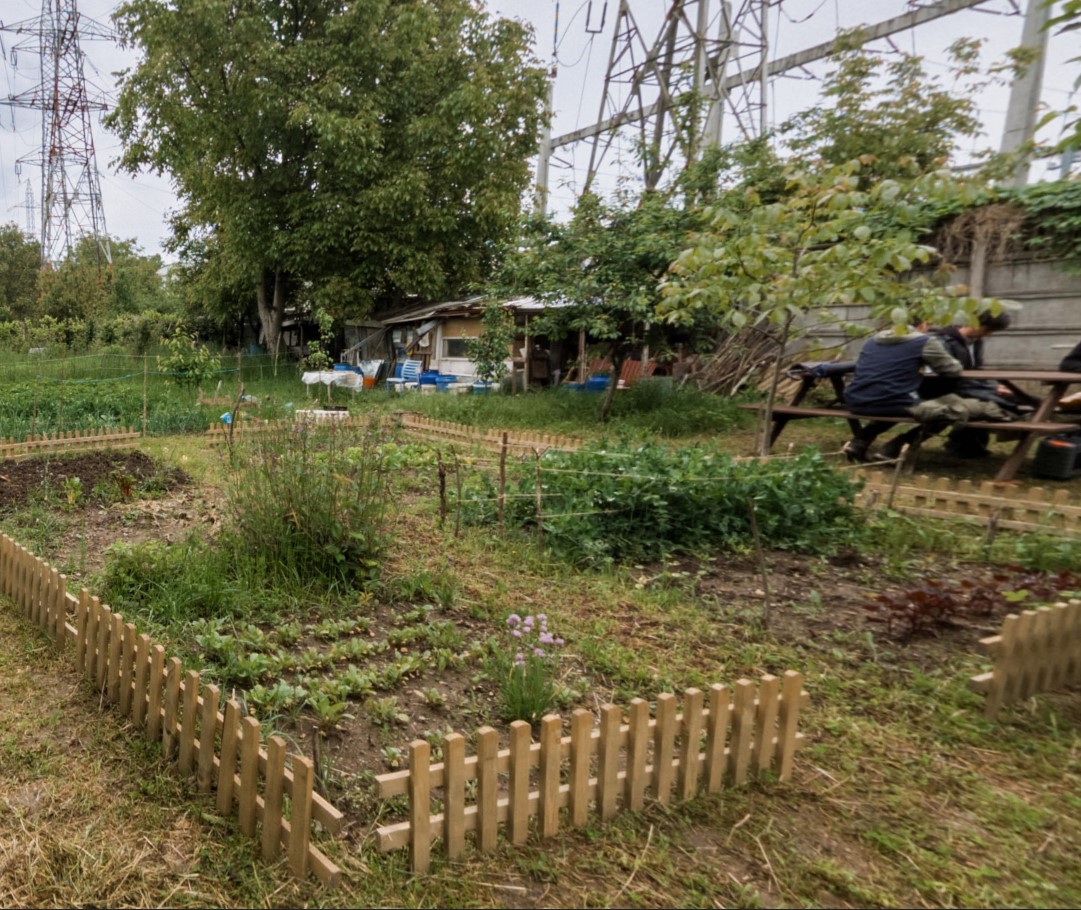
GUST is therefore more than a place where vegetables are grown. It functions as a living laboratory for sustainable urban development, combining community participation, local knowledge, environmental action, social interaction, food production, education and policy innovation.
Context #
GUST demonstrates how a relatively small community-led intervention can connect several dimensions of urban sustainability.
The initiative connects:
urban gardening;
protection of green spaces;
local food production;
nature-based solutions;
community participation;
intergenerational knowledge exchange;
environmental awareness;
civic engagement;
public-policy development;
informal and experiential learning.
The garden has also been promoted as a space for meeting between generations, knowledge exchange, observation and learning. Its location makes it particularly suitable for connecting everyday urban life with environmental and sustainability education.
Learning Objectives #
Understand how community gardening can function as a nature-based solution in an urban environment.
Analyse how an informal local practice can be transformed into a community-led pilot initiative.
Identify the environmental, social, political, economic and educational dimensions of community gardening.
Understand the role of citizens and civic organisations in developing local public-policy proposals.
Explore how community gardens can become places for intergenerational and experiential learning.
Develop ideas for transferring the GUST approach to another neighbourhood, city or community.
Design a basic implementation plan for a local community garden.
Session Plan #
- Introduction to community gardening and urban sustainability – 15 min
Introduction to community gardens as nature-based solutions and examples of urban food-growing spaces.
- Case study analysis: GUST – Cluj-Napoca – 30 min
Presentation of the GUST initiative, its local context, stakeholders, challenges and potential for replication.
- Workshop: Designing a community garden for a local community – 45 min
Participants identify a potential site and develop a basic model covering environmental, social, political, economic and educational functions.
- Reflection and feedback – 30 min
Participants discuss what elements of GUST could be transferred to their own locality and what would need to be adapted.
NEB Principles Identified in the Example #
Sustainability #
Sustainability is central to GUST because the initiative promotes community gardening as a nature-based solution and as a way of maintaining and activating urban green spaces. The wider policy proposal developed in Cluj connects community gardens with urban regeneration, green infrastructure and reconnection between communities and nature. The initiative also proposes the use of community composting as a way of processing plant residues locally and transforming organic waste into a natural fertiliser for the garden.
Inclusion #
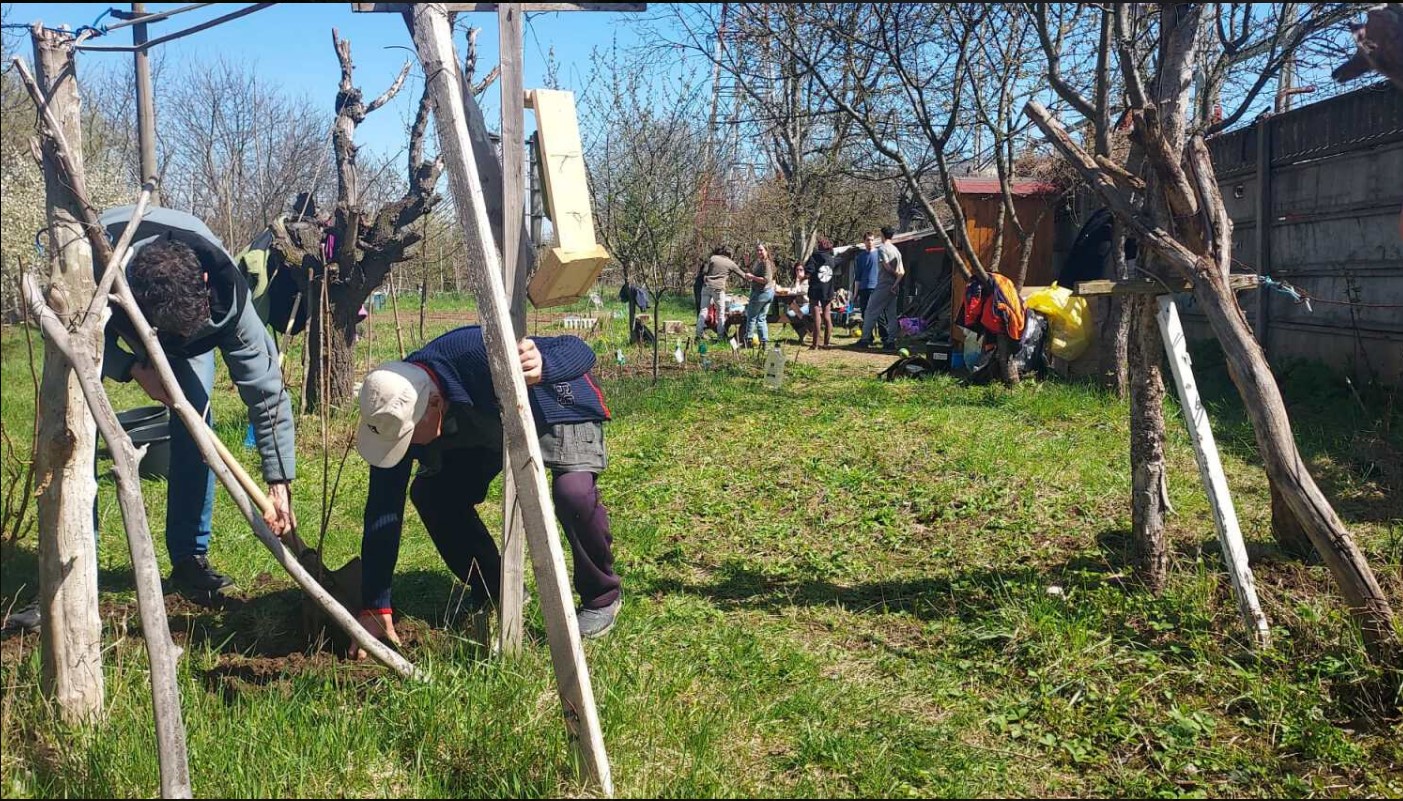
GUST creates a shared space where residents can meet, work together and exchange knowledge. The initiative is explicitly described as a potential meeting place between generations and as a space for knowledge exchange and learning. Community gardening can therefore provide a relatively accessible form of participation that connects people through a common practical activity.
Aesthetics #
The aesthetic dimension is expressed through the transformation and care of an urban green space and through the relationship between gardening, nature and the surrounding public space. A community garden can contribute to people’s perception of their neighbourhood by transforming a functional or underused space into a place associated with food, plants, social interaction and care. In the NEB context, this dimension is important because sustainability is not considered separately from the quality of people’s everyday experience.
What the Sectors Can Learn: Community Gardening (QHM-Oriented) #
🌍 Environment #
GUST demonstrates that community gardening can function as a nature-based solution for urban areas, connecting green infrastructure, food growing, biodiversity and community stewardship. The Cluj policy proposal specifically identifies community gardening as a way to connect communities with nature and strengthen urban green infrastructure.
Community gardens can protect and activate urban green infrastructure #
Lesson: Urban green spaces can provide ecological, social and food-production functions simultaneously. GUST demonstrates how a community garden can maintain a productive relationship between citizens and an urban green area.
Community composting can close local organic-resource loops #
Lesson: GUST has been identified as a suitable location for a community composting station where plant residues could be transformed locally into natural fertiliser. This demonstrates how gardening can be connected with circular management of organic resources.
Local food production reconnects citizens with nature #
Lesson: GUST demonstrates how growing vegetables in an urban environment can reconnect residents with food production and natural processes.
👥 Society #
GUST demonstrates that community gardening can create a shared civic space where people meet, exchange knowledge and participate in a common activity.
Community gardening creates opportunities for intergenerational knowledge exchange #
Lesson: GUST is intended as a meeting place between generations and as a space for knowledge exchange and learning.
The history of the site also demonstrates the value of local knowledge: people who have cultivated gardens in the area for decades possess practical knowledge that can be shared with newer generations.
Shared practical activities strengthen community connections #
Lesson: Working together on a garden provides an accessible reason for residents to interact and cooperate.
Community participation can transform a local space into a civic asset #
Lesson: GUST was created together with residents and civic activists, demonstrating the potential of citizen involvement in shaping local green spaces.
🏛️Politics #
GUST provides an important lesson about the relationship between grassroots initiatives and public policy.
Pilot projects can provide evidence for public-policy development #
Lesson: GUST was created as a pilot to demonstrate how community gardening could work in practice, while the organisations involved also contributed to a local public-policy proposal for community gardens.
Civic organisations can contribute to policy innovation #
Lesson: The Cluj experience shows that public policy can emerge from collaboration between civic organisations, residents and actors connected to local administration. The policy proposal was developed as a participatory process involving several organisations and institutions.
Formal recognition is important for long-term development #
Lesson: The GUST experience also demonstrates the challenge of scaling community gardening when a broader regulatory framework is not yet established. S.O.S. notes that further efforts are needed to scale the practice throughout the city.
💶 Economy #
GUST demonstrates an alternative form of urban value creation in which the main benefit is not commercial profit but shared social, environmental and food-related value.
Urban gardening can create value from existing spaces #
Lesson:Community gardening can increase the social and practical value of urban land without requiring the transformation of the site into a conventional commercial development.
Community gardens can support local food resilience #
Lesson: GUST demonstrates how residents can participate directly in growing vegetables and herbs within the city. Local food production can strengthen people’s connection with food systems and increase awareness of seasonal and locally produced food.
Community gardening can stimulate local partnerships #
Lesson: A community garden can become a meeting point between civic organisations, residents, educational institutions, businesses and public authorities.
🎓 Education #
Education is a central potential of GUST. The garden is described as a place of observation and learning, while its community dimension creates opportunities for knowledge exchange between generations.
Community gardens create experiential learning environments #
Lesson: GUST demonstrates that sustainability can be learned through direct interaction with plants, soil, food and other people rather than only through classroom instruction.
Local knowledge can become an educational resource #
Lesson: The history of gardening in the area provides an opportunity to preserve and transmit local knowledge.
Community gardening can develop transversal skills #
Lesson: Gardening requires communication, teamwork, planning, problem solving, responsibility and cooperation.
Community gardens can connect formal and informal education #
Lesson: A garden can bring together schools, families, residents, NGOs and specialists in one learning environment.
🔧 Practical Steps for Implementation #
To transfer the GUST model to another locality:
- Identify a founding community group willing to take responsibility for the pilot.
- Map existing informal gardens and underused green spaces in the neighbourhood.
- Assess land ownership, accessibility and environmental conditions before selecting a site.
- Identify local residents with gardening experience and involve them as knowledge holders.
- Engage the relevant local authority at an early stage and clarify the legal and administrative conditions for using the space.
- Develop a simple co-design process involving residents and potential users.
- Start with a small pilot before attempting city-wide implementation.
- Create basic rules covering cultivation methods, shared spaces, maintenance and responsibilities.
- Include circular practices, particularly composting and responsible use of water and materials.
- Develop educational activities for children, young people, adults and older residents.
- Organise public events to make the garden visible to the wider community.
- Document the process and results through photographs, participation data, stories and learning outcomes.
- Evaluate the pilot from environmental, social, political, economic and educational perspectives.
- Use the evidence to develop policy recommendations for wider implementation.
- Create partnerships with schools, NGOs, universities, businesses and public authorities.
- Develop a sustainable management and funding model before scaling the initiative.
Transferability #
The GUST model is transferable to:
municipalities seeking low-cost nature-based solutions;
neighbourhoods with informal or underused gardens;
citizen groups and environmental NGOs;
schools and adult education organisations;
universities and research institutions;
social organisations working on community participation;
local authorities developing green infrastructure;
cities interested in community-gardening policies;
organisations promoting local food systems and circular economy;
communities seeking intergenerational learning opportunities.
The model is particularly suitable for places where there are existing informal gardening practices, unused or underused green spaces, active residents and organisations willing to facilitate community participation. However, transfer should focus on the principles and process, not on copying the physical design of GUST. Each locality should adapt the model to its land ownership, legal framework, environmental conditions, community structure and available resources.
The most important lesson from GUST is that a community garden can become much more than a place for growing food. A community garden can be: an environmental solution; a social meeting place; a laboratory for local policy; a generator of shared local value; an outdoor learning environment. GUST demonstrates how a small, locally rooted initiative can generate knowledge that informs wider urban development.
GP4: Urban Regeneration and Community Gardening at the Butcher’s Bastion #
Location: Baia Mare, Maramureș County
Main source: Museum of History and Archaeology Maramureș – Official Portal (Butcher’s Bastion Section): https://www.muzeubaiamare.ro/category/bastionul-macelarilor-baia-mare/
Additional sources:
National Heritage Institute (cIMeC) – Cultural Heritage Database: Bastionul Măcelarilor din Baia Mare (Fișă de monument). Available at: http://ghidulmuzeelor.cimec.ro/id.asp?k=2114
Baia Mare City Hall – Official Tourism & Heritage Portal: Atractii Turistice: Bastionul Măcelarilor. Available at: https://www.baiamare.ro/ro/Descopera-Baia-Mare/Obiective-turistice-si-atractii/Atractii-turistice/Bastionul-Macelarilor/
Kacsó, Carol (2011). Repertoriul arheologic al județului Maramureș (2nd edition). Baia Mare: Editura Bibliotheca Marmatia.
European Commission. New European Bauhaus: Beautiful, Sustainable, Together. Official Policy Framework. Available at: https://new-european-bauhaus.europa.eu/index_en
Mihali, Nicoară & Mihail, Tudor (2003). Pintea Viteazul. Oșteanul de la Baia. Editura Proema (For historical context regarding the 1703 events at the South Gate).
Photos: https://www.facebook.com/BastionulMacelarilorBM/photos, https://www.facebook.com/profile.php?id=61572356025551&sk=photos
Introduction #
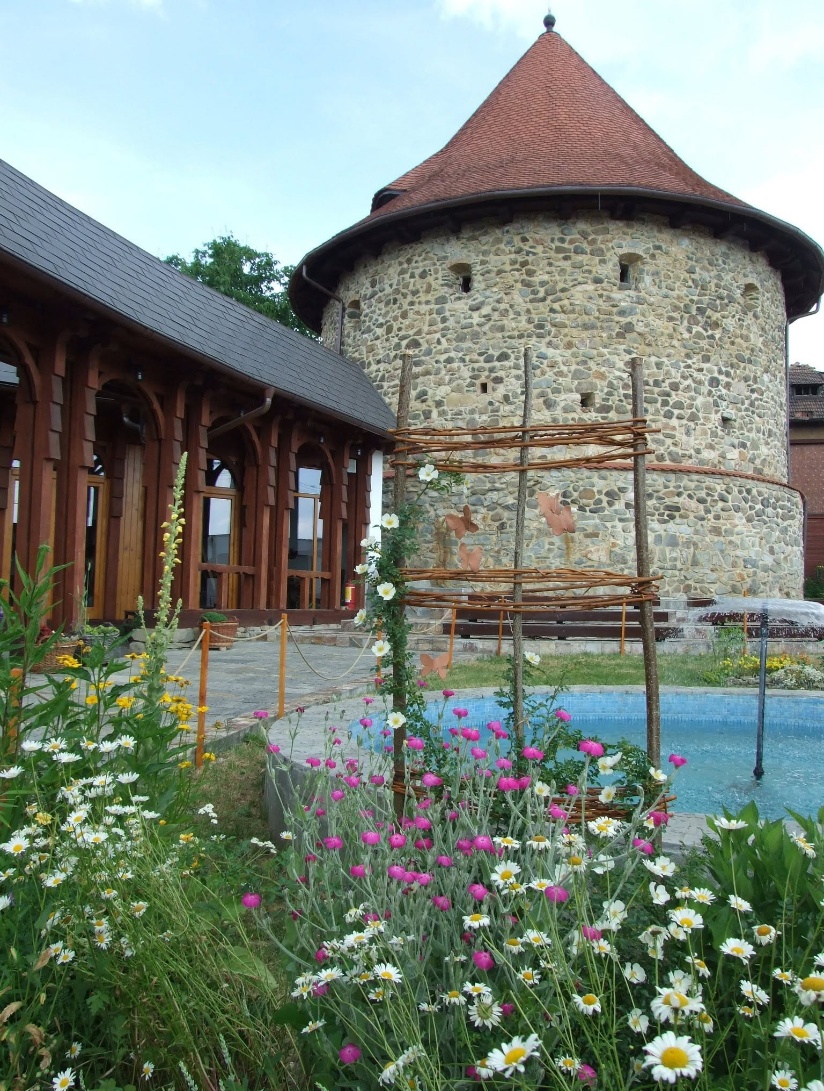
The Butcher’s Bastion (Bastionul Măcelarilor), also known historically as the Munitions Tower (Turnul Munițiilor), is the only fully preserved tower in the medieval fortification system of Baia Mare, located in Maramureș County, Romania. Originally erected around 1547 under the rule of Gașpar Drágfi to guard the city’s South Gate (Poarta Maghiară), the circular stone structure embodies the strategic and economic significance of Baia Mare as a free royal town famous for its rich gold and silver deposits. Entrusted to the Guild of Butchers, one of the wealthiest and most influential medieval guilds in the region, the bastion served both a defensive function and a symbolic role in civic responsibility.
Over the centuries, the site became closely linked to local identity, most notably defined by the events of August 1703, when the famous anti-Habsburg outlaw Pintea Viteazul was killed in an ambush near its gates. Following extensive restoration works between 2009 and 2011 funded by European development programs, the monument was integrated into the public circuit as an external department of the County Museum of History and Archaeology Maramureș. Today, the bastion hosts cultural exhibitions, craft workshops (such as weaving and pottery), and seasonal community meetings, bridging historical memory with contemporary social life.
Despite its successful architectural conservation, the Butcher’s Bastion functions within a dense urban ecosystem defined by high traffic, environmental pollution, and proximity to the city’s primary food market (Piața Izvoarele). This spatial context creates a pressing requirement for accessible green spaces that foster urban biodiversity, social cohesion, and environmental education. In reaction to these challenges, the concept of a community garden, an integrated “Living Garden” (Grădina Vie), provides an innovative framework for transforming the bastion’s courtyard into an active agro-cultural and eco-social hub.
This Good Practice project explores how the principles of community gardening, urban permaculture, and circular economy can be applied to a Class A historical monument. Rather than treating the medieval tower as a static museum piece, the initiative envisions the site as an adaptive, living organism where heritage preservation and ecological regeneration reinforce one another. By introducing non-invasive, raised wooden planting beds, rain-harvesting systems, and organic composting infrastructure, the project creates an open space where residents, elderly citizens, students, and local artisans can cooperate to cultivate heirloom crops, medicinal herbs, and plants associated with traditional Maramureș crafts.
Context #
The Butcher’s Bastion demonstrates how a historic heritage site can be transformed into a living, multifunctional community space without compromising its historical character. The initiative therefore does not replace the cultural function of the Bastion. It adds a new layer to it: the historic site becomes a place where people can experience history, nature, community and learning together.
The proposed garden combines:
heritage preservation – respecting the medieval structure and archaeological layers;
urban greening – introducing plants and biodiversity;
community gardening – creating opportunities for residents to participate;
circular economy – composting organic residues and using rainwater;
traditional knowledge – connecting plants with local crafts and natural dyes;
education – creating opportunities for schools and intergenerational learning.
Learning Objectives #
Understand how a historical heritage site can be connected with sustainable urban development and community gardening.
Identify the main NEB principles present in the example: sustainability, inclusion and quality of experience/aesthetics.
Recognize how community gardening can contribute to biodiversity, urban greening and circular resource management.
Explain how low-impact and reversible interventions can be used in protected heritage environments without damaging archaeological or historical features.
Analyse how the “Living Garden” concept connects heritage, environment, community, traditional knowledge and education.
Identify opportunities for intergenerational learning through gardening, traditional crafts, seeds and local knowledge.
Understand how composting, rainwater harvesting and reuse of organic resources can support circular-economy practices.
Explore how museums, local authorities, residents, schools, NGOs and local artisans can collaborate in the management of a community space.
Develop ideas for adapting the Butcher’s Bastion model to other historic buildings, courtyards or protected urban spaces.
Design a basic implementation plan for a heritage-based community garden, taking into account environmental, social, cultural, educational and heritage-protection requirements.
Session Plan #
Introduction to heritage, community gardening and urban sustainability – 15 min
Introduction to the relationship between cultural heritage, urban greening and community gardening, using the Butcher’s Bastion as an example of how a historic site can become a living and sustainable community space.
Case study analysis: Butcher’s Bastion – Baia Mare – 30 min
Presentation of the Butcher’s Bastion, its historical and urban context, the “Living Garden” concept, proposed stakeholders, environmental challenges and opportunities for combining heritage conservation, community gardening, biodiversity and circular practices.
Workshop: Designing a “Living Garden” for a heritage site – 45 min
Participants identify a historical or culturally significant site in their own locality and develop a basic model for a community garden, considering heritage protection, environmental sustainability, social participation, local partnerships and educational activities.
Reflection and feedback – 30 min
Participants discuss which elements of the Butcher’s Bastion “Living Garden” model could be transferred to their own locality, what adaptations would be necessary, and how heritage, nature, community and education could be connected.
NEB Principles Identified in the Example #
The community gardening project at the Butcher’s Bastion demonstrates comprehensive alignment with the core values of the New European Bauhaus (NEB) by integrating sustainability, social inclusion, and aesthetics into the revitalization of a Class A historical monument.
Sustainability #
From a sustainability perspective, the initiative directly integrates circular economic practices into the site’s physical and social management. By introducing non-invasive, raised wooden planting beds (raised beds), the project avoids disturbing the underlying archaeological layers while encouraging urban permaculture. The garden prioritizes renewable and compostable materials, reliance on local heirloom seeds (Seed Sharing), rainwater harvesting from the annex roofs, and organic composting of green waste sourced both from the garden and the neighboring municipal market. This closed-loop resource management lowers environmental impact, lowers dependence on synthetic inputs, and improves urban biodiversity by attracting key pollinators like bees and butterflies to a dense, asphalt-heavy urban area.
Inclusion #
In terms of inclusion, the project positions social equity and civic co-creation at its center. By granting a shared, accessible green space adjacent to a busy commercial district, the initiative bridges generational and social divides. Residents, particularly elderly individuals living in nearby apartment blocks with limited access to nature, are invited to participate through programs like “Adopt a Bed” alongside students and volunteers. Furthermore, the garden functions as a platform for intergenerational knowledge transfer, where customary ecological wisdom regarding native herbs and dye plants is preserved and shared alongside workshops hosted by local artisans. The site transforms from a static historical enclosure into a participatory civic hub that reinforces social cohesion, belonging, and collective stewardship.
Aesthetics #
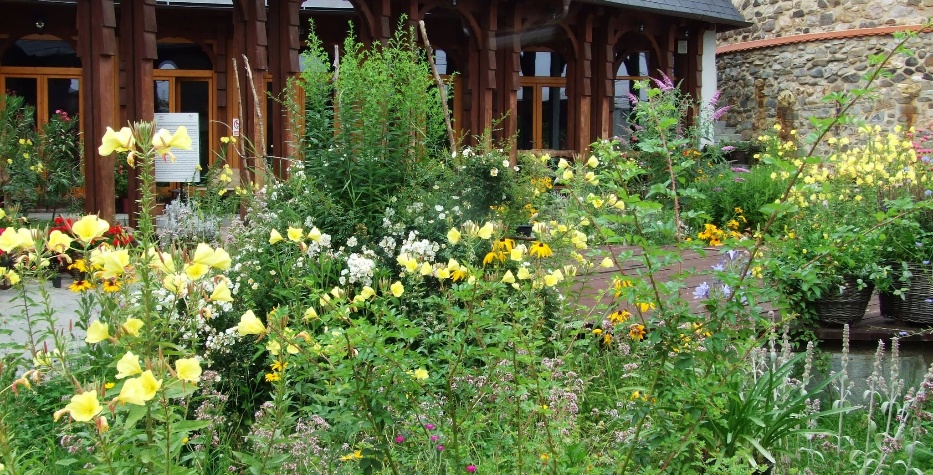
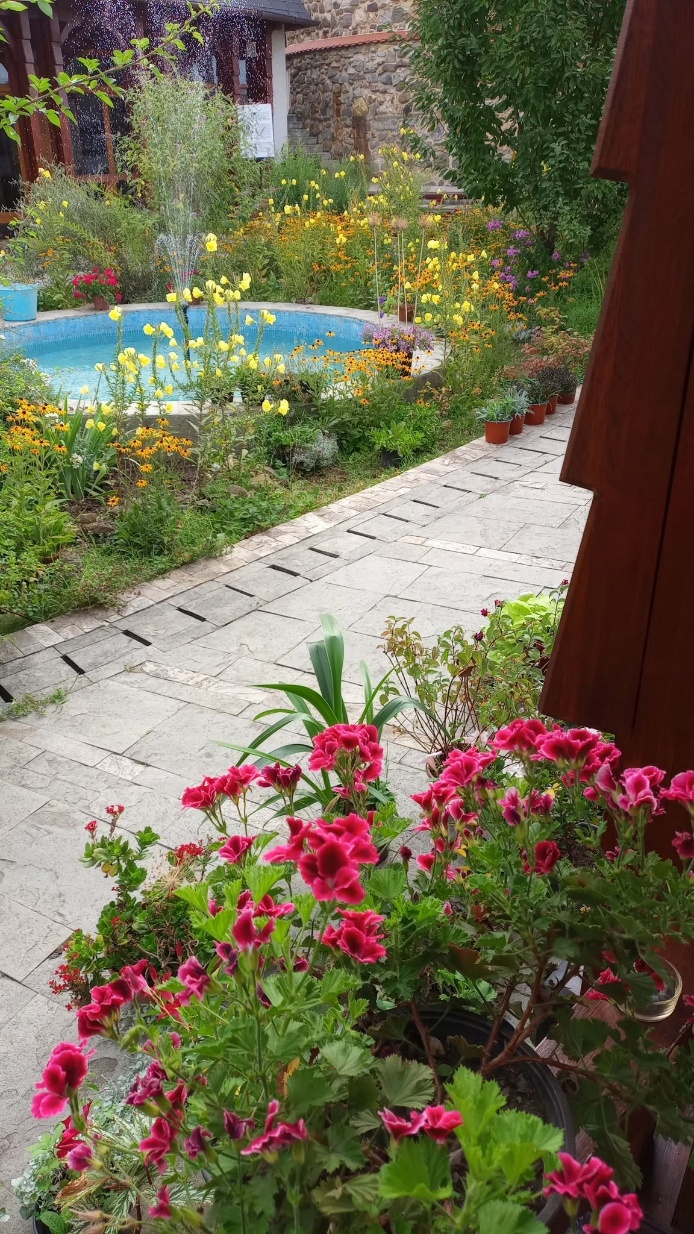
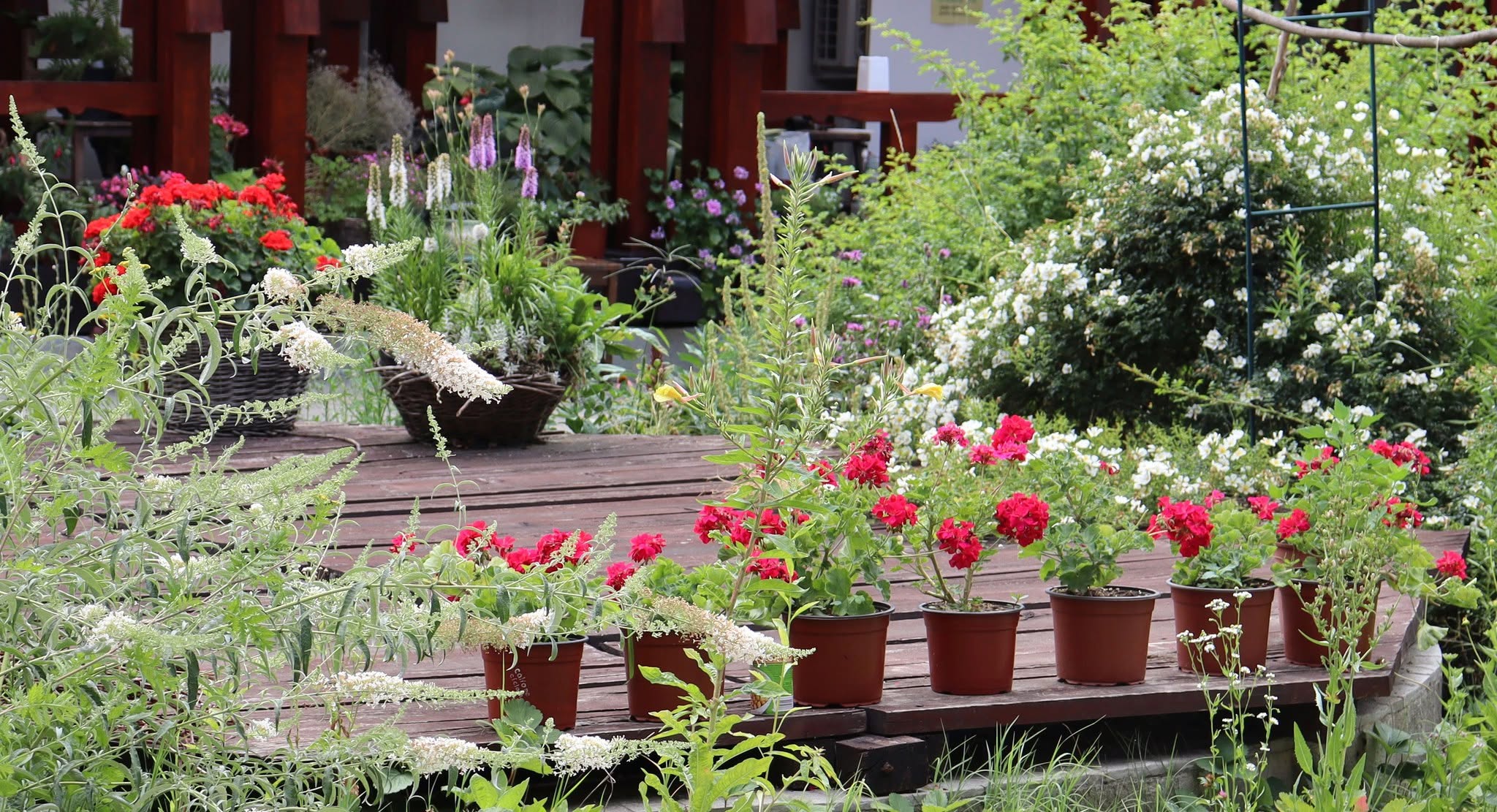
The NEB framework’s aesthetic dimension is clearly reflected in the balanced integration of natural elements with medieval stone architecture. The warm textures of local timber, vivid greenery, and aromatic plant displays soften the massive volcanic rock walls of the 16th-century fortification, creating a multisensory refuge in the heart of Baia Mare. Beauty is approached not as a superficial ornament, but as an agent for emotional connection: by making sustainable living visually attractive and experiential, the garden stimulates a deeper public appreciation for both built heritage and nature-based solutions. In doing so, the Butcher’s Bastion demonstrates how historical preservation and ecological innovation can merge to enhance the quality of life in contemporary cities.
What the Sectors Can Learn: Community Gardening (QHM-Oriented) #
🌍 Environment #
The Butcher’s Bastion example demonstrates that environmental regeneration in dense urban heritage areas does not necessarily require heavy infrastructure or invasive interventions. Low-impact community gardening, nature-based solutions and urban permaculture can introduce ecological functions while respecting archaeological and structural constraints. Raised wooden beds and vertical growing systems allow cultivation on paved or historic surfaces without excavating or damaging underlying archaeological layers.
Community gardening as a low-impact nature-based solution in heritage areas #
Lesson: The Butcher’s Bastion example demonstrates that community gardening can contribute to environmental regeneration in protected heritage areas without compromising their historical and archaeological value. This approach shows that heritage conservation and environmental sustainability can coexist, allowing historic urban spaces to support biodiversity, community participation and ecological learning while preserving their cultural identy.
Urban community gardens as biodiversity and micro-climate refuges #
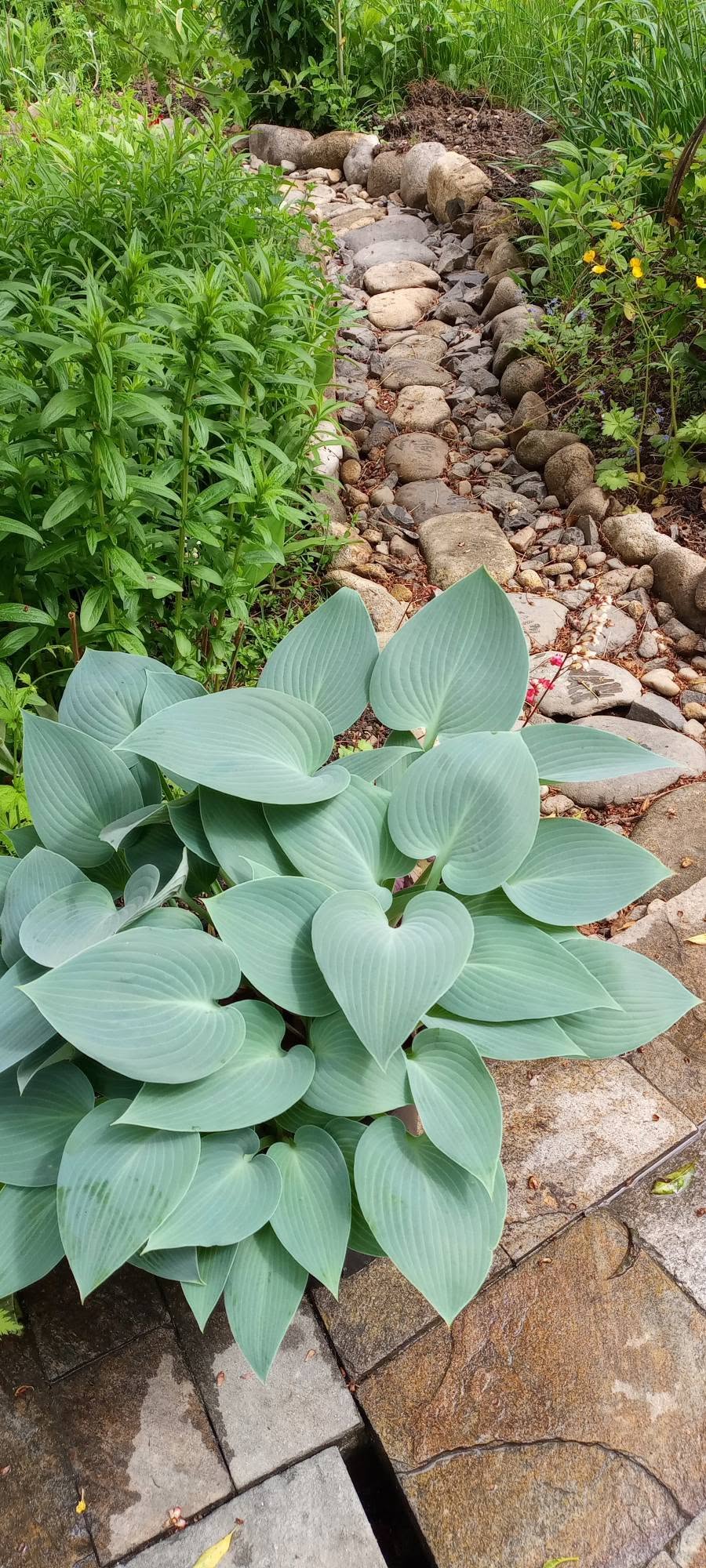
Lesson: The proposed garden can transform a relatively sealed urban courtyard into a small biodiversity refuge. In the context of the Bastion, located near traffic and a busy market, vegetation can contribute to creating a greener micro-environment and provide habitats and food resources for pollinators and other urban species. The proposed use of native and drought-tolerant plants also supports biodiversity while reducing maintenance and water requirements.
Connecting biodiversity with local cultural heritage #
Lesson: The Butcher’s Bastion model demonstrates that environmental restoration can be connected with local cultural memory and traditional practices. The proposed planting of species associated with natural dyes creates a direct link between biodiversity, gardening and the Bastion’s craft and educational activities.
Closing local organic-resource loops through composting #
Lesson: The Butcher’s Bastion example demonstrates how community gardening can contribute to the circular use of organic resources. Organic residues from the garden and potentially from the neighbouring market can be composted and transformed into a useful soil amendment instead of becoming waste.
Rainwater harvesting and efficient water management #
Lesson: The proposed model demonstrates how rainwater can become a local resource for community gardens. Collecting rainwater from existing roof surfaces can reduce reliance on mains water and support efficient irrigation.
A low-impact model that can be transferred to other places #
Lesson: One of the strongest lessons from the Butcher’s Bastion example is the transferability of a modular, low-impact approach. Community gardens can be introduced even in places where conventional ground-based gardening is restricted by heritage, spatial or environmental conditions.
👥 Society #
From a social perspective, the community garden program at the Butcher’s Bastion demonstrates how heritage sites can function as vital catalysts for social inclusion, civic engagement, and long-term community resilience. A central lesson from this model is that eco-friendly urban transformation is most effective when it directly engages the different populations living within the immediate vicinity of historical landmarks.
Community gardening as a catalyst for social inclusion and community resilience #
Lesson: By providing accessible opportunities for residents to garden, meet and participate in collective activities, the garden can help reduce social isolation, encourage active participation and strengthen people’s connection with their neighbourhood. The proposed model particularly highlights the potential to involve older residents who may have limited access to private green spaces.
Intergenerational gardening as a way of preserving local knowledge #
Lesson: The Butcher’s Bastion model demonstrates how community gardening can create a space for intergenerational knowledge exchange, connecting older residents, local artisans, museum staff and younger generations. Knowledge about plants, traditional gardening practices, medicinal herbs and natural dyes can be transmitted through practical activities rather than remaining only as historical information.
Community gardening as a tool for civic participation and ownership #
Lesson: The proposed Butcher’s Bastion model shows that community participation can extend beyond simply visiting a heritage site. Activities such as “Adopt a Bed,” seed exchanges and collective harvesting can give residents an active role in caring for the space and encourage a sense of collective responsibility.
Community gardening as a space for wellbeing and social connection #
Lesson: The proposed garden demonstrates how combining gardening, heritage and community activities can create opportunities for social interaction, active participation and everyday contact with nature. Rather than treating heritage as something that is only observed, the garden can make the site part of people’s everyday community life.
🏛️Politics #
The Butcher’s Bastion example demonstrates that community gardening can become a practical mechanism for participatory local governance, bringing together heritage protection, environmental sustainability and community involvement. The central lesson is that heritage sites can become spaces not only for cultural preservation, but also for participatory decision-making and collaborative urban development.
Heritage-led community gardening as a model for participatory local governance #
Lesson: The Butcher’s Bastion example demonstrates that community gardening in a heritage site can become a tool for participatory governance, connecting heritage management with environmental policy, community participation and local decision-making. The proposed “Living Garden” requires cooperation between the museum, local authorities, residents, schools, NGOs and other community actors, showing how different stakeholders can contribute to the management and development of a shared public space.
Integrating heritage protection with environmental and urban policy #
Lesson: The Butcher’s Bastion model demonstrates that heritage conservation, environmental sustainability and urban development can be addressed together. The proposed garden uses reversible, non-invasive interventions, allowing ecological and community activities to take place while respecting the archaeological and architectural value of the site.
Participatory decision-making and community ownership #
Lesson: The proposed “Living Garden” shows that public spaces can be managed through shared responsibility rather than exclusively top-down decision-making. Activities such as “Adopt a Bed”, seed exchanges and community events provide mechanisms through which residents can actively contribute to the use and care of the space.
From pilot initiative to local policy #
Lesson: The Butcher’s Bastion example demonstrates how a small-scale local initiative can provide a practical testing ground for future public policy. Rather than introducing a large programme immediately, municipalities can use a pilot community garden to test solutions, identify challenges, evaluate participation and gather evidence for future scaling.
Multi-stakeholder governance for long-term sustainability #
Lesson:The proposed model shows that the long-term success of a community garden in a heritage site depends on clear cooperation and shared responsibilities between different stakeholders. The source specifically proposes a co-management committee involving relevant institutions and community actors.
💶 Economy #
The Butcher’s Bastion example demonstrates that a community garden can generate economic and local value beyond direct food production. The model shows that heritage spaces can contribute to the local economy when they are activated through community-based and sustainable activities.
Community gardening as a source of local value and circular economic opportunities #
Lesson: By connecting the heritage site with the neighbouring market, local artisans, community organisations and educational activities, the proposed “Living Garden” can create a network of local relationships that supports the circulation of resources, knowledge and opportunities.
Circular economy through local organic resources #
Lesson: The Butcher’s Bastion model demonstrates how community gardening can contribute to a local circular economy by transforming organic residues into useful resources. The proposed composting system could connect the garden with organic material generated by the neighbouring market, reducing waste while producing compost for the garden.
Connecting community gardening with local crafts and cultural production #
Lesson: The proposed garden creates opportunities to connect plants with traditional crafts and local cultural knowledge. For example, plants used for natural dyes can support weaving and craft activities associated with the museum, creating a connection between environmental resources, cultural heritage and local creative practices.
Heritage sites as platforms for local economic activity #
Lesson: The Butcher’s Bastion demonstrates that activating a heritage site with community and environmental activities can increase its social, cultural and economic attractiveness. A living garden can complement exhibitions and cultural activities by giving visitors additional reasons to engage with the site and with local products, knowledge and traditions.
Low-cost approaches to local economic development #
Lesson: The proposed “Living Garden” shows that local value can be generated through small-scale, modular and resource-efficient interventions, rather than requiring large infrastructure investments. Raised beds, composting, rainwater harvesting and community participation can create multiple benefits using relatively simple resources.
🎓 Education #
From an educational perspective, the community garden project at the Butcher’s Bastion affords a dynamic model for transforming static heritage sites into active, open-air learning environments.
Community gardening as an experiential and place-based learning environment #
Lesson: By introducing community gardening and permaculture practices into the historic setting, abstract concepts such as biodiversity, soil health, urban microclimates and circular economy can become practical, hands-on learning experiences. This approach connects cultural heritage with environmental education and allows learners to understand sustainability through direct experience.
Intergenerational learning and traditional ecological knowledge #
Lesson: The proposed garden provides an opportunity for intergenerational knowledge exchange, connecting older residents and local craftspeople with children, young people and other learners. Traditional knowledge about plants, gardening, medicinal herbs, natural dyes and crafts can be transmitted through practical activities rather than remaining only as historical information.
Museums as hubs for lifelong and non-formal learning #
Lesson: The Butcher’s Bastion demonstrates the potential for cultural institutions to extend their educational role beyond conventional exhibitions. A community garden can complement existing cultural activities with hands-on workshops, environmental activities and informal learning opportunities.
Learning through practical sustainability activities #
Lesson: The garden allows learners to develop knowledge and practical skills through learning by doing. Activities such as growing plants, composting, observing biodiversity and exploring traditional plant uses can strengthen environmental awareness and encourage active participation.
Heritage interpretation through plants and crafts #
Lesson: The Butcher’s Bastion model creates opportunities to connect historical interpretation with plants, traditional crafts and local practices. The proposed use of plants associated with natural dyes provides an example of how visitors can experience cultural heritage through practical activities rather than only through written information or exhibitions.
🔧 Practical Steps for Implementation #
Translating the community garden program at the Butcher’s Bastion from a conceptual framework into a fully functioning, heritage-compliant reality calls for a structured, phase-based implementation methodology. Replicating this model in historic sites, public courtyards, or underutilized municipal spaces requires careful coordination among public authorities, heritage experts, civil society, and residents. By following a transparent operational roadmap, project leaders can navigate compliance constraints, ensure financial efficiency, and secure deep community engagement from the outset.
- Identify a suitable heritage site or historic courtyard where community gardening could be introduced without compromising the cultural, architectural or archaeological value of the site.
- Assess the heritage and environmental conditions of the location, including protected elements, available space, sunlight, microclimate, water availability and existing surfaces.
- Consult heritage specialists and local authorities at an early stage to clarify the legal, conservation and administrative conditions for introducing gardening activities.
- Map local stakeholders including residents, museum or cultural institution staff, schools, NGOs, local artisans, businesses and community organisations.
- Develop a participatory co-design process involving future users, heritage specialists, environmental practitioners and local organisations.
- Use reversible and non-invasive infrastructure, such as raised wooden beds, vertical planting structures and mobile containers, particularly where archaeological layers must be protected.
- Design accessible spaces that allow older residents, people with reduced mobility, children and other community members to participate.
- Include biodiversity-friendly planting, particularly native, heirloom, aromatic and pollinator-supporting species appropriate to the local context.
- Introduce circular practices, particularly composting of suitable organic residues and responsible management of water and other resources.
- Explore rainwater harvesting and efficient irrigation where these systems are compatible with the heritage characteristics of the site.
- Establish a co-management structure involving the cultural institution, local authorities, residents, NGOs and other relevant stakeholders.
- Develop educational activities connecting gardening with local history, biodiversity, traditional knowledge, crafts and sustainability.
- Document the process and results through photographs, participation data, stories, environmental observations and educational outcomes.
- Evaluate the pilot from environmental, social, political, economic and educational perspectives.
- Develop a sustainable management and funding model covering maintenance, materials, educational activities and long-term community participation before scaling the initiative.
Transferability #
The Butcher’s Bastion “Living Garden” model is transferable to:
municipalities seeking to combine heritage conservation with urban greening;
historic centres and protected heritage sites with underused courtyards or public spaces;
museums and cultural institutions interested in developing living heritage experiences;
neighbourhoods with limited access to green spaces;
community groups and environmental NGOs promoting community gardening and biodiversity;
schools and adult education organisations seeking outdoor, place-based learning environments;
universities and research institutions working on heritage, sustainability, urban ecology and community participation;
social organisations working on inclusion, intergenerational exchange and community wellbeing;
local authorities developing participatory urban-greening and heritage policies;
organisations promoting circular economy practices, such as composting and rainwater harvesting;
cultural organisations and artisans interested in connecting traditional knowledge, plants and crafts;
communities seeking opportunities for intergenerational learning and local knowledge transmission.
The model is particularly suitable for places where there are historic buildings or cultural sites, underused courtyards or urban spaces, local communities willing to participate, and institutions able to coordinate heritage protection with environmental and educational activities. The Butcher’s Bastion example is especially relevant where conventional ground-based gardening may be restricted by archaeological or heritage considerations, as the proposed model relies on low-impact and reversible interventions such as raised beds and vertical planting.
However, transfer should focus on the principles and process rather than copying the physical design of the Butcher’s Bastion. Each locality should adapt the model according to its heritage status, archaeological conditions, legal framework, available space, environmental characteristics, community needs, stakeholder structure and financial resources.
The most important lesson from the Butcher’s Bastion is that a community garden in a heritage site can become much more than a place for growing plants. A heritage community garden can be:
an environmental solution supporting biodiversity and resource efficiency;
a social meeting place promoting participation and intergenerational exchange;
a participatory governance tool connecting residents, institutions and local authorities;
a generator of local value through crafts, cultural activities and circular practices;
an outdoor learning environment connecting heritage, nature and sustainability education;
a living interpretation of cultural heritage, where traditional knowledge and practices can be experienced rather than simply displayed.
The Butcher’s Bastion demonstrates how a small-scale, heritage-based initiative can connect environmental sustainability, social participation, local culture, education and community governance, creating a model that can be adapted to other historic and urban contexts.
GP5 Title: Neapoli Food Forest – Community-Based Edible Forest #
Location: Neapoli, Thessaloniki, Greece
Main sources: MamaGea / Green Sustainable Paths; Municipality of Neapoli-Sykies
Introduction #
The Neapoli Food Forest is a community-based urban greening initiative created in 2024 in Neapoli, Thessaloniki. It was initiated by the environmental organisation MamaGea in cooperation with the Municipality of Neapoli-Sykies, the social cooperative cob.gr and the school community of the 5th Gymnasium of Neapoli. An underused urban plot was transformed into Greece’s first urban food forest, with more than 750 food-producing trees and plants.
The project combines edible planting, biodiversity, soil care, natural water management and practices inspired by permaculture. More than 400 citizens, students and volunteers participated in planting, while participatory workshops involved municipal staff, students, residents and environmental practitioners in shaping the future use of the site.
Context
The Food Forest demonstrates how community gardening can connect urban greening with learning, participation and ecological regeneration. Before planting, participatory design workshops explored local needs, maintenance, access, safety and social uses of the space. The project therefore developed not only as a planting initiative, but as a shared neighbourhood space for environmental education, collective care and community activity.
Learning Objectives
Understand how an urban food forest can support biodiversity, soil care and sustainable food-growing.
Explore how participatory design can help communities shape and care for shared green spaces.
Recognise how community involvement can turn a green intervention into a long-term learning and engagement process.
Connect the example with New European Bauhaus values and the Quintuple Helix Model.
Session Plan
Introduction to urban food forests and regenerative community gardening – 15 min
Case study analysis: Neapoli Food Forest – 30 min
Workshop: designing a small food forest or edible community garden for a local site – 45 min
Reflection and feedback – 30 min
NEB Principles Identified in the Example #
Sustainability
The project transforms underused urban land into a productive green ecosystem. Edible trees and plants, biodiversity, soil regeneration, water management and permaculture-inspired practices demonstrate how urban greening can support climate resilience and more sustainable food systems.
Inclusion
Residents, students, municipal services, volunteers, civil society organisations and environmental groups were involved in planning and implementation. This shared process strengthened participation, local ownership and collective responsibility.
Aesthetics
The conversion of an uncultivated urban lot into a green, edible and welcoming landscape improves the quality of the neighbourhood. Seasonal change, diverse planting and social use connect beauty with ecological function and community life.
What the Sectors Can Learn – QHM-Oriented
🌍 Environment #
Lesson: Unused urban land can become a biodiverse, productive ecosystem when soil, water, planting and long-term care are planned from the beginning.
Transfer: Communities can start with small plots, select locally suitable edible and pollinator-friendly species, and combine food production with biodiversity and low-impact care.
👥 Society #
Lesson: Early participation builds ownership. In Neapoli, residents, students and local actors helped define how the Food Forest should be used and cared for.
Transfer: Future users should be involved before final design decisions, and simple shared-care routines should continue after the first planting event.
🏛️Politics #
Lesson: Municipal involvement was important not only for access to the site, but also for technical preparation, irrigation, safety, access and long-term maintenance.
Transfer: Municipalities can support community gardening by combining public land, technical services and participatory planning rather than treating the project as a one-off event.
💶 Economy #
Lesson: The main value created is shared local value rather than commercial profit: an unused plot becomes a productive, educational and socially useful space.
Transfer: Local authorities can combine modest public investment, professional support and volunteer participation, while documenting benefits such as participation, skills, events and environmental improvement.
🎓 Education #
Lesson: The Food Forest functions as a living classroom where learners can explore biodiversity, soil, food systems, climate adaptation, cooperation and responsibility through direct experience.
Transfer: Schools and adult education providers can use community gardens for seasonal, task-based learning linked to real garden care and local sustainability issues.
🔧 Practical Steps for Implementation #
Identify an underused or neglected urban plot with realistic access to sunlight, water and safe public use.
Involve municipal technical services, schools, residents and local organisations before the final design is fixed.
Check soil, irrigation, access, safety and maintenance requirements before organising a public planting event.
Use a diverse mix of edible trees, shrubs, herbs and flowering plants suited to local conditions.
Plan shared uses beyond gardening, such as school activities, workshops, community events and environmental learning.
Create a simple care structure with clear responsibilities for watering, maintenance, access and annual review.
Document participation, planted species, volunteer input, learning activities and community use to support future replication.
Transferability
The Neapoli Food Forest model is particularly transferable to:
municipalities with small underused urban plots;
neighbourhoods seeking more accessible green and social spaces;
schools and adult education providers interested in outdoor learning;
community organisations and environmental NGOs;
cities exploring food forests, edible landscapes or nature-based solutions;
local partnerships combining public authorities, civil society and social-economy actors.
The main transferable lesson is that a food forest does not need to be a large-scale project. Its strength comes from combining ecological design, public support, participatory planning, education and shared long-term care.
Source and Copyright Note
This condensed case study is based on the supplied BeCom Neapoli Food Forest material and its cited public sources. External source materials remain the property of their respective authors and organisations.
GP6 Title: L’Horta Alliberada de Sants #
📍 Location: Barcelona, Spain
🔗 https://www.horta-alliberada.cat/
 @hortaalliberda
Source https://www.horta-alliberada.cat/
Introduction #
L’Horta Alliberada is a free, open neighbourhood space in Sants, collectively self-managed by local residents. Work, maintenance and activities are decided at a weekly open assembly held on site.
The project was launched in 2016 by the Sants Neighbourhood Assembly to create a free, community-run green space and reconnect the area with its agricultural history.
Food grown in the garden is shared with the Can Vies Food Network and participants. After drought reduced yields in 2023, the group reduced cultivation beds and planted more trees to strengthen the site as a climate refuge.
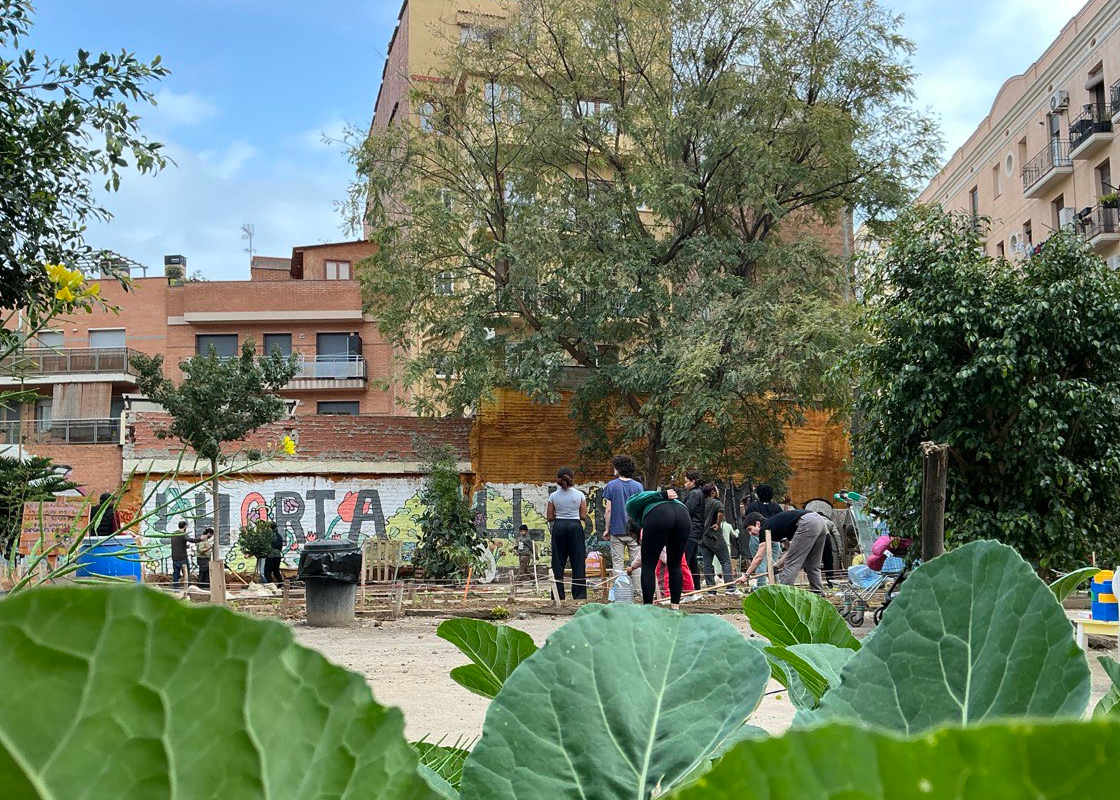
Source: Horta alliberada’s web
Context
L’Horta Alliberada de Sants occupies an abandoned plot of more than 850 m² in Barcelona’s Sants neighbourhood. It includes permeable soil, trees, cultivation beds, aromatic and ornamental plants, and shaded areas.
More than 9,000 people live within a five-minute walk, making the garden an important nearby green space around Sants Market and Rambla de Badal.
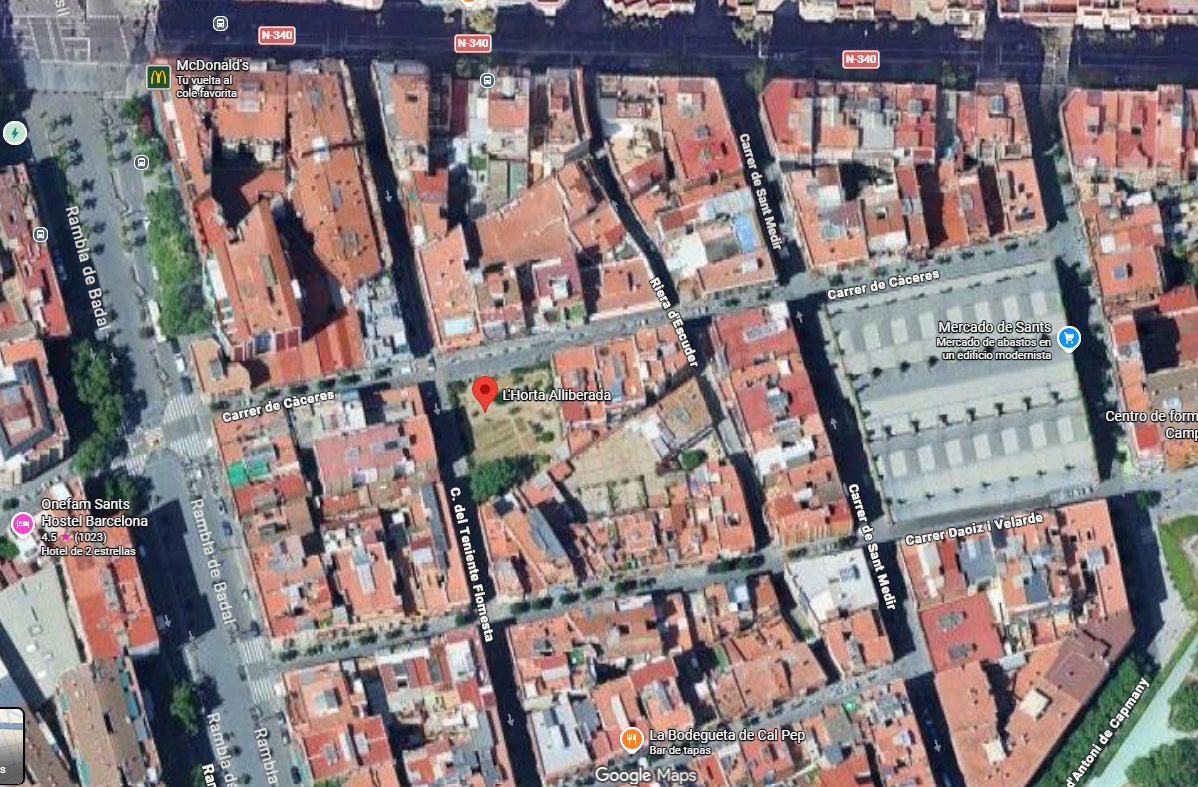 Source: Google maps
Learning Objectives
Understand how a community garden can transform an abandoned urban space.
Identify its environmental, social, economic and educational benefits.
Explain the role of collective participation and community governance.
Recognise the main steps needed to develop a similar initiative.
Session Plan
New European Bauhaus Principles in L’Horta Alliberada de Sants #
L’Horta Alliberada can be analysed through the New European Bauhaus values of Beautiful, Sustainable and Together. These relate here to quality of place, climate adaptation and biodiversity, and open, inclusive community participation.
1. Beautiful: quality of experience and sense of place
L’Horta Alliberada turns an abandoned plot into a welcoming green neighbourhood space with trees, cultivation beds, plants, shade, tables and areas for children.
The garden supports well-being by offering space to rest, meet, participate and connect with nature. Its beauty comes not only from appearance but also from shared experiences and a sense of belonging.
The project also reinforces local identity by reconnecting Sants with its agricultural history and giving that heritage a contemporary environmental and community role.
Level of alignment: Strong in sense of place, well-being and collective experience; evidence of a formal artistic or architectural design process is limited.
2. Sustainable: environmental regeneration and climate resilience
Sustainability is a key strength. The project converted neglected land into more than 850 m² of permeable green space with soil, trees, shrubs and cultivation areas, helping avoid further soil sealing and supporting urban biodiversity.
Pesticide-free cultivation, seasonal food production and local distribution support short food chains and neighbourhood food resilience.
After drought reduced yields, the community planted more trees and reduced cultivation beds, increasing shade and strengthening the garden’s role as a climate refuge.
This supports NEB goals such as:
Restoring and expanding nature.
Supporting biodiversity.
Adapting public spaces to climate change.
Reducing environmental impacts.
Developing more local and regenerative systems.
Level of alignment: Very strong in nature restoration, climate adaptation, biodiversity, permeable land and local food production.
3. Together: inclusion, accessibility and solidarity
L’Horta Alliberada strongly represents the NEB value of Together. The space is free and open to everyone, with no membership fee or gardening experience required.
Gardening, maintenance, workshops and meetings strengthen cooperation and make the garden an important neighbourhood meeting place.
Harvests are shared with participants and the Can Vies Food Network, linking environmental action with mutual aid and local food support.
The project also responds to property speculation and limited public space by prioritising collective social and environmental value.
Level of alignment: Very strong in open access, community building, cooperation and food solidarity.
✅ What the sector can learn: Community Garden
🌍 Environment #
L’Horta Alliberada improves the local environment by turning an abandoned plot into more than 850 m² of permeable green space. Trees, vegetation and shade help reduce heat, while ecological cultivation supports local food production and biodiversity.
Green spaces in densely populated urban areas
Lesson: Abandoned or underused plots can become valuable community green spaces where public green areas are scarce.
→ Adaptation: Convert suitable vacant land into accessible, permeable and community-managed green space.
→ Example Implementation: L’Horta Alliberada transformed an abandoned 850 m² plot into a green space with trees, cultivation beds, plants and shade.
→ Practical Step: Identify vacant plots in dense neighbourhoods and assess their potential for community greening.
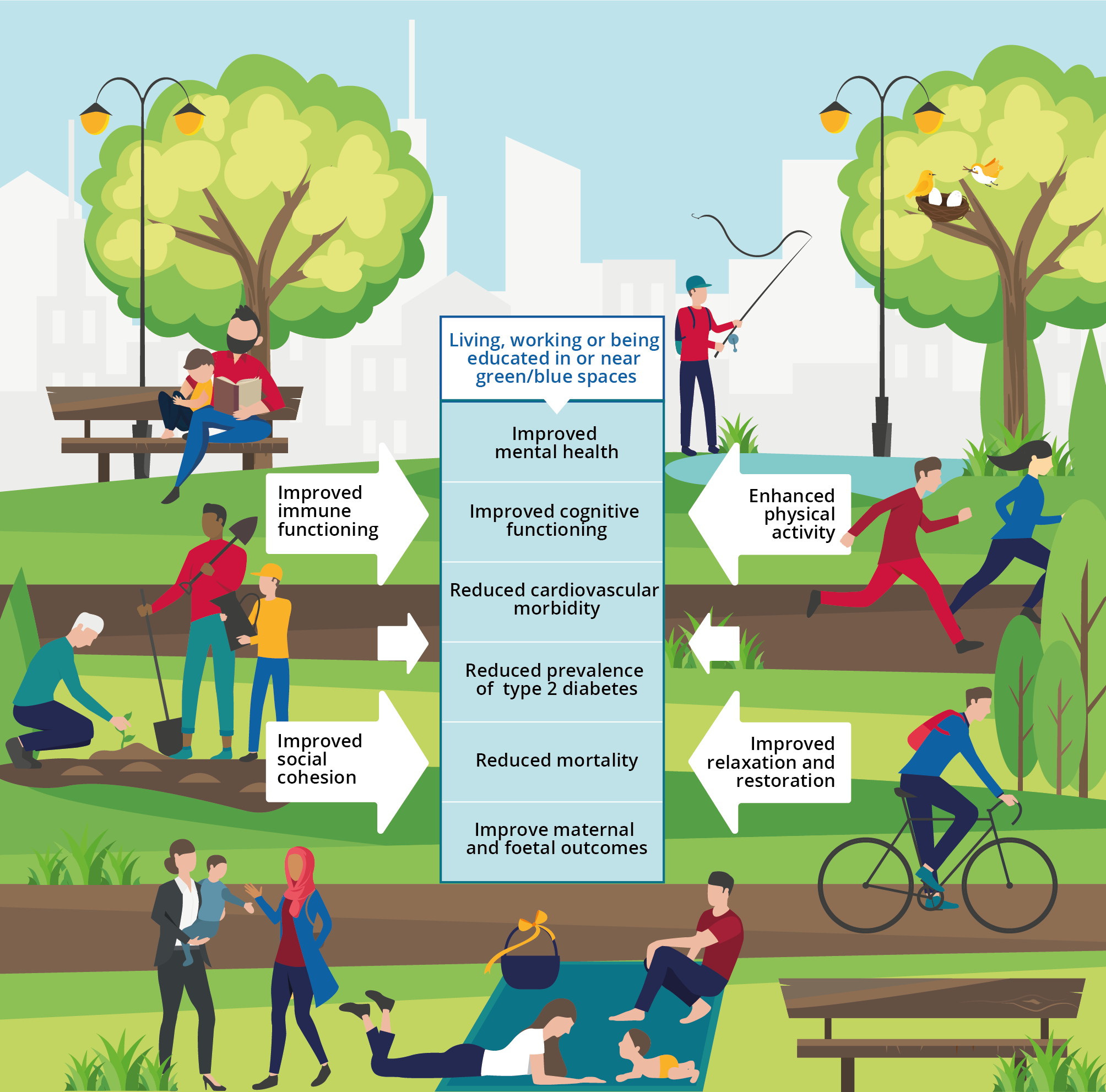
Climate refuges during heatwaves
Lesson: Small neighbourhood green spaces can provide shade, permeable soil and vegetation during heatwaves.
→ Adaptation: Increase tree cover, shade and heat-resistant vegetation where access to parks is limited.
→ Example Implementation: After drought and rising temperatures, L’Horta Alliberada reduced cultivation beds and planted more trees.
→ Practical Step: Prioritise hot areas with little tree cover for planting, shade and resting spaces.
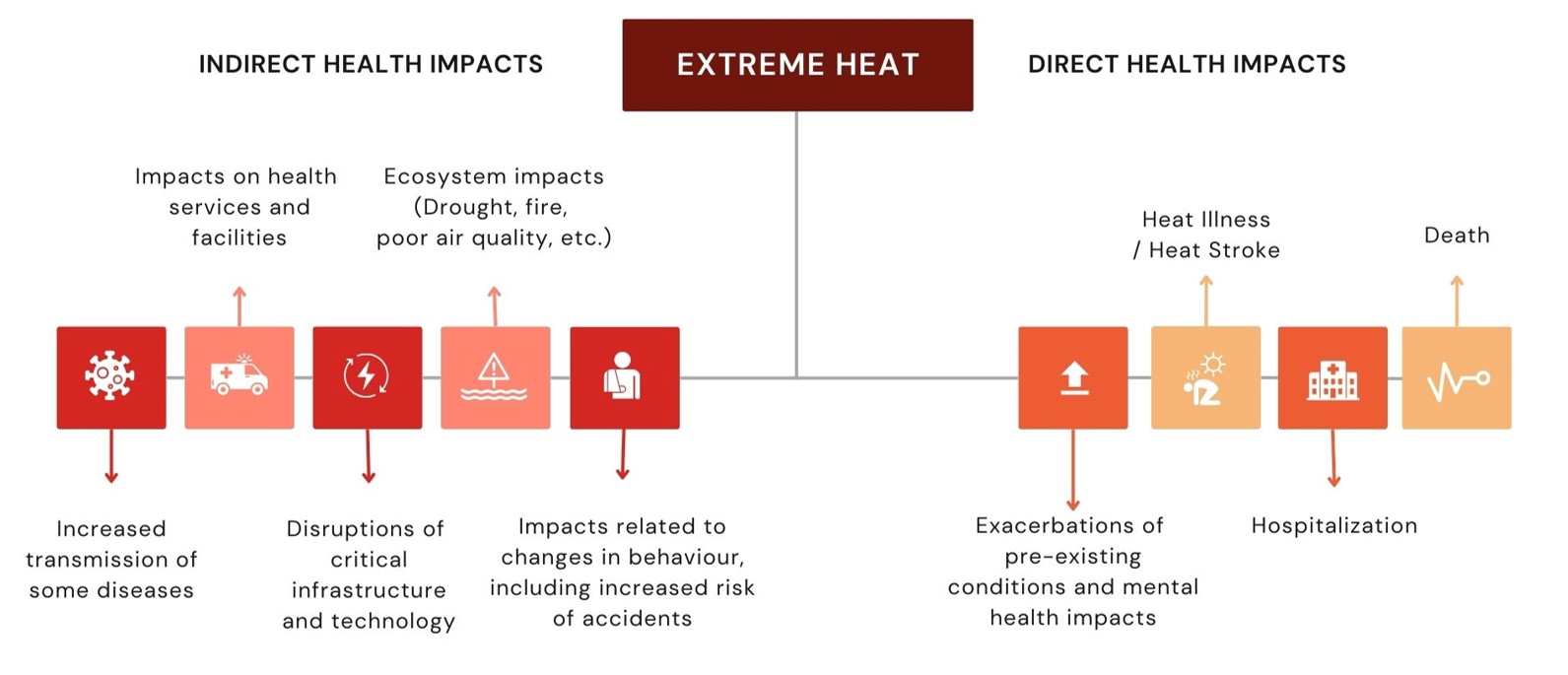 Source:https://www.who.int/multi-media/details/scale-and-nature-of-the-health-impacts-of-heat
Organic urban agriculture
Lesson: Community gardens can produce food while supporting ecological cultivation and practical learning.
→ Adaptation: Use low-water, pesticide-free cultivation suited to local climate and resources.
→ Example Implementation: Community-managed beds produce food shared with local networks and participants.
→ Practical Step: Use seasonal organic cultivation, drought-resistant crops, composting and efficient irrigation.
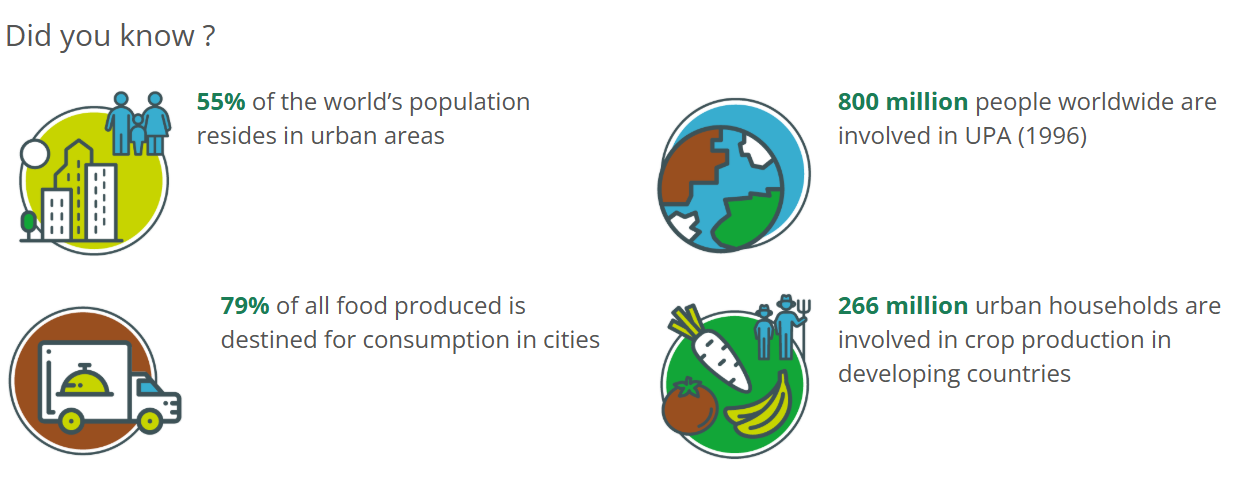 Source: Home | Urban and peri-urban agriculture | Food and Agriculture Organization of the United Nations
👥 Society #
L’Horta Alliberada creates strong social value as an open, free and collectively managed neighbourhood space. Assemblies, gardening and shared maintenance strengthen participation, trust and local ownership, while harvest sharing supports food solidarity.
Community building and stronger neighbourhood networks
Lesson: Shared management and regular activities can turn a garden into a meeting place that builds trust and belonging.
→ Adaptation: Include participatory governance and community-led maintenance.
→ Example Implementation: Weekly assemblies decide maintenance, activities and future development.
→ Practical Step: Hold regular open meetings and shared work sessions.
Social inclusion and open participation
Lesson: Removing financial and social barriers enables people with different backgrounds to participate.
→ Adaptation: Keep green spaces open, welcoming and accessible without fees or prior experience.
→ Example Implementation: Residents can join assemblies, gardening, work sessions and community events.
→ Practical Step: Clearly communicate free access and offer different ways to participate.
Free leisure and recreational opportunities
Lesson: Community gardens can provide free recreation, relaxation, social contact and access to nature.
→ Adaptation: Combine environmental functions with areas for rest, workshops and community gatherings.
→ Example Implementation: L’Horta offers shade, vegetation, gardening, workshops and free community events.
→ Practical Step: Reserve areas for resting, meeting, play and informal community use.
.
🏛️ Politics #
At policy level, L’Horta Alliberada shows how grassroots action can respond to local needs that are not fully addressed by formal planning.
Community governance can activate neglected urban land
Lesson: Open assemblies and shared responsibility can turn neglected land into valuable community space.
→ Adaptation: Use participatory governance for vacant or underused urban spaces.
→ Example Implementation: Weekly assemblies make collective decisions on maintenance, gardening and activities.
→ Practical Step: Create a neighbourhood management group with regular open meetings and clear responsibilities.
Urban policies should recognize and protect community-managed green spaces
Lesson: Community-managed green spaces can provide important environmental and social services and may need public recognition and support.
→ Adaptation: Support such spaces through agreements, grants, technical help or legal recognition.
→ Example Implementation: A renewable land-use agreement can allow a community group to manage a vacant plot while preserving public access.
→ Practical Step: Identify community-managed spaces and the support needed for their continuity.
.
Vacant land policies should prioritize social and environmental value
Lesson: Vacant-land decisions should consider community needs, climate resilience and access to green space, not only development value.
→ Adaptation: Include social and environmental criteria in decisions on vacant land.
→ Example Implementation: An unused development site can temporarily become a community garden and climate refuge.
→ Practical Step: Map vacant plots using criteria such as population density, green-space shortage and heat exposure.
💶 Economy #
L’Horta Alliberada supports a local solidarity economy by combining community-managed resources, local food production and shared benefits.
Local production supports short food supply chains
Lesson: Local food production shortens supply chains and strengthens neighbourhood resilience.
→ Adaptation: Support small-scale urban agriculture linked to local markets, cooperatives and organisations.
→ Example Implementation: Vegetables and herbs are grown and used within the same neighbourhood.
→ Practical Step: Identify local groups that can receive, exchange or distribute produce.
Community food production can reduce household expenses
Lesson: Shared urban agriculture can supplement household food supplies and reduce some food costs.
→ Adaptation: Include productive growing areas and transparent harvest-sharing rules.
→ Example Implementation: Produce is shared with people involved in gardening and maintenance.
→ Practical Step: Record production and distribute it according to agreed criteria.
Urban gardens can strengthen food solidarity networks
Lesson: Community gardens can support food security by contributing produce to local mutual-aid networks.
→ Adaptation: Include solidarity-based distribution as a project objective.
→ Example Implementation: Part of L’Horta’s harvest goes to the Can Vies Food Network.
→ Practical Step: Agree collection and distribution procedures with a local food-support network.
🎓 Education #
L’Horta Alliberada is an informal learning space where knowledge is shared through participation and practice, linking environmental awareness with everyday community life.
Urban gardens support practical environmental education
Lesson: Working directly with soil, water, plants and biodiversity supports practical environmental learning.
→ Adaptation: Include hands-on ecological learning in community green spaces.
→ Example Implementation: Participants learn organic cultivation, seasonal cycles, composting, biodiversity and water management while maintaining the garden.
→ Practical Step: Offer practical workshops linked to seasonal gardening tasks.
Peer-to-peer learning strengthens community knowledge
Lesson: Collaborative spaces allow people to exchange skills regardless of previous experience.
→ Adaptation: Use peer-to-peer learning in which residents can be both learners and knowledge holders.
→ Example Implementation: Experienced participants share gardening and maintenance skills with newcomers.
→ Practical Step: Pair experienced participants with newcomers through simple mentoring.
Community gardens connect education with local history and identity
Lesson: Community-garden education can preserve local knowledge and connect residents with neighbourhood history.
→ Adaptation: Include local history and cultural memory in environmental education.
→ Example Implementation: L’Horta reconnects residents with Sants’ agricultural past and urban transformation.
→ Practical Step: Use guided activities, exhibitions or oral-history sessions with local residents and organisations.
🔧 Practical Steps for Implementation for complete GP #
Practical Steps for Implementation
· Identify suitable urban land: Prioritise vacant or underused plots in dense areas with little green space or high heat exposure.
· Assess land conditions and ownership: Review soil, access, planning status and whether temporary or permanent use is possible.
· Build a neighbourhood management group: Involve residents, associations, environmental groups and local food initiatives.
· Establish participatory governance: Use open assemblies and clear responsibilities for maintenance, activities and finances.
· Secure access to the site: Explore temporary-use agreements, leases or other arrangements that clarify responsibilities.
· Design a multifunctional green space: Combine trees, permeable surfaces, cultivation, shade, seating and areas for collective use.
· Strengthen the climate-refuge role: Increase shade, drought-resistant planting, seating and access to water where possible.
· Use ecological cultivation: Apply pesticide-free practices, composting, mulching, efficient irrigation and climate-adapted species.
· Plan water use carefully: Use low-consumption irrigation or rainwater collection where feasible and adapt cultivation during drought.
· Define fair harvest sharing: Agree how produce is distributed among participants and local food-support networks.
· Connect with local food initiatives: Cooperate with food networks, cooperatives, markets or community kitchens.
· Ensure inclusive participation: Keep access free and reduce barriers related to age, experience, income, language or mobility.
· Create free leisure opportunities: Include areas for rest, meetings, culture, workshops and children’s activities.
· Develop an educational programme: Offer workshops on cultivation, biodiversity, composting, water, climate adaptation and local food.
· Promote peer learning: Encourage experienced participants to share knowledge with newcomers.
· Connect with schools and local organisations: Invite educational and community groups to visits and joint activities.
· Link the project to public policy: Connect it with urban greening, climate, food, health, education and neighbourhood strategies.
· Secure basic resources: Budget for tools, irrigation, plants, soil improvement, accessibility, communication and activities.
· Monitor impact: Track green space, trees, food production, participation, activities and partnerships.
· Communicate results: Share achievements and lessons with residents, authorities, funders and partners.
GP7 Title: NIRGENDWO Berlin – Urban Nature, Community Gardening and Environmental Learning #
📍 Location: Wriezener Park, Berlin-Friedrichshain, Germany
🔗 Main source: https://nirgendwo-berlin.de/
🔗 NIRGENDWO Blog: https://nirgendwo-berlin.de/nirgendwo-blog/
Introduction #
NIRGENDWO is a non-profit environmental and cultural place in Wriezener Park in Berlin. It developed between approximately 2013 and 2015 around a former railway site and old locomotive shed. The project transformed a neglected urban brownfield into a shared space for urban nature, community activity, culture and environmental education. Since 2021 it has operated as an environmental education centre, strengthening biodiversity, sustainability and collaborative urban gardening.
The site is deliberately hands-on. Visitors and local participants can join gardening activities, build nesting aids for wild bees, take part in workshops and guided tours, help with construction or clean-up activities, and experience biodiversity directly. NIRGENDWO therefore functions not only as a green place but as a living learning landscape shaped through participation and ongoing co-creation.
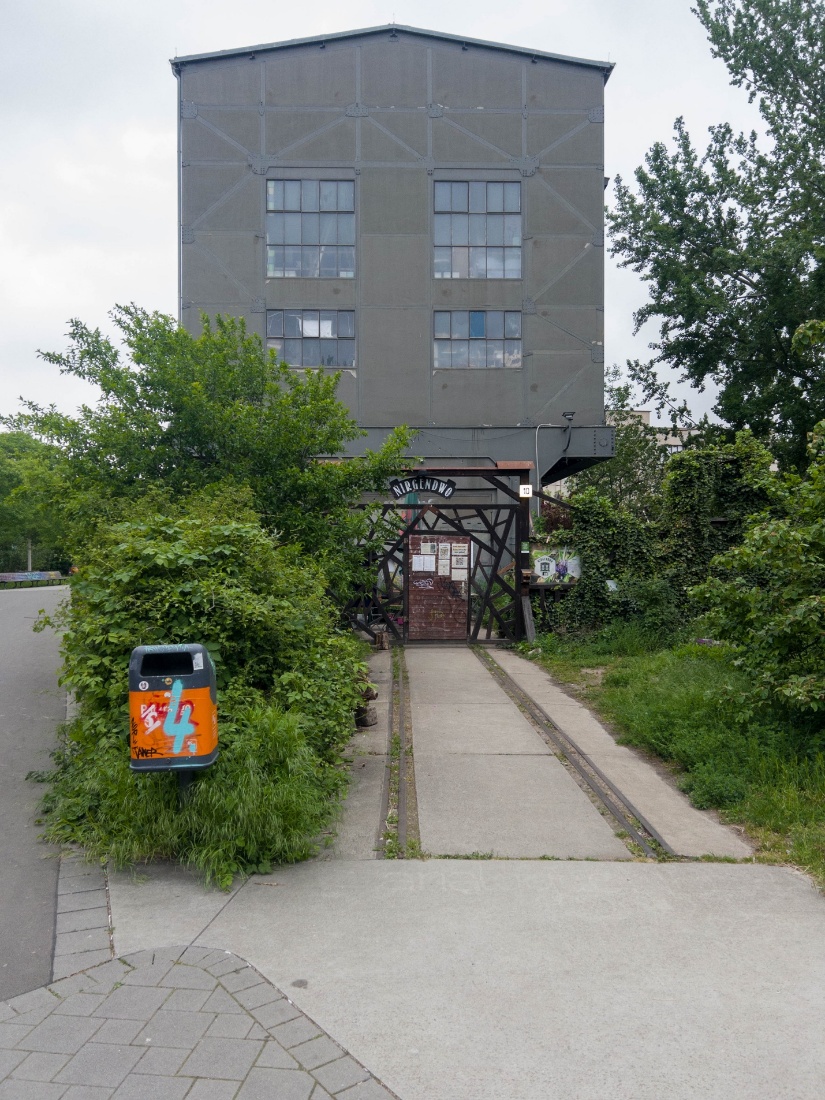
The former railway structure gives the project a distinctive identity and connects reuse, culture and urban nature.
A particular strength of NIRGENDWO is the combination of urban biodiversity, community participation, culture and practical learning. The project explicitly presents itself as a place for peaceful encounters, common good, neighbourhood gardening, family cultural events and activities for different groups. This mix enables environmental learning to become part of everyday urban life rather than a separate specialist activity.
The ecological dimension is visible in gardens, insect habitats, nesting aids, native plants and nature-friendly maintenance. At the same time, workshops, school and kindergarten activities, guided tours and digital learning resources connect these physical measures with Education for Sustainable Development.
Context:
NIRGENDWO shows how a small, previously neglected urban site can become a multifunctional community learning environment. Its combination of biodiversity measures, cultural programming, shared gardening, professional event use and civic participation makes the project directly relevant to the New European Bauhaus and the Quintuple Helix Model, in which environment, society, politics, economy and education interact.
Learning Objectives:
Understand how a former urban brownfield can be transformed into a community-based environmental learning space
Explore how biodiversity, gardening, culture and social participation can reinforce one another
Analyse the role of civic engagement, local administration and partnerships in maintaining a shared urban place
Develop transferable ideas for small-scale biodiversity, environmental education and community action in other neighbourhoods
Session Plan:
Introduction to community gardening, urban biodiversity and participatory place-making (15 min)
Case study analysis: NIRGENDWO, Wriezener Park, Berlin (30 min)
Workshop: designing one small-scale biodiversity and participation intervention for a local urban site (45 min)
Reflection and feedback (30 min)
NEB Principles Identified in the Example #
Sustainability
NIRGENDWO converts a former industrial railway site into a green learning and biodiversity space. Gardening, habitat creation, nature-friendly maintenance and reuse of an existing urban site support climate-friendly urban development and strengthen ecological resilience.
Inclusion
The project is open to neighbours, families, children, schools, kindergartens, companies and local groups. Participatory formats allow people with different backgrounds and levels of experience to take part in gardening, workshops, environmental action, events and shared decision-making.
Aesthetics
NIRGENDWO combines the rough industrial character of a former railway site with gardens, vegetation, cultural spaces and informal design. The result is a distinctive urban environment in which nature, reuse and community activity become part of the visual identity of the place.
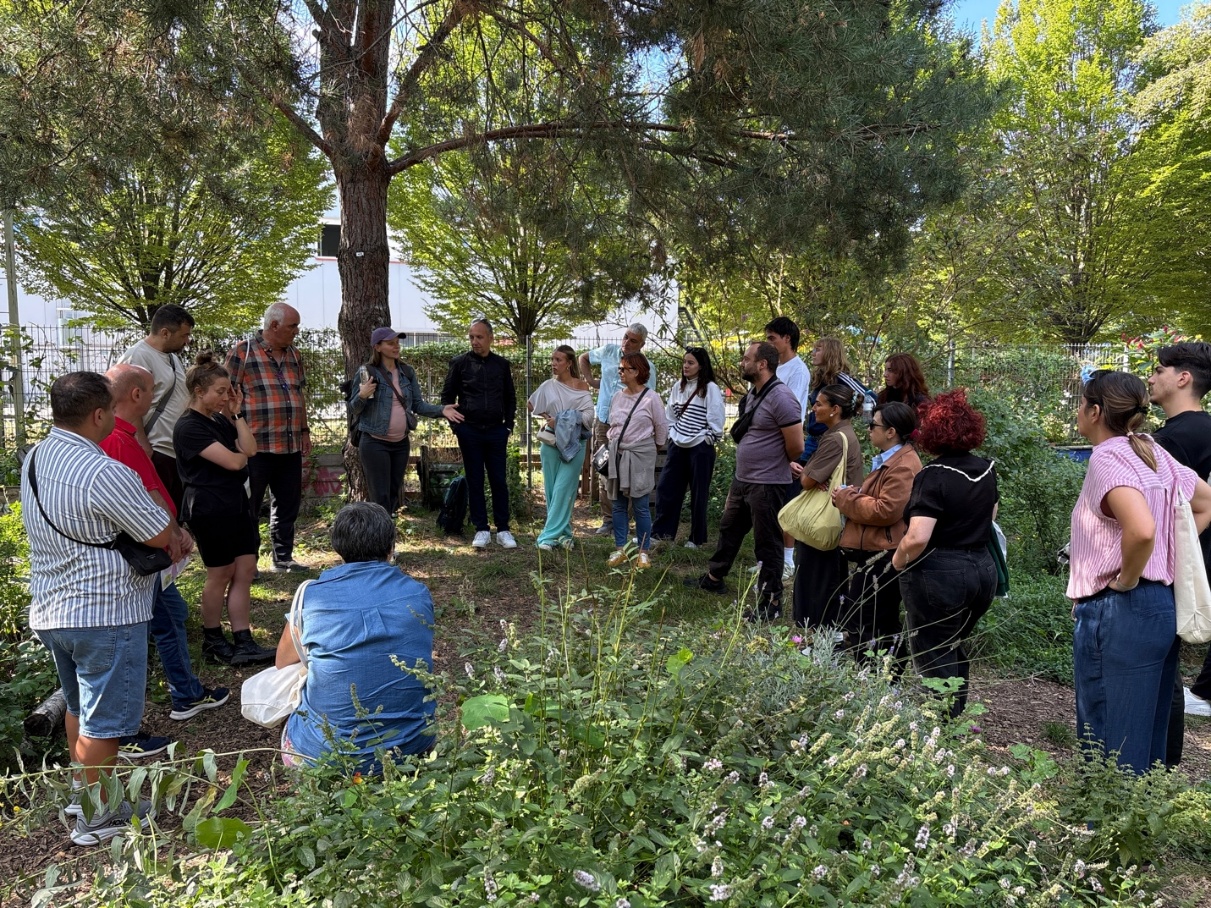
Guided learning in the urban garden: explanation, observation and discussion take place directly in the green space.
✅ What the Sectors Can Learn: Community Gardening (QHM-Oriented)
🌍 Environment #
NIRGENDWO demonstrates that relatively small urban spaces can make a meaningful contribution to biodiversity, climate adaptation and environmental awareness.
Small-scale biodiversity measures can create an urban ecological mosaic
Lesson: NIRGENDWO combines insect gardens, nesting aids, native plants, diverse vegetation and nature-friendly gardening. These interventions show that biodiversity support does not always require a large park or major capital investment.
→ Adaptation: Neighbourhood projects should identify small areas where habitat quality can be improved with locally appropriate plants, nesting structures and low-intensity maintenance.
→ Example Implementation: Create a micro-habitat network using pollinator beds, deadwood, nesting aids, flowering areas and small water or sand habitats.
→ Practical Step: Map three underused or biodiversity-poor spaces within walking distance and define one low-cost intervention for each.
Urban gardening can strengthen climate resilience and everyday contact with nature
Lesson: Community gardening and green maintenance bring ecological processes into daily life. Participants see seasonal change, soil, insects, plants and water cycles directly.
→ Adaptation: Environmental education should connect climate and biodiversity topics to visible, local examples that residents can observe and influence themselves.
→ Example Implementation: Combine a small shared garden with a seasonal observation calendar and simple climate-resilience tasks such as mulching, shade planting or drought-tolerant species selection.
→ Practical Step: Choose one local planting area and document how it changes through one season, including pollinators, soil moisture and maintenance needs.
👥 Society #
NIRGENDWO functions as a shared civic and cultural place where community activities, urban nature and environmental learning create opportunities for encounter and participation.
Inclusive shared spaces strengthen social cohesion
Lesson: The project brings together neighbours, families, children, young people, adults, schools, kindergartens and local groups. Shared activities give people a reason to meet and cooperate beyond their usual social circles.
→ Adaptation: Community gardens should offer more than growing plots; they should include welcoming spaces for conversation, group work, cultural activities and informal participation.
→ Example Implementation: Create flexible zones for gardening, sitting, workshops, small events and quiet observation rather than assigning the entire site to one function.
→ Practical Step: Review a local community space and list which user groups can currently participate, which are missing, and one design or programme change that could improve access.
Shared responsibility builds stronger relationships with the neighbourhood
Lesson: NIRGENDWO involves local people in gardening, maintenance, clean-up, construction and activities. Participation supports a stronger connection with the place and encourages collective care.
→ Adaptation: Projects should create clear, visible opportunities for residents to contribute time, knowledge or practical help without requiring long-term membership.
→ Example Implementation: Offer monthly open garden and maintenance sessions with simple tasks suitable for different ages and abilities.
→ Practical Step: Define three volunteer tasks that can be completed in less than two hours and explain them in plain language.
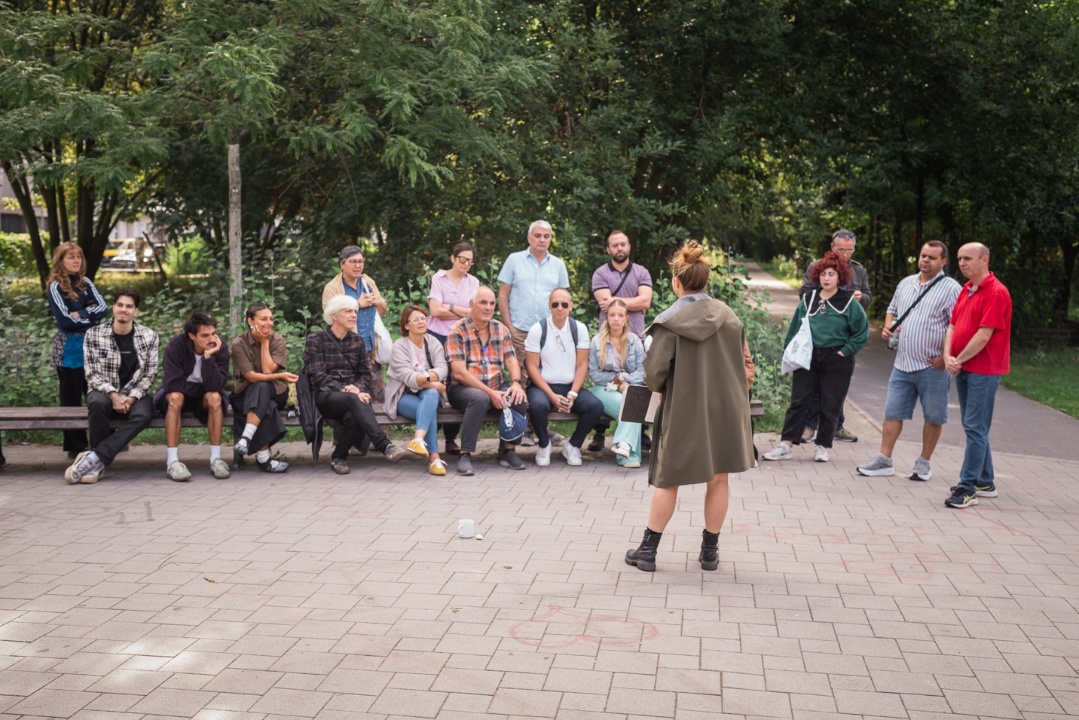
The BeCom study group during an outdoor learning and discussion session in Wriezener Park.
🏛️ Politics #
NIRGENDWO illustrates how community-based urban projects depend on cooperation between civil society, neighbourhood initiatives, environmental organisations and public administration.
Participation and civic engagement should be built into place management
Lesson: The project has been shaped through local involvement and a network that includes residents, initiatives, environmental organisations and district-level departments responsible for green spaces, environment and nature conservation.
→ Adaptation: Municipalities should treat local communities as co-producers of urban green space rather than only as users or consultees.
→ Example Implementation: Establish a recurring neighbourhood coordination round that includes the site team, local initiatives, relevant municipal departments and education partners.
→ Practical Step: Identify the five actors whose cooperation is essential for a local community-garden or biodiversity project and assign one concrete responsibility to each.
Urban community projects need clear responses to everyday conflicts and pressures
Lesson: The supplied course material notes that shared urban spaces can face challenges such as vandalism, illegal overnight stays, littering and competing uses. Long-term resilience requires communication, coordination and practical conflict management.
→ Adaptation: Projects should agree simple procedures for reporting problems, deciding responses and communicating with neighbours and public authorities.
→ Example Implementation: Create a one-page site protocol covering contacts, recurring problems, escalation steps and responsibilities.
→ Practical Step: Run a short scenario exercise with the project team: choose one realistic conflict and decide who communicates, who acts and how the result is documented.
💶 Economy #
NIRGENDWO combines a non-profit environmental and cultural mission with professional services and self-generated activities. This creates an organisational model in which economic activity supports wider social and environmental goals.
Self-generated income can support community and environmental objectives
Lesson: The project combines environmental education and non-profit activities with professional event management, workshops, consulting and the use of its location for events. Income-generating activities are connected to the character and values of the place.
→ Adaptation: Community projects should identify revenue sources that are compatible with their environmental and social mission rather than separating commercial and non-commercial activities completely.
→ Example Implementation: Offer mission-aligned workshops, guided tours, training, event use or consulting and dedicate part of the income to site maintenance and educational programming.
→ Practical Step: Draft a simple list of three possible income-generating activities and test each against two questions: Does it support the mission? Does it cover a real cost?
Lean structures and community support improve resource efficiency
Lesson: The supplied course material describes a small professional team supported by volunteers, neighbours and users. This combination allows the project to maintain a broad programme without building a large organisational structure.
→ Adaptation: Smaller community initiatives should distinguish tasks that require professional continuity from tasks that can be supported through volunteering or partnerships.
→ Example Implementation: Maintain a small core team for coordination, safety, administration and programme quality while organising volunteer days and partner contributions for selected activities.
→ Practical Step: Create a responsibility matrix dividing essential recurring tasks into professional, volunteer and partner-supported roles.
🎓 Education #
Education is one of NIRGENDWO’s central strengths. The site turns biodiversity, climate resilience and sustainable urban development into direct experiences and encourages people to learn through observation, practical action and reflection.
Practical environmental education turns knowledge into action
Lesson: Participants can observe urban ecosystems, work with plants, build nesting aids, care for green spaces and learn about biodiversity. Sustainability is therefore experienced through activity rather than only through theoretical information.
→ Adaptation: Learning programmes should connect each ecological topic with one safe and manageable action that participants can repeat in their own surroundings.
→ Example Implementation: A biodiversity workshop can combine a short introduction with the construction of a nesting aid, identification of suitable plants and a simple follow-up observation task.
→ Practical Step: For each learning topic, formulate one action question: “What can the learner observe, build, plant, compare or change?”
Small spaces can become accessible learning laboratories
Lesson: The course material emphasises that biodiversity action can begin on a balcony, in a small garden or on approximately one square metre of business premises. This makes the approach highly transferable.
→ Adaptation: Education providers should design tasks that work at multiple scales, from a single planter to a larger community garden.
→ Example Implementation: Create a “one-square-metre biodiversity challenge” with native flowering plants, shelter for insects and a short observation log.
→ Practical Step: Ask learners to identify one square metre in their home, school, workplace or neighbourhood that could support more biodiversity.
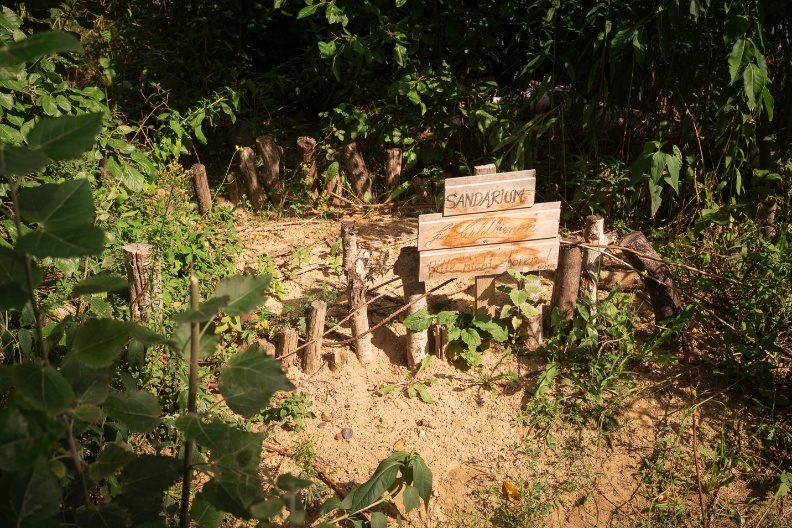
A small sand habitat demonstrates how specialised micro-sites can support urban biodiversity.
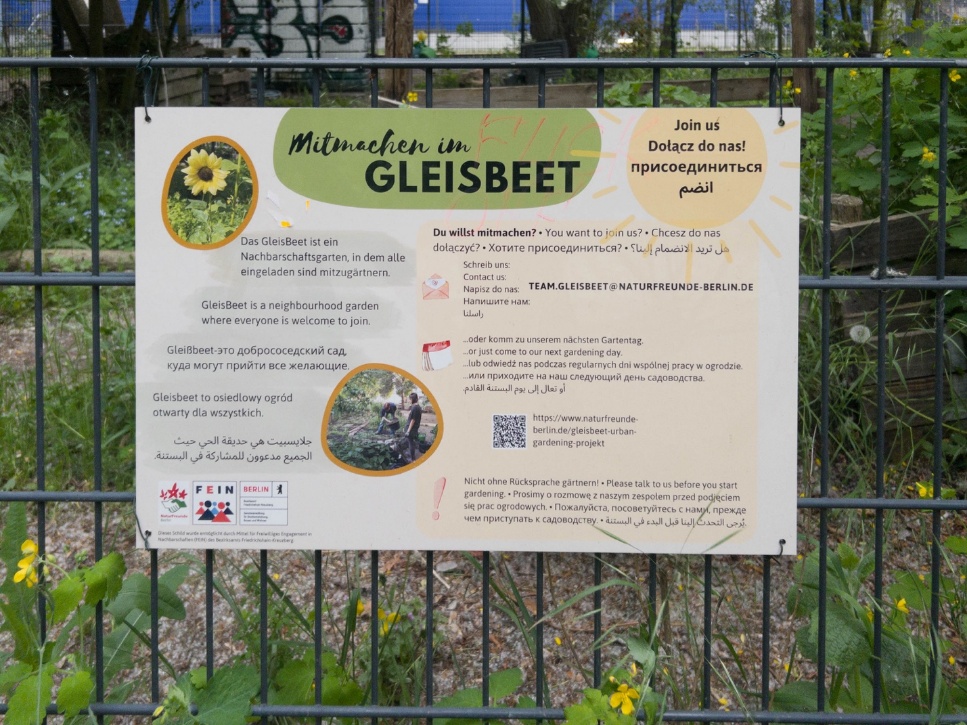
Multilingual participation signage illustrates accessible neighbourhood involvement in urban nature.
🔧 Practical Steps for Implementation #
Identify an underused urban site that can combine biodiversity, community activity and learning
Map existing local actors: residents, environmental groups, schools, cultural initiatives and relevant municipal departments
Define a clear ecological focus such as pollinators, native plants, urban gardening or habitat creation
Create low-threshold opportunities for participation, including open garden days, workshops and practical maintenance tasks
Combine permanent green infrastructure with educational activities, cultural programming and informal meeting spaces
Design activities for children, families, schools, adults and organisations rather than one target group only
Use small-scale, affordable biodiversity measures that can be transferred to balconies, school grounds and business premises
Develop a simple organisational model that combines a reliable core team with volunteers and partner contributions
Identify mission-aligned income sources such as workshops, guided tours, training or event use
Create a clear process for maintenance, conflict management, communication and cooperation with local authorities
Document participation, biodiversity measures and learning activities to communicate impact and attract further partners
✅ Transferability #
This model is transferable to:
Neighbourhood initiatives seeking to transform underused urban spaces into shared green places
Community gardens that want to strengthen biodiversity and environmental education
Schools, kindergartens and adult-education providers seeking accessible outdoor learning sites
Municipalities and district administrations developing participatory green-space programmes
Cultural and environmental organisations combining events, learning and urban nature
Companies and organisations wishing to introduce small-scale biodiversity measures on their own premises
The case description and learning structure are based primarily on the supplied NIRGENDWO course document and its cited official sources.
The photographs reproduced in this document originate from the supplied BeCom course material and document the NIRGENDWO / Wriezener Park learning environment and study visit. All trademarks, organisation names and product names mentioned are acknowledged and remain the property of their respective owners.
Official / project sources:
Disclaimer / Copyright Notice for ALL #
Parts of this material were created and structured with the support of AI-assisted research tools. The content was adapted, checked and reviewed for use within the BeCom project. Good Practice descriptions are based on the publicly available sources listed for each example.
Photographs and other visual materials included in the document are used according to the information and permissions available to the project team.
All trademarks ™ and product names mentioned are acknowledged and remain the property of their respective owners.
20.09.2026 BeCom Project Team

Funded by the European Union. Views and opinions expressed are however those of the author(s) only and do not necessarily reflect those of the European Union or the European Education and Culture Executive Agency (EACEA). Neither the European Union nor EACEA can be held responsible for them.


