Introduction
Discover the Pavlos Melas Metropolitan Park: A Good Practice in Action

The project is an excellent example of Beautiful Communities principles, specifically because it manages to balance heritage preservation with sustainability and social needs. The goal for this introduction is to understand the project’s scale and core objectives before diving into the specific dimensions in the later modules. Please watch above video Pavlos Melas Municipality Park-Connecting Nature. This video, along with the subsequent content below, provides the essential foundation.
HISTORY OF THE PARK
To create meaningful learning experiences, we must start with the story—
This site has witnessed profound historical transformations: from its origins as Ottoman military grounds in the 1890s, through its use by the Greek Army after Thessaloniki’s liberation in the 1920s-1940s, to its dark period as a WWII detention site in the 1940s. After complete abandonment in 2005, the real transformation began in 2013 when the community-led revival started…

Pavlos Melas site witnessed a rapid transformation throughout history
Development of the Project and Key Points
Political – Governance Aspect
The park’s development follows a carefully planned Phased urban development plan that you will explore later on in this course
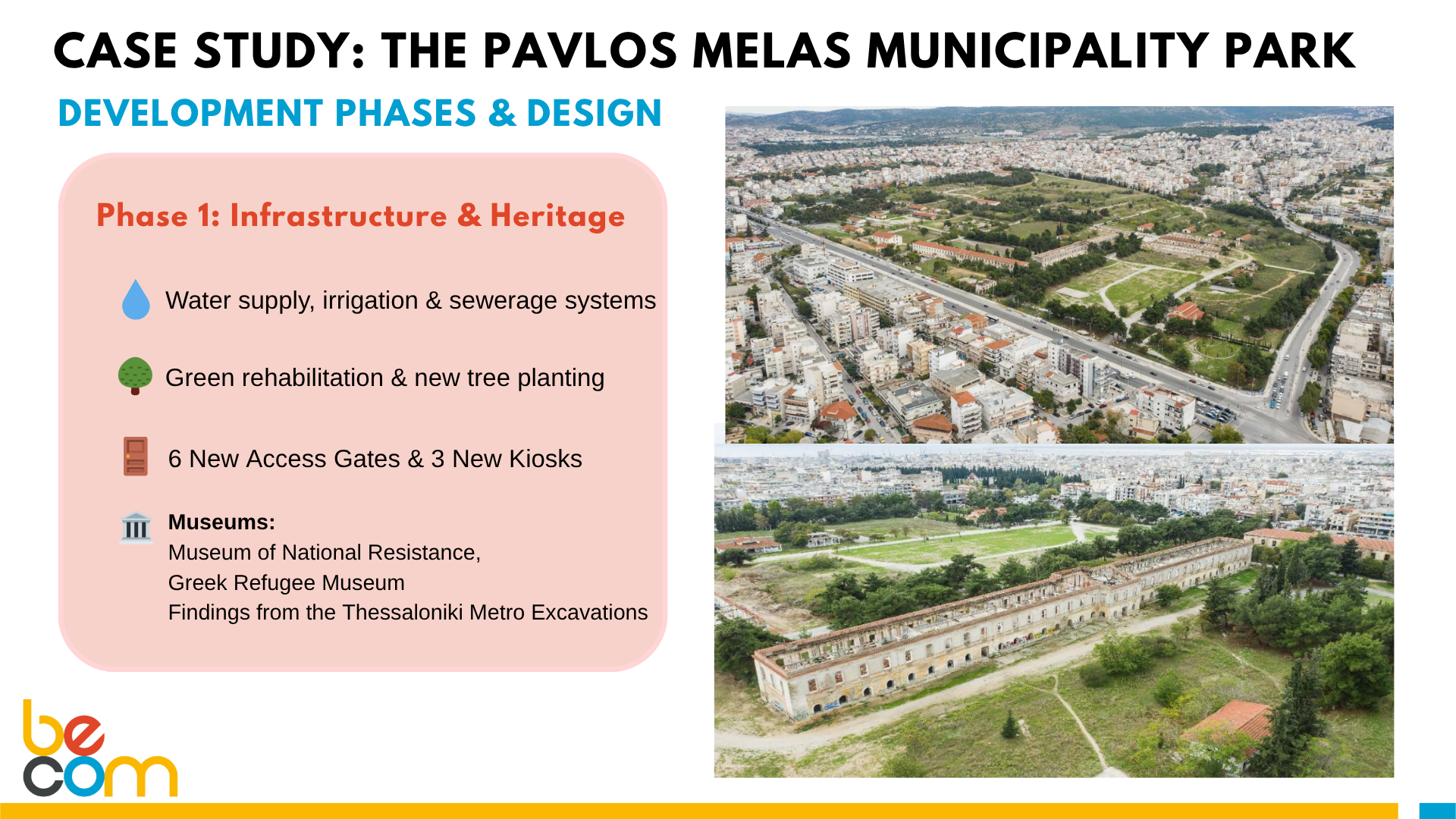
Phase One: Infrastructure and Heritage
Phase One, with a 20-million-euro budget, focuses on critical infrastructure and heritage preservation. This includes comprehensive water supply, irrigation, and sewerage systems, alongside extensive green rehabilitation with new tree planting. Six new access gates and three refreshment kiosks will improve accessibility and visitor experience. Particularly significant is the restoration of the most emblematic building—Building A2—which will house the Museum of National Resistance, the Greek Refugee Museum, and display findings from the Thessaloniki Metro excavations. This demonstrates how adaptive reuse can preserve heritage while serving contemporary community needs.
Source: citymagthess.gr/citymagcat/long-reads/article/h-anoixi-erchetai-apo-ta-dytika/

The Façade of A2 Building Source: pavlosmelas.gr/ktirio_a2_video/
Phase Two: Community Spaces
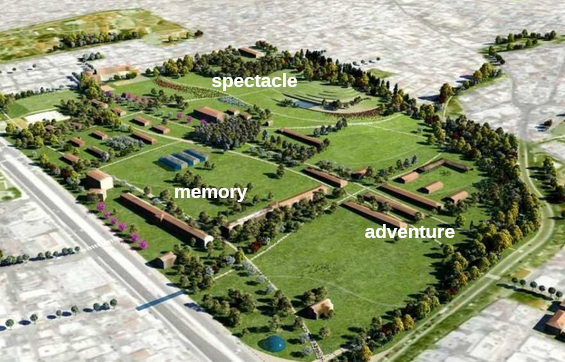
Phase Two takes a more community-centered approach. Following a city council-approved design competition, three distinct spaces are being created:
“Memory”—a central square defined by two historic barracks for historical commemoration and reflection; “Spectacle”—an outdoor cinema and live event venue in the north; “Adventure”—recreational facilities and activity spaces in the south. This phased approach demonstrates strategic planning that balances immediate community needs with long-term vision.
Source: citymagthess.gr/citymagcat/long-reads/article/h-anoixi-erchetai-apo-ta-dytika/
Economic Aspect
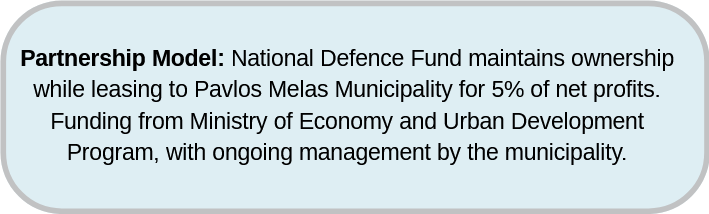
Through a partnership between the National Defence Fund and Pavlos Melas Municipality, the land remains publicly owned while local management ensures community-responsive operations. The municipality pays 5% of net profits to the National Defence Fund, creating a sustainable revenue model supported by Ministry of Economy funding.
Environmental and Social Aspect
The park’s environmental features reflect both ambitious sustainability goals and genuine community engagement.
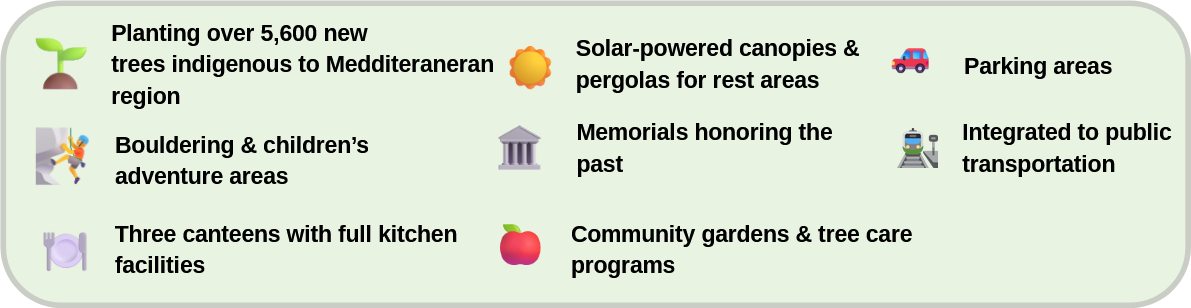
The planners aimed for at least 50% shade coverage through strategic tree placement, featuring over 5,600 new indigenous Mediterranean trees perfectly adapted to the local climate. The community-focused amenities tell a story of inclusive design: bouldering and children’s adventure areas encourage active lifestyles, while three canteens with full kitchen facilities support extended visits and potentially local food businesses. Solar-powered canopies and pergolas provide sustainable comfort, and memorial spaces honor the site’s complex history.